
Free Safe Operating Procedure (Theatre Backstage Clean) Template
Download our free Safe Operating Procedure (Theatre Backstage Clean) Template to formalise your cleaning processes and manage backstage hazards.
Free Safe Operating Procedure (Theatre Backstage Clean) Template
DOCX • 126 KB + PDF
Updated Oct 2026
No signup required
Purpose of the Free Safe Operating Procedure (Theatre Backstage Clean) Template
A structured approach to backstage cleaning is critical for preventing common injuries and maintaining a professional, safe work environment in a theatre. This area is often crowded with equipment, props, and personnel, making systematic cleaning essential.
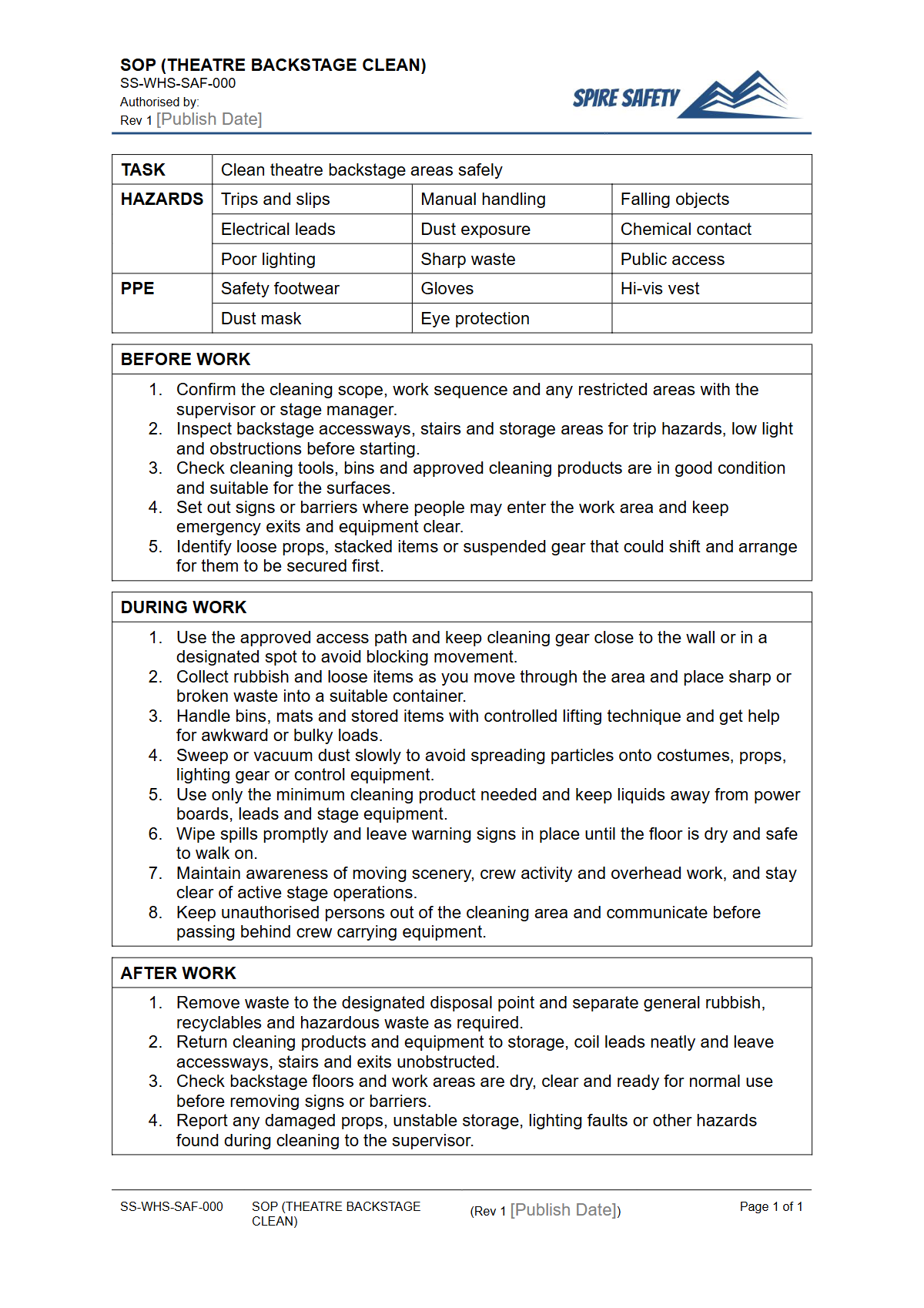
This Free Safe Operating Procedure (Theatre Backstage Clean) Template provides a documented framework for identifying hazards and outlining step-by-step cleaning tasks. Formalising your process helps control risks such as slips from wet floors, trips over cables or misplaced items, manual handling injuries, and exposure to cleaning chemicals.
A clean and organised backstage area is fundamental to the smooth and safe execution of any performance.
By implementing a clear SOP, you ensure that everyone understands their responsibilities and follows a consistent, safe method for cleaning. This reduces the likelihood of incidents and supports a positive safety culture.
The principles of documenting specific tasks and associated risks are transferable across different operational areas. While this procedure focuses on general backstage cleaning, the structured approach is similar to what you might find in our free deep fryer SOP template, which also addresses cleaning-related risks in a specialised context.
Video walkthrough
How to use the Free Safe Operating Procedure (Theatre Backstage Clean) Template
This downloadable template is designed as a starting point, aligned with Australian WHS practice. It is not a complete, ready-to-use document.
To make it effective, you must customise it to reflect the specific hazards and operational realities of your theatre or venue. We have pre-filled sections covering common risks and controls, but every workplace is unique.
When customising the document, consider:
- The specific layout of your backstage area, including crossovers, wing space, and storage areas.
- The types of flooring and surfaces that require cleaning.
- The specific equipment present (e.g., fog machines, lighting rigs, sound equipment) and any special cleaning considerations.
- The Safety Data Sheets (SDS) for all cleaning chemicals used.
- Your venue's emergency procedures, including first aid and spill response.
- Consultation with your stage crew, technicians, and cleaning staff who perform the work.
Integrating this SOP into a comprehensive safety framework is key to its success. A robust procedure forms a vital part of your overall WHS management systems, ensuring it is consistently applied, reviewed, and improved upon over time.
This process of continuous improvement helps maintain a safe environment for performers, crew, and visitors.
When to use this Safe Operating Procedure
This Safe Operating Procedure should be used as a routine guide for all cleaning activities backstage. It is not just for major clean-ups but should be integrated into daily operations. Key times to refer to and apply this SOP include:
- Pre-show checks: Ensuring walkways are clear and the stage is free from debris.
- Post-show clean-up: A systematic process to reset the space for the next performance or day.
- Weekly or periodic deep cleans: More thorough cleaning of storage areas, technical booths, and less-frequented spaces.
- During bump-in and bump-out: Managing waste and maintaining clear access routes when activity levels are high and new hazards are introduced.
Many theatre workshops utilise heavy machinery and tools for set construction, each requiring its own documented safety protocols. The need for a specific procedure is similar to the structured controls outlined in a FREE Circular Saw SOP (Safe Operating Procedure) Template, highlighting the importance of task-specific safety management.
Who should use it
This SOP is intended for anyone involved in working in or managing a theatre's backstage area. Specific roles that will use or oversee this procedure include:
- Stage Crew and Technicians: The primary users who perform the cleaning tasks and must understand the associated hazards and controls.
- Stage Managers: Responsible for ensuring the SOP is followed during rehearsals and performances.
- Production Managers: For overseeing the overall safety of the production, including the implementation and review of procedures like this one.
- Venue Managers: Responsible for the overall health and safety of the building and all personnel within it.
- Cleaning Staff: If dedicated cleaners are used, they must be trained on this specific procedure, which addresses hazards unique to a theatre environment.
If your backstage operations rely on equipment like pneumatic tools for set changes or maintenance, workers should also be familiarised with relevant equipment-specific procedures, such as those detailed in our Free Air Compressor SOP (Safe Operating Procedure) Template. For expert help adapting this template or developing more complex safety documentation, our WHS consulting services can provide tailored support.
By formalising your cleaning processes, you create a more predictable and controlled work environment, significantly reducing the risk of injury. For more templates and safety guides to support your WHS obligations, browse our complete free WHS resources library.
Common mistakes
Common mistakes to avoid
- Using the template without customising it for the specific venue and tasks.
- Failing to provide training to all crew members and staff who work backstage.
- Not having Safety Data Sheets (SDS) readily available for all cleaning chemicals used.
- Forgetting to review and update the SOP after an incident or when new equipment or procedures are introduced.
Legal references
Legal considerations
The following legal requirements may be relevant to this type of work.
- Work Health and Safety Act (Harmonised) — Provides the primary duties for protecting workers and other people from work health and safety risks.
- Work Health and Safety Regulations (Harmonised) — Sets out requirements supporting the management of workplace hazards and risks.
The following codes may be relevant to this type of work.
- Managing WHS Risks Code of Practice — Provides practical guidance on identifying hazards, assessing risks and applying effective controls.
- Work Health and Safety Consultation, Cooperation and Coordination Code of Practice — Provides practical guidance on consulting workers and coordinating with other duty holders.
- Managing the Work Environment and Facilities Code of Practice — Provides practical guidance on safe work environments, workplace facilities and related controls.
Did you know
A Common Backstage Injury
Slips, trips, and falls are the most common cause of injury in live performance venues, often caused by unseen cables, misplaced props, or wet surfaces in dimly lit backstage areas.
Hidden Hazards
Beyond physical objects, backstage environments can have atmospheric hazards. Theatrical smoke and haze, if not properly managed, can cause respiratory irritation or trigger conditions like asthma.
FAQ
Frequently asked questions
01What hazards are covered in a theatre backstage cleaning SOP?
02How often should backstage areas be cleaned?
03Is this template suitable for all types of performance venues?
04What is the difference between a Safe Operating Procedure (SOP) and a Safe Work Method Statement (SWMS)?
Share this resource
Free Safe Operating Procedure (Theatre Backstage Clean) Template
Browse Categories
How To Use It
- 1Download and open in Word or PDF.
- 2Replace the placeholders with your business details.
- 3Get it reviewed by a WHS specialist before rollout.
Need it customised?
Our WHS consultants can adapt this template to your site, run a gap analysis, or audit what you already have in place.
Book a Free Consultation WHS consulting servicesor call 1300 156 382
Related templates
- Free Safe Operating Procedure (Thermal Imaging Camera) Template
- Free Safe Operating Procedure (Thermal Lance) Template
- Free Safe Operating Procedure (Thickness Planer) Template
- Free Safe Operating Procedure (Tile Grout Cleaning) Template
- Free Safe Operating Procedure (Tile Saw) Template
- Free Safe Operating Procedure (Till Drawer Removal) Template