
Free Safe Operating Procedure (Till Drawer Removal) Template
Download our free Safe Operating Procedure (Till Drawer Removal) Template to formalise cash handling processes and manage manual handling risks.
Free Safe Operating Procedure (Till Drawer Removal) Template
DOCX • 126 KB + PDF
Updated Oct 2026
No signup required
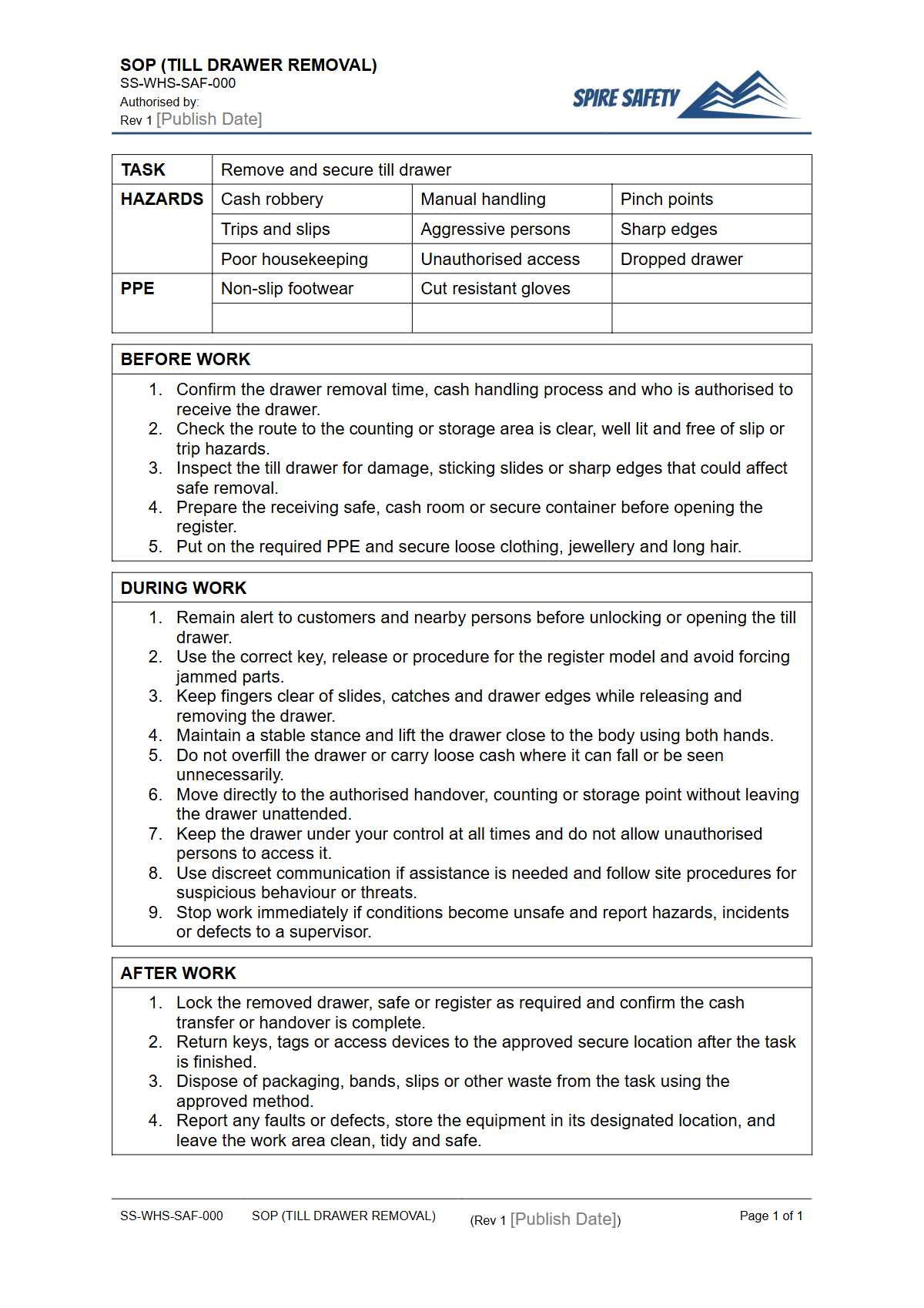
Purpose of the Free Safe Operating Procedure (Till Drawer Removal) Template
This Safe Operating Procedure (SOP) template provides a structured framework for documenting the process of removing and transporting a cash register till drawer. Handling till drawers, often laden with coins and notes, presents unique risks including musculoskeletal injuries from awkward lifting and security vulnerabilities related to cash handling.
Implementing a formal procedure helps organisations in the retail, hospitality, and service industries to standardise this common task, ensuring it is performed safely and securely every time. By using our Free Safe Operating Procedure (Till Drawer Removal) Template, you can clearly define responsibilities, outline step-by-step instructions, and specify control measures to mitigate identified hazards.
This document serves as a crucial tool for training employees and demonstrating due diligence in managing workplace risks associated with end-of-shift cash clearance.
Video walkthrough
How to use the Free Safe Operating Procedure (Till Drawer Removal) Template
This resource is available as a DOCX file, designed for easy editing and customisation, and a PDF for straightforward printing and distribution. To use it effectively, download the DOCX version and adapt it to the specific layout, equipment, and security protocols of your workplace.
It is critical to conduct a site-specific risk assessment to identify all relevant hazards before finalising the procedure.
Important: This is a template only. We have provided a comprehensive starting point, but you must customise this document with your specific site details, personnel roles, till system models, and cash clearance paths.
This SOP should be integrated into your existing WHS management systems to ensure it aligns with your overall safety framework and objectives. A generic procedure that doesn't reflect your actual operations will not be effective in controlling risks.
When to use this Safe Operating Procedure
A Safe Operating Procedure for till drawer removal should be used consistently whenever the task is performed. This typically occurs at the end of a trading day, during a shift changeover, or when a till float needs to be reconciled or replenished.
Its application is also critical during maintenance or replacement of point-of-sale (POS) equipment. Formalising the procedure ensures that even during busy or stressful periods, employees follow a pre-determined, safe, and secure method, reducing the likelihood of manual handling injuries or security breaches.
Consistent use reinforces safe work habits and is a key component of a positive safety culture.
Who should use this Safe Operating Procedure
This SOP is primarily for workers tasked with handling cash and operating tills, including retail assistants, cashiers, and hospitality staff. Supervisors and managers also have a critical role in using the SOP to train staff, oversee the procedure, and supports your compliance efforts.
Security personnel may also refer to the document to understand the approved process for cash transit within the premises. All individuals involved must be trained on the final, customised procedure to ensure they understand the steps, the associated hazards, and the control measures in place to protect them.
For expert assistance in developing and implementing your procedures, consider our WHS consulting services.
Key Hazards in Till Drawer Removal
While seemingly simple, removing a till drawer involves several notable hazards that this SOP aims to control. A thorough risk assessment is the first step in identifying these for your specific environment.
Musculoskeletal Disorders (MSDs)
Till drawers full of coins can be surprisingly heavy and awkward to handle. Key risk factors include:
- Forceful exertion: Lifting a heavy drawer from a confined space.
- Awkward postures: Bending, twisting, or reaching to access and carry the drawer.
- Repetition: Performing the task multiple times per day across different registers.
Proper manual handling techniques are essential to prevent strains and sprains to the back, shoulders, and wrists. You can find more templates and guides on managing various workplace risks in our free WHS resources library.
Security and Robbery Risks
The process of removing and transporting cash is a vulnerable time for any business. Risks include external robbery and internal theft.
This procedure should define a secure route from the point of sale to the cash office, specify the personnel authorised to perform the task, and outline communication protocols. Using lockable bags or cases and ensuring the transport route is well-lit and monitored by CCTV are common control measures.
Integrating This SOP Into Your Safety System
A Safe Operating Procedure is most effective when it is a living document within a functional safety system. It should not be created and filed away.
Integrate this SOP by including it in new employee inductions and regular refresher training sessions. Keep records of this training.
Refer to the SOP during incident investigations involving cash handling or manual tasks. For an example of how to build a library of procedures for your workplace, you might also consider our Free Safe Operating Procedure (Deep Fryer - Standard Operation) template for hospitality environments.
Periodically, the SOP's effectiveness should be verified through workplace inspections and observations. These checks can be incorporated into your routine WHS compliance auditing schedule to confirm the procedure is being followed correctly and remains effective.
Common mistakes
Common mistakes to avoid
- Failing to customise the template with site-specific details, such as the exact route to the cash office.
- Neglecting to train employees on the final, approved procedure.
- Storing the SOP in an office where cashiers and frontline staff cannot easily access it for reference.
- Not reviewing or updating the procedure after an incident, near miss, or change in the work environment.
Legal references
Legal considerations
The following legal requirements may be relevant to this type of work.
- Work Health and Safety Act (Harmonised) — Provides the primary duties for protecting workers and other people from work health and safety risks.
- Work Health and Safety Regulations (Harmonised) — Sets out requirements supporting the management of workplace hazards and risks.
The following codes may be relevant to this type of work.
- Managing WHS Risks Code of Practice — Provides practical guidance on identifying hazards, assessing risks and applying effective controls.
- Work Health and Safety Consultation, Cooperation and Coordination Code of Practice — Provides practical guidance on consulting workers and coordinating with other duty holders.
- Managing the Work Environment and Facilities Code of Practice — Provides practical guidance on safe work environments, workplace facilities and related controls.
Did you know
The Weight of Money
A full till drawer can weigh over 7 kilograms, with the majority of the weight coming from coins. This places the task firmly in the category of a hazardous manual task, requiring specific risk controls to prevent musculoskeletal injury.
Procedural Justice
Studies have shown that clear, fair, and consistently enforced internal procedures, like SOPs for cash handling, can significantly reduce the likelihood of employee theft by creating a perception of organisational fairness and control.
FAQ
Frequently asked questions
01What should be included in a till drawer removal SOP?
02How often should we review our Safe Operating Procedure for till removal?
03Is this template suitable for all types of retail businesses in Australia?
04What training is required after implementing this SOP?
Share this resource
Free Safe Operating Procedure (Till Drawer Removal) Template
Browse Categories
How To Use It
- 1Download and open in Word or PDF.
- 2Replace the placeholders with your business details.
- 3Get it reviewed by a WHS specialist before rollout.
Need it customised?
Our WHS consultants can adapt this template to your site, run a gap analysis, or audit what you already have in place.
Book a Free Consultation WHS consulting servicesor call 1300 156 382
Related templates
- Free Safe Operating Procedure (Tilt Meter) Template
- Free Safe Operating Procedure (Toaster) Template
- Free Safe Operating Procedure (Toilet Cubicle Clean) Template
- Free Safe Operating Procedure (Torque Multiplier) Template
- Free Safe Operating Procedure (Torque Wrench) Template
- Free Safe Operating Procedure (Total Station) Template