
Free Safe Operating Procedure (Total Station) Template
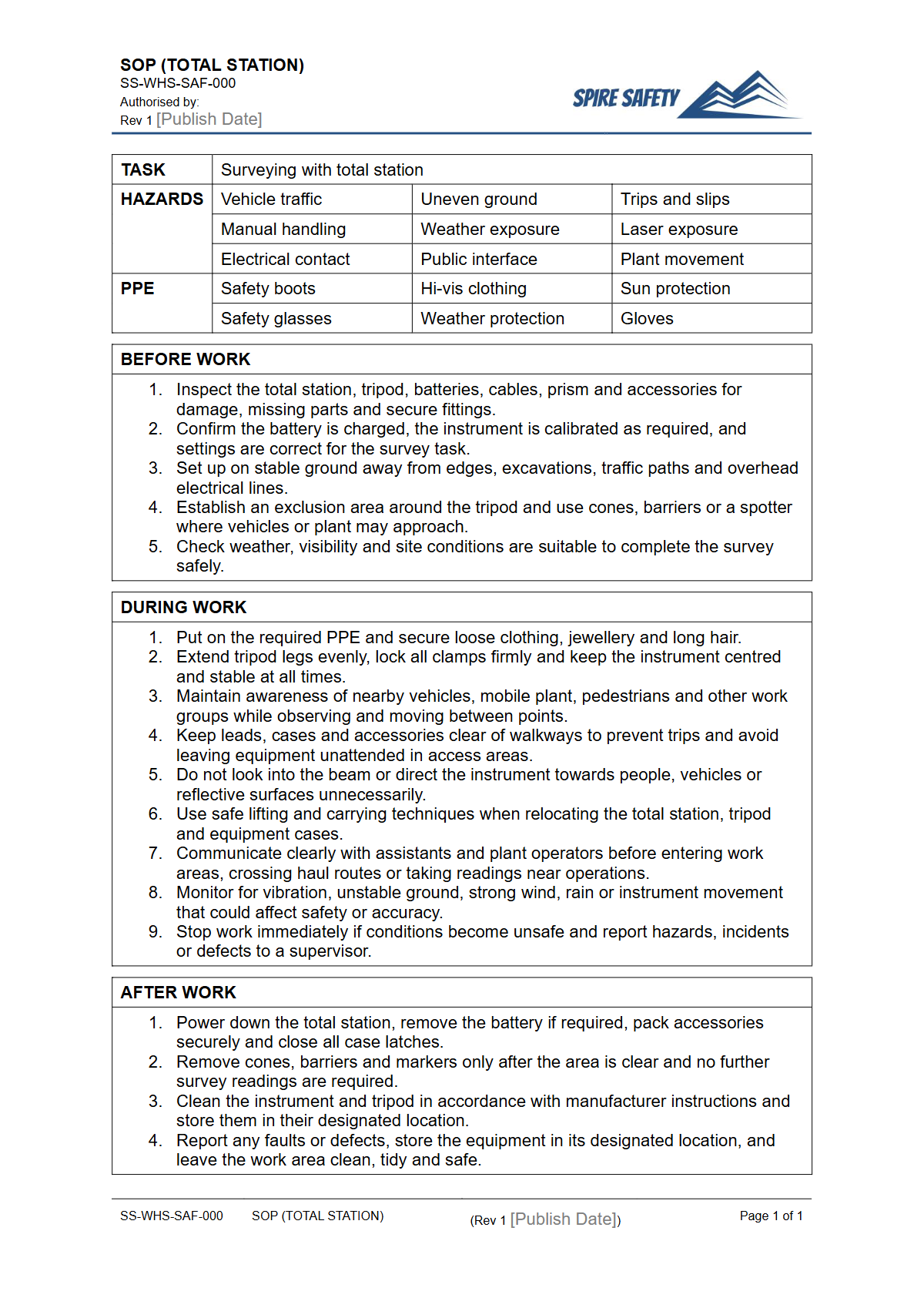
Get a head start on your worksite safety with our free Safe Operating Procedure (Total Station) Template. Download the DOCX and PDF today.
Free Safe Operating Procedure (Total Station) Template
DOCX • 126 KB + PDF
Updated Oct 2026
No signup required
Purpose of the Free Safe Operating Procedure (Total Station) Template
Operating a total station requires precision and an awareness of surrounding hazards. This Free Safe Operating Procedure (Total Station) Template provides a structured starting point for documenting the essential health and safety steps for this task.
A well-drafted Safe Operating Procedure helps to control risks associated with manual handling, trip hazards from tripod legs, environmental exposure, and working near mobile plant or traffic. It formalises your process, ensuring that every operator follows a consistent, safe method for setup, operation, and pack-down.
Implementing task-specific SOPs is a fundamental part of building robust WHS management systems. It demonstrates a commitment to proactive risk management and provides a clear reference for training and supervision. By documenting the approved procedure, you reduce the likelihood of errors that could lead to costly rework or, more importantly, a workplace incident.
It also ensures that safety controls are communicated effectively throughout your organisation.
Hazards Associated with Total Station Use
- Musculoskeletal Injury: Lifting and carrying the instrument and accessories can cause strains and sprains if not done correctly.
- Slips, Trips, and Falls: Tripod legs create a significant trip hazard for the operator and others in the vicinity. Working on uneven or slippery ground increases the risk of falls.
- Struck-by Hazards: Surveyors often work near moving vehicles, mobile plant, or in areas with overhead activity.
- Environmental Factors: Exposure to sun, heat, cold, rain, and insects can lead to illness or injury.
- Public Interface: Working in public spaces can introduce risks from pedestrians, cyclists, and other unexpected interactions.
Video walkthrough
How to use the Free Safe Operating Procedure (Total Station) Template
This template is provided in both DOCX and PDF formats for your convenience. The DOCX file is fully editable, allowing you to adapt it to the specific context of your workplace, the models of total station you use, and any unique site hazards.
It is crucial that you tailor this document to your own operations and risk profile.
Note: We have created this document as a guide. You must customise it to reflect the actual equipment, personnel, and procedures in your business.
Generic safety documents are not sufficient for demonstrating compliance; they must be made specific to your work environment. If you need assistance with this customisation process, our WHS consulting team can provide expert guidance.
For complex project sites, you may need to integrate this SOP with other documents, such as a FREE Trencher SOP Template, to manage interactions between different work groups and ensure a holistic approach to site safety.
When to use a Total Station Safe Operating Procedure
A Safe Operating Procedure for a total station should be a core part of your daily workflow and safety management processes. It should be used as a primary reference during the planning phase of any surveying task to ensure all safety measures are considered before work begins.
It also serves as an essential training document for new employees or those unfamiliar with the specific equipment being used.
The SOP should also be reviewed during pre-start meetings or toolbox talks to refresh workers' knowledge of the risks and controls. Following any incident, near miss, or change in working conditions, the SOP must be reviewed and updated to ensure it remains relevant and effective. Regular reviews are a key component of due diligence and can be verified through processes like WHS compliance auditing.
Who should use this Safe Operating Procedure
This SOP is designed for use by a range of personnel within an organisation. Primarily, it is for the surveyors and field technicians who physically operate the total station.
They must understand and follow the documented steps to ensure their own safety and the safety of those around them.
Supervisors and site managers should use the SOP to oversee work, verify correct procedures are being followed, and conduct safety observations or inspections. WHS advisors and managers can use it as a foundational document for risk assessments, training development, and incident investigations. Fostering a strong safety culture involves providing accessible and practical tools for all workers, many of which can be found in our free WHS resources library.
Common mistakes
Common mistakes to avoid
- Failing to properly level the instrument on the tripod, leading to inaccurate measurements and rework.
- Setting up in unsafe locations, such as on unstable ground, too close to live traffic, or under overhead hazards.
- Not accounting for environmental factors like heat shimmer, strong wind, or rain, which can affect accuracy and stability.
- Using poor manual handling techniques when transporting and setting up the heavy equipment, leading to sprains and strains.
Legal references
Legal considerations
The following legal requirements may be relevant to this type of work.
- Work Health and Safety Act (Harmonised) — Provides the primary duties for protecting workers and other people from work health and safety risks.
- Work Health and Safety Regulations (Harmonised) — Sets out requirements supporting the management of workplace hazards and risks.
The following codes may be relevant to this type of work.
- Managing WHS Risks Code of Practice — Provides practical guidance on identifying hazards, assessing risks and applying effective controls.
- Work Health and Safety Consultation, Cooperation and Coordination Code of Practice — Provides practical guidance on consulting workers and coordinating with other duty holders.
- Managing the Work Environment and Facilities Code of Practice — Provides practical guidance on safe work environments, workplace facilities and related controls.
Did you know
Precision Surveying
Modern total stations can measure distances to a precision of a few millimetres over several kilometres, making them essential for high-tolerance construction and engineering projects.
Evolution of Tools
Before total stations, surveying relied on theodolites for angles and measuring chains for distance. This required separate, time-consuming processes that are now combined in one instrument.
FAQ
Frequently asked questions
01What are the main hazards when using a total station?
02Is a Safe Operating Procedure legally required for a total station in Australia?
03How often should a Total Station SOP be reviewed?
04Can this template be used for robotic total stations?
Share this resource
Free Safe Operating Procedure (Total Station) Template
Browse Categories
How To Use It
- 1Download and open in Word or PDF.
- 2Replace the placeholders with your business details.
- 3Get it reviewed by a WHS specialist before rollout.
Need it customised?
Our WHS consultants can adapt this template to your site, run a gap analysis, or audit what you already have in place.
Book a Free Consultation WHS consulting servicesor call 1300 156 382
Related templates
- Free Safe Operating Procedure (Towel Collection) Template
- Free Safe Operating Procedure (Towel Folding) Template
- Free Safe Operating Procedure (Towel Laundry Handling) Template
- Free Safe Operating Procedure (Tower Crane Access) Template
- Free Safe Operating Procedure (Track Surface Cleaning) Template
- Free Safe Operating Procedure (Traffic Cone Setup) Template