
Free Safe Operating Procedure (Towel Collection) Template
Formalise towel collection procedures in hospitality, laundry, or healthcare with our free template.
Free Safe Operating Procedure (Towel Collection) Template
DOCX • 126 KB + PDF
Updated Oct 2026
No signup required
Purpose of the Free Safe Operating Procedure (Towel Collection) Template
Managing the collection of used towels, whether in a hotel, gym, healthcare facility, or industrial laundry, involves more than just tidiness. It's a task with genuine work health and safety risks.
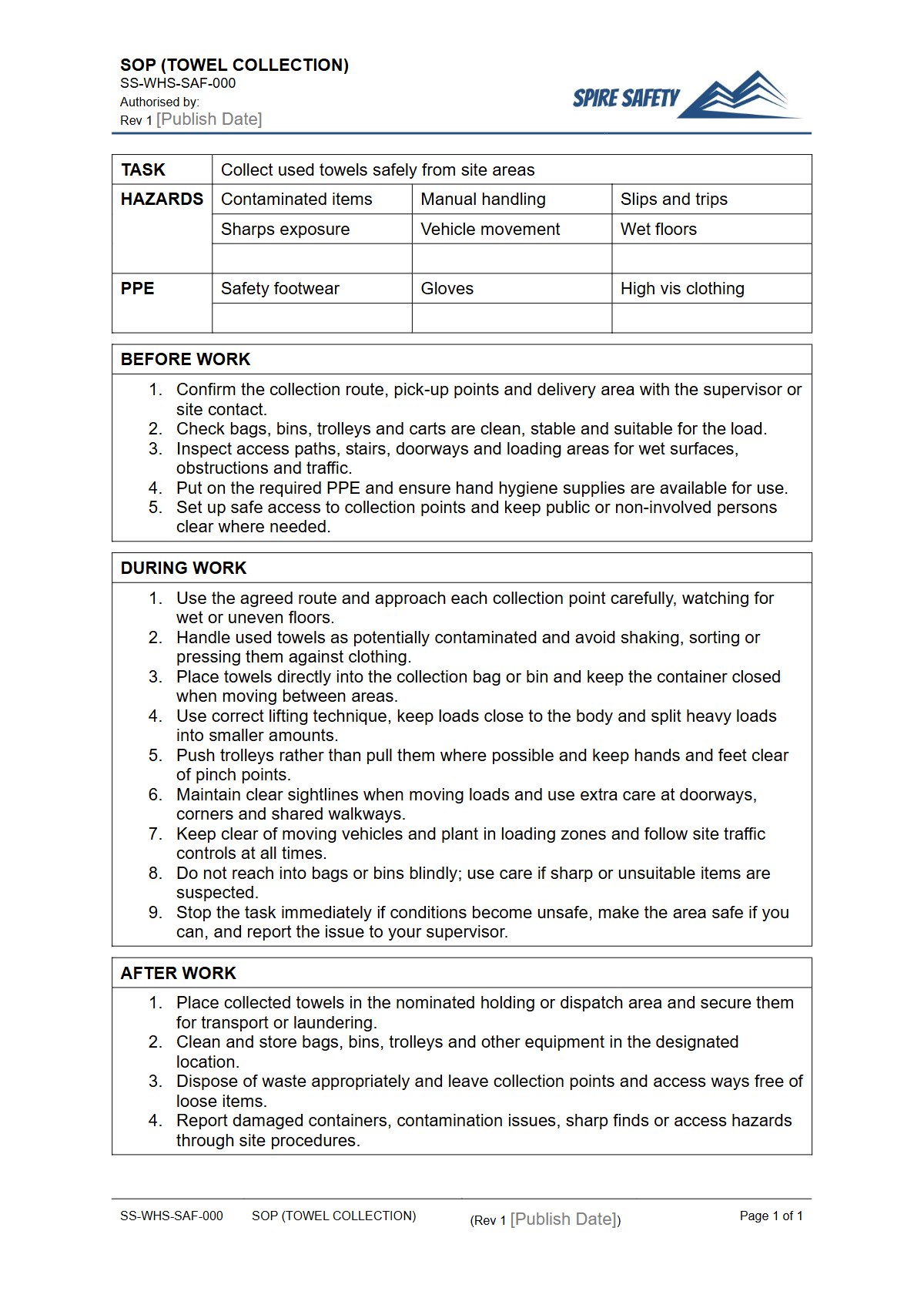
Our Free Safe Operating Procedure (Towel Collection) Template provides a structured framework to help your organisation document a consistent, safe method for this common activity. Using this SOP helps formalise procedures, ensuring every worker understands the identified hazards and the required control measures.
The primary purpose of a Safe Operating Procedure (SOP) is to minimise the risk of injury. For towel collection, this includes addressing common hazards such as:
- Manual Handling: Bending, lifting heavy bags of wet towels, and pushing or pulling trolleys can lead to musculoskeletal injuries.
- Slips, Trips, and Falls: Wet towels dropped on the floor create a significant slip hazard for both workers and others in the area.
- Biological Hazards: Soiled towels, particularly from healthcare or clinical settings, can carry bacteria and other contaminants.
- Awkward Postures: Repeatedly reaching into deep collection bins or under furniture can cause strain over time.
By implementing a clear SOP, you establish a baseline for training, supervision, and performance. It forms a critical part of comprehensive WHS management systems, demonstrating a proactive approach to workplace safety.
Video walkthrough
How to use the Free Safe Operating Procedure (Towel Collection) Template
This resource is available for download in both DOCX and PDF formats. The DOCX file is fully editable, allowing you to adapt it directly to your operational needs.
The PDF version is useful for easy printing and distribution once your customisations are complete.
It is crucial to understand that this document is a template, not a finished safety solution. You must customise this Safe Operating Procedure to reflect the specific hazards, equipment (e.g., trolleys, bags, personal protective equipment), and environment of your unique workplace. We strongly recommend conducting a site-specific risk assessment for the task of towel collection and using the findings to inform the content of your final SOP.
Consultation with the workers who perform the task is a mandatory part of the risk management process and will ensure the procedure is practical and effective.
If you require assistance in adapting this template or conducting the necessary risk assessments, engaging professional WHS consulting services can provide expert guidance and ensure your documentation is robust and fit-for-purpose.
When to use a Towel Collection SOP
A Safe Operating Procedure for towel collection should be a living document, integrated into your daily operations. It is most effective when used in the following situations:
- Induction and Training: Use the SOP as a core training tool for all new employees responsible for this task.
- Refresher Training: Schedule periodic reviews of the SOP with existing staff to reinforce safe work practices and address any complacency.
- Following an Incident: If a near miss or injury occurs during towel collection, the SOP should be reviewed and updated as part of the investigation process.
- Audits and Inspections: The SOP serves as an evidence-based document during internal or external safety audits, demonstrating that a process is in place to manage identified risks. Formal WHS compliance auditing will often reference such documents as proof of a managed safety system.
- When Processes Change: If you introduce new equipment (like a different style of cart) or change the layout of your facility, the SOP must be reviewed and amended to reflect these changes.
Who should use it
Responsibility for safety is shared across an organisation. Various roles will interact with this SOP:
- Persons Conducting a Business or Undertaking (PCBUs): Have the primary duty of care to ensure safe systems of work are provided and maintained.
- Managers and Supervisors: Are responsible for implementing the SOP, providing adequate training, ensuring workers follow the procedure, and conducting supervision. For example, a hotel manager would use this SOP for housekeeping staff and a separate deep fryer SOP for kitchen personnel.
- Workers: Must follow the instructions outlined in the finalised SOP and report any hazards or difficulties they encounter.
- WHS Representatives and Officers: Use the SOP as a tool for monitoring compliance, facilitating consultation, and promoting a positive safety culture.
For larger operations like industrial laundries, where manual collection might feed into automated processes, you may also require a Conveyer System SOP to manage risks at the next stage of the workflow. You can find more templates like these in our free WHS resources library to build a comprehensive suite of safety documents.
Common mistakes
Common mistakes to avoid
- Using the template 'as-is' without customising it for the specific workplace.
- Failing to adequately train workers on the finalised SOP's contents and requirements.
- Not reviewing or updating the SOP after an incident, near miss, or change in process.
- Storing the SOP in an office where workers performing the task cannot easily access it.
Legal references
Legal considerations
The following legal requirements may be relevant to this type of work.
- Work Health and Safety Act (Harmonised) — Provides the primary duties for protecting workers and other people from work health and safety risks.
- Work Health and Safety Regulations (Harmonised) — Sets out requirements supporting the management of workplace hazards and risks.
The following codes may be relevant to this type of work.
- Managing WHS Risks Code of Practice — Provides practical guidance on identifying hazards, assessing risks and applying effective controls.
- Work Health and Safety Consultation, Cooperation and Coordination Code of Practice — Provides practical guidance on consulting workers and coordinating with other duty holders.
- Managing the Work Environment and Facilities Code of Practice — Provides practical guidance on safe work environments, workplace facilities and related controls.
Did you know
Manual Handling Impact
According to Safe Work Australia, serious claims for body stressing, which includes hazardous manual tasks, account for over a third of all serious workers' compensation claims.
The Power of Consultation
The model WHS Act requires businesses to consult with their workers on health and safety matters. Involving staff in the creation of an SOP makes the final procedure more practical and effective.
FAQ
Frequently asked questions
01What are the main hazards involved in towel collection?
02How often should an SOP for towel collection be reviewed?
03Is a Safe Operating Procedure a legal requirement in Australia?
04Can I use this template for collecting other types of laundry?
Share this resource
Free Safe Operating Procedure (Towel Collection) Template
Browse Categories
How To Use It
- 1Download and open in Word or PDF.
- 2Replace the placeholders with your business details.
- 3Get it reviewed by a WHS specialist before rollout.
Need it customised?
Our WHS consultants can adapt this template to your site, run a gap analysis, or audit what you already have in place.
Book a Free Consultation WHS consulting servicesor call 1300 156 382
Related templates
- Free Safe Operating Procedure (Towel Folding) Template
- Free Safe Operating Procedure (Towel Laundry Handling) Template
- Free Safe Operating Procedure (Tower Crane Access) Template
- Free Safe Operating Procedure (Track Surface Cleaning) Template
- Free Safe Operating Procedure (Traffic Cone Setup) Template
- Free Safe Operating Procedure (Trailer Door Check) Template