
Free Safe Operating Procedure (Towel Laundry Handling) Template
Download our free Safe Operating Procedure (Towel Laundry Handling) template.
Free Safe Operating Procedure (Towel Laundry Handling) Template
DOCX • 126 KB + PDF
Updated Oct 2026
No signup required
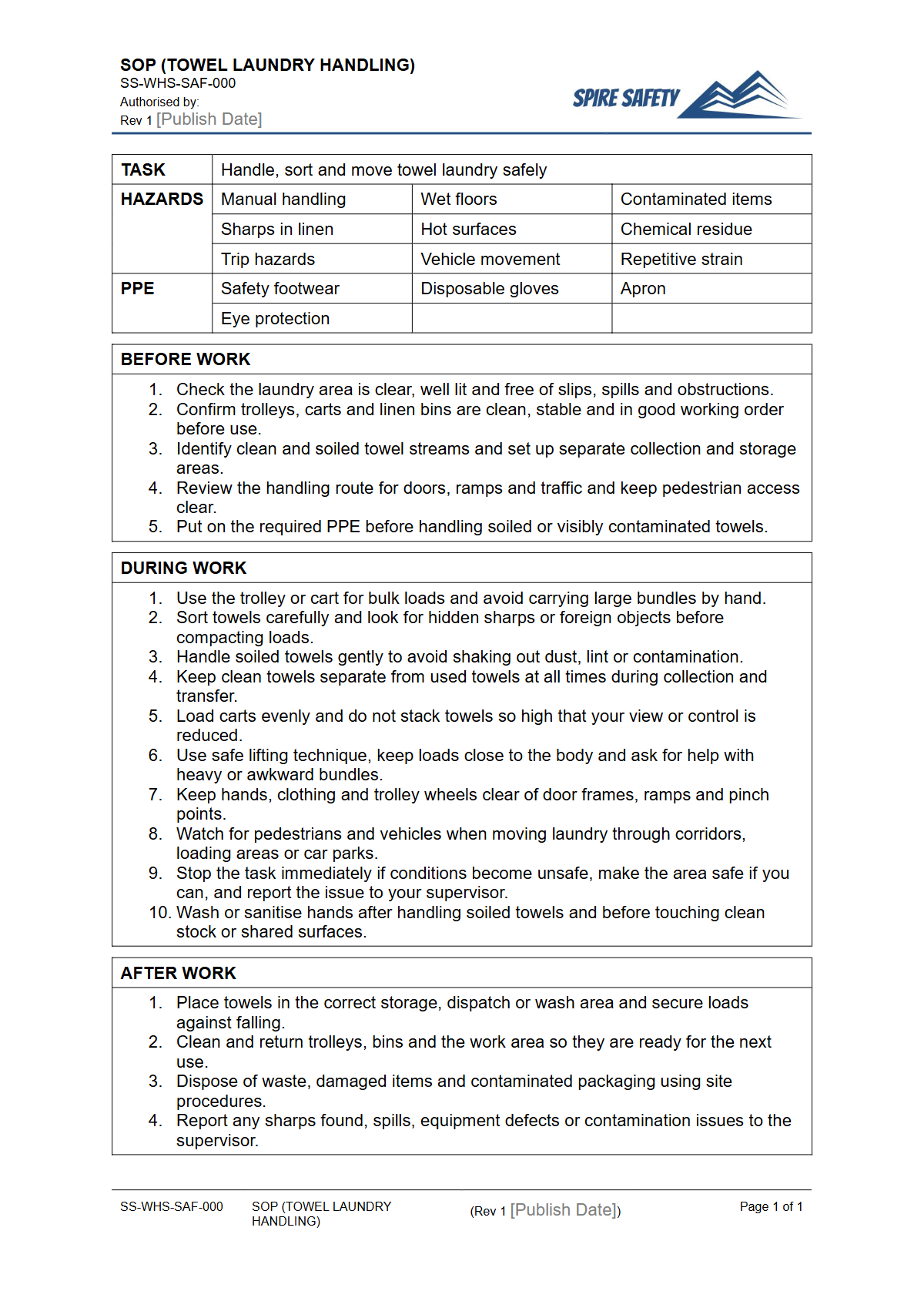
Purpose of the Free Safe Operating Procedure (Towel Laundry Handling) Template
Handling soiled and clean towels is a routine task in many industries, from hospitality and healthcare to fitness centres. However, it carries significant risks, including manual handling injuries, exposure to biological contaminants, and chemical hazards.
Our Free Safe Operating Procedure (Towel Laundry Handling) Template provides a structured starting point for documenting and managing these risks effectively in your workplace.
This Safe Operating Procedure template is designed to help you create a formal document that outlines the safest way to perform laundry handling tasks. A clear, well-defined SOP helps standardise your processes, ensuring every worker follows the same safe steps.
It serves as a vital tool for worker training and induction, reinforces safe work behaviour, and demonstrates due diligence in managing workplace health and safety. It specifically addresses common hazards such as musculoskeletal disorders from lifting heavy laundry bags, infection control breaches from contaminated linen, and skin or respiratory issues from cleaning chemicals.
Video walkthrough
How to use the Free Safe Operating Procedure (Towel Laundry Handling) Template
This resource is available for download in both DOCX and PDF formats. The DOCX file is fully editable, allowing you to tailor the content directly to your operational needs, including adding your company branding and specific procedural details.
Important: This document is a template and must be customised to reflect the specific hazards and controls in your workplace. We have provided a comprehensive framework aligned with Australian WHS practice, but you are responsible for adding details about your unique equipment, the specific chemicals you use, your site layout, and your established emergency procedures.
A generic SOP is not effective and may not meet your legal obligations.
When to use a Laundry Handling SOP
A Safe Operating Procedure for towel laundry handling should be a core part of your daily operations. It is essential for training and inducting new employees, ensuring they understand the risks and control measures from day one.
It should also be used for regular refresher training with existing staff and be readily accessible in the laundry area for quick reference. Furthermore, the SOP is a critical reference document during formal safety activities, such as incident investigations or when conducting a WHS compliance audit.
Who is this Safe Operating Procedure for?
This template is intended for any person conducting a business or undertaking (PCBU) where laundry is handled. This includes managers, supervisors, and WHS representatives in sectors like hotels, motels, aged care facilities, hospitals, gyms, and commercial laundries.
The final, customised SOP should be used by all workers who perform laundry tasks, including collection, sorting, washing, drying, and folding. Integrating this SOP into your broader WHS management systems ensures a consistent approach to safety across all business activities.
Key Hazards in Towel Laundry Handling
Customising your SOP requires a thorough understanding of the specific risks involved. Key hazards to consider and document include:
- Biological Hazards: Soiled towels can be contaminated with bacteria, viruses, fungi, and other pathogens. The SOP should outline procedures for handling potentially infectious linen, including the use of appropriate Personal Protective Equipment (PPE).
- Manual Handling: Lifting and moving heavy bags of wet towels, pushing heavy carts, and bending to load/unload machines can lead to sprains, strains, and chronic musculoskeletal injuries.
- Chemicals: Detergents, bleaches, softeners, and disinfectants can cause skin irritation, dermatitis, or respiratory problems if handled improperly. Your SOP must reference Safety Data Sheets (SDS) and detail correct handling, storage, and spill response procedures.
- Slips, Trips & Falls: Wet floors are a constant risk in laundry areas. Good housekeeping procedures are essential. Storing clean towels on high shelving can also introduce fall risks, which is why tasks like retrieving items from height require their own documented procedures, similar to what you would find in our FREE Step Ladder SOP Template.
Customising Your Towel Laundry SOP
To make this template effective, you must add site-specific information. Your final document should clearly define:
- The specific make and model of washing machines and dryers.
- Step-by-step instructions for operating each machine.
- The names of all chemicals used and where their Safety Data Sheets (SDS) are located.
- The exact PPE required (e.g., type of gloves, aprons, eye protection).
- Procedures for segregating contaminated linen.
- Emergency procedures for chemical spills, machine faults, or personal injury.
- Contact details for supervisors and first aid officers.
If you need assistance with risk assessments or customising safety documentation, our WHS consulting team can provide expert support. Just as you would document procedures for other plant and equipment, like with our Free Air Compressor SOP, documenting tasks involving biological and chemical hazards is crucial.
Taking the time to properly customise and implement this SOP will strengthen your safety culture and help protect your team. Find more templates and checklists in our extensive free WHS resources library.
Common mistakes
Common mistakes to avoid
- Using a generic template without adding site-specific details like machine models and chemical names.
- Failing to adequately train workers on the finalised SOP and confirm their understanding.
- Not providing or enforcing the use of the Personal Protective Equipment (PPE) specified in the procedure.
- Overloading laundry bags or washing machines, which significantly increases manual handling risks.
Legal references
Legal considerations
The following legal requirements may be relevant to this type of work.
- Work Health and Safety Act (Harmonised) — Provides the primary duties for protecting workers and other people from work health and safety risks.
- Work Health and Safety Regulations (Harmonised) — Sets out requirements supporting the management of workplace hazards and risks.
The following codes may be relevant to this type of work.
- Managing WHS Risks Code of Practice — Provides practical guidance on identifying hazards, assessing risks and applying effective controls.
- Work Health and Safety Consultation, Cooperation and Coordination Code of Practice — Provides practical guidance on consulting workers and coordinating with other duty holders.
- Managing the Work Environment and Facilities Code of Practice — Provides practical guidance on safe work environments, workplace facilities and related controls.
Did you know
Manual Handling Risk
According to Safe Work Australia, the accommodation and food services industry has one of the highest rates of serious claims for manual handling injuries, making documented procedures for tasks like laundry crucial.
Temperature Matters
Washing linen at a temperature of at least 60°C is generally effective for thermal disinfection, killing most bacteria and viruses commonly found on soiled towels and bedding.
FAQ
Frequently asked questions
01What is a Safe Operating Procedure for towel laundry handling?
02Are soiled hotel or gym towels considered a biohazard?
03What PPE is needed for handling commercial laundry?
04How often should we review our laundry handling SOP?
Share this resource
Free Safe Operating Procedure (Towel Laundry Handling) Template
Browse Categories
How To Use It
- 1Download and open in Word or PDF.
- 2Replace the placeholders with your business details.
- 3Get it reviewed by a WHS specialist before rollout.
Need it customised?
Our WHS consultants can adapt this template to your site, run a gap analysis, or audit what you already have in place.
Book a Free Consultation WHS consulting servicesor call 1300 156 382
Related templates
- Free Safe Operating Procedure (Tower Crane Access) Template
- Free Safe Operating Procedure (Track Surface Cleaning) Template
- Free Safe Operating Procedure (Traffic Cone Setup) Template
- Free Safe Operating Procedure (Trailer Door Check) Template
- Free Safe Operating Procedure (Trailer Seal Check) Template
- Free Safe Operating Procedure (Train Interior Cleaning) Template