
Free Safe Operating Procedure (Trailer Door Check) Template
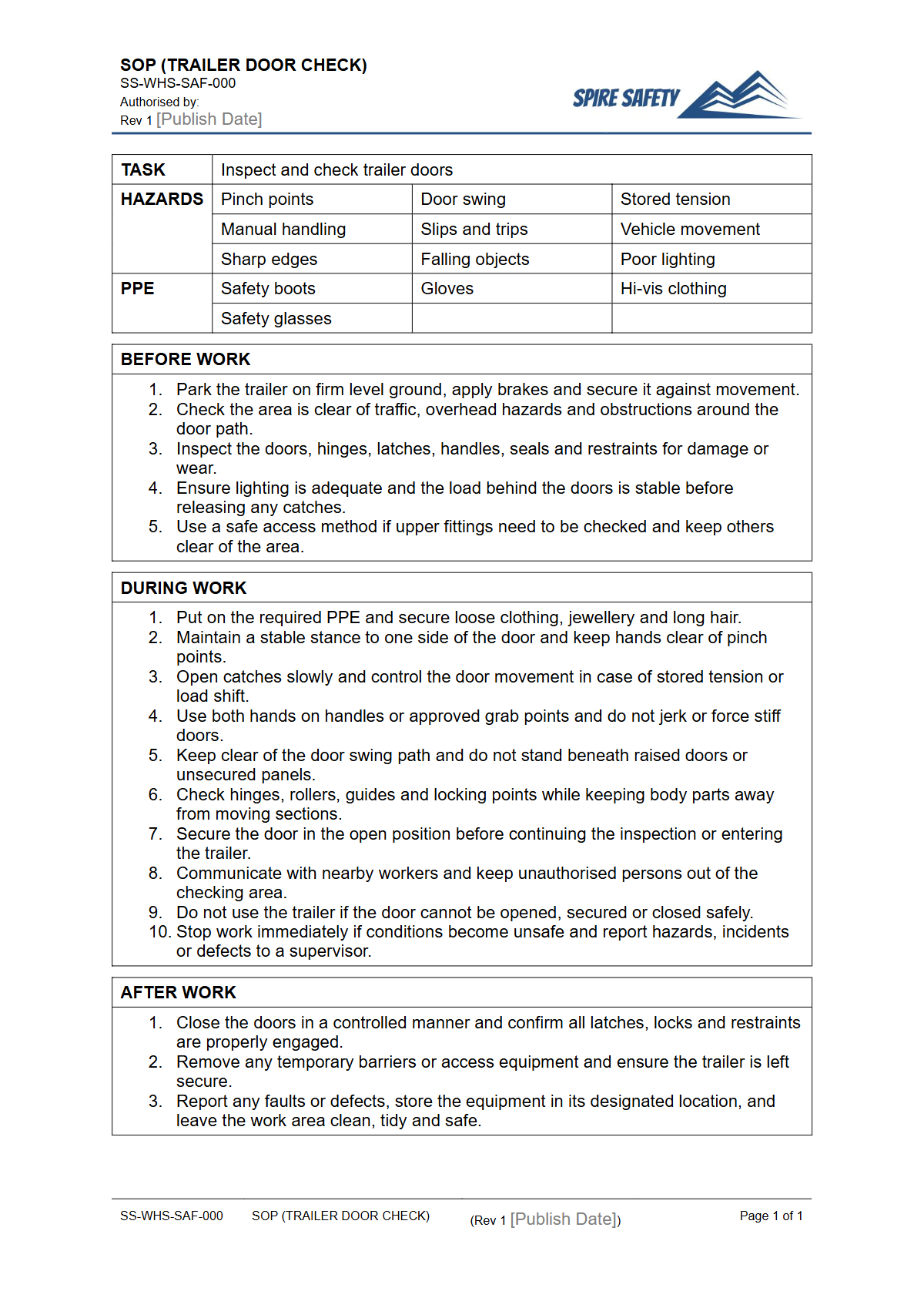
Download our free Safe Operating Procedure (Trailer Door Check) Template to formalise safety checks. This customisable guide helps you manage transport risks.
Free Safe Operating Procedure (Trailer Door Check) Template
DOCX • 126 KB + PDF
Updated Oct 2026
No signup required
Purpose of the Free Safe Operating Procedure (Trailer Door Check) Template
Opening trailer doors is a routine task in many industries, from logistics and transport to warehousing and retail. However, it carries significant risks, including injuries from falling objects, musculoskeletal disorders from forceful exertion, and being struck by unsecured doors.
This Free Safe Operating Procedure (Trailer Door Check) Template provides a structured framework for businesses to document and implement a safe system of work for this common activity. By clearly outlining the steps, precautions, and responsibilities, this SOP helps organisations meet their duty of care and prevent serious incidents.
Implementing a robust SOP is a key component of a functional safety framework. It formalises risk control measures and provides a clear, auditable record of how high-risk tasks should be performed.
Integrating this procedure into your broader WHS management systems ensures consistency and reinforces a proactive safety culture across your operations.
Video walkthrough
How to use the Free Safe Operating Procedure (Trailer Door Check) Template
This template is designed as a comprehensive starting point, aligned with Australian WHS principles. To make it effective for your workplace, you must customise it to reflect your specific environment, equipment, and operational risks.
Download the DOCX file and adapt it by adding site-specific details, vehicle types, and any unique hazards present at your facility. It is crucial to consult with your workers—the transport operators, warehouse staff, and supervisors who perform the task—during the customisation process to ensure the procedure is practical and addresses real-world challenges.
Once customised, this document should be used as a primary reference for training and daily operations. Many worksites that handle freight also use other machinery in loading bays.
If your operations involve mechanical handling equipment, you might also benefit from our FREE Telehandler SOP Template to ensure consistent safety standards are applied across all tasks.
Customisation Note
Remember, this is a template, not a finished document. We have provided a solid foundation, but you must take the final steps to ensure it is suitable for your business.
Review every section and modify it to align with your specific machinery, risk assessments, and internal safety policies. Your final SOP should be a direct reflection of the safe work practices you expect on your site.
When to use it
The Safe Operating Procedure for a trailer door check should be referenced and followed every time a worker needs to open the doors of a truck, semi-trailer, or shipping container. It is particularly critical in situations where there is a risk of load shift, such as after long-haul transit or if the vehicle has undergone sudden braking.
This SOP should be integrated into your standard workflow for receiving goods and be a mandatory part of pre-start checks for unloading tasks. It also serves as a critical training tool for new employee inductions and refresher courses.
If you need assistance integrating this SOP into your existing safety documentation or developing a broader training program, consider engaging professional WHS consulting services to ensure a seamless and effective implementation.
Who should use it
This procedure is intended for all personnel involved in or working near loading and unloading operations. This includes:
- Transport and truck drivers
- Warehouse and stores personnel
- Forklift operators
- Dispatch and receiving coordinators
- Site supervisors and managers
Supervisors hold a key responsibility for ensuring the procedure is understood, followed, and enforced. They should conduct regular observations and verifications to confirm that workers are adhering to the documented steps, especially the critical safety checks before unlatching the doors.
Regular reviews of compliance can be built into your internal audit schedule, a process which can be supported through a formal WHS compliance auditing program.
For organisations with complex logistics, such as those using automated sorting equipment, this SOP can be used alongside other machinery-specific procedures. For example, it can complement documents like a FREE Conveyer System SOP (Safe Operating Procedure) Template to create a holistic safety plan for your entire goods-in/goods-out process.
You can find more templates and checklists in our complete free WHS resources library to support your safety management efforts.
Common mistakes
Common mistakes to avoid
- Standing directly in the path of the door as it opens.
- Failing to visually inspect the doors for bulging or other signs of a shifted load before unlatching.
- Using excessive force or unsafe tools (e.g., cheater bars) to open a jammed door latch.
- Not securing the doors in the fully open position before starting to unload.
Legal references
Legal considerations
The following legal requirements may be relevant to this type of work.
- Work Health and Safety Act (Harmonised) — Provides the primary duties for protecting workers and other people from work health and safety risks.
- Work Health and Safety Regulations (Harmonised) — Sets out requirements supporting the management of workplace hazards and risks.
The following codes may be relevant to this type of work.
- Managing WHS Risks Code of Practice — Provides practical guidance on identifying hazards, assessing risks and applying effective controls.
- Work Health and Safety Consultation, Cooperation and Coordination Code of Practice — Provides practical guidance on consulting workers and coordinating with other duty holders.
- Managing the Work Environment and Facilities Code of Practice — Provides practical guidance on safe work environments, workplace facilities and related controls.
Did you know
Load Shift Dynamics
Even minor braking or turning manoeuvres can cause an unsecured load to shift against trailer doors, creating significant stored energy. This force can cause doors to fly open violently when unlatched.
The 'Live Hinge'
The area where a trailer door swings open is often called the 'live hinge' or 'swing zone'. Standing within this area during opening is a leading cause of impact injuries in loading docks.
FAQ
Frequently asked questions
01What are the main hazards when opening trailer doors?
02How often should an SOP for trailer door checks be reviewed?
03Is this trailer door check SOP a legal requirement in Australia?
04What should be included in training for this Safe Operating Procedure?
Share this resource
Free Safe Operating Procedure (Trailer Door Check) Template
Browse Categories
How To Use It
- 1Download and open in Word or PDF.
- 2Replace the placeholders with your business details.
- 3Get it reviewed by a WHS specialist before rollout.
Need it customised?
Our WHS consultants can adapt this template to your site, run a gap analysis, or audit what you already have in place.
Book a Free Consultation WHS consulting servicesor call 1300 156 382
Related templates
- Free Safe Operating Procedure (Trailer Seal Check) Template
- Free Safe Operating Procedure (Train Interior Cleaning) Template
- Free Safe Operating Procedure (Train Seat Cleaning) Template
- Free Safe Operating Procedure (Train Toilet Cleaning) Template
- Free Safe Operating Procedure (Transfer Belt Cleaning) Template
- Free Safe Operating Procedure (Transfer Board Cleaning) Template