
Free Safe Operating Procedure (Train Toilet Cleaning) Template
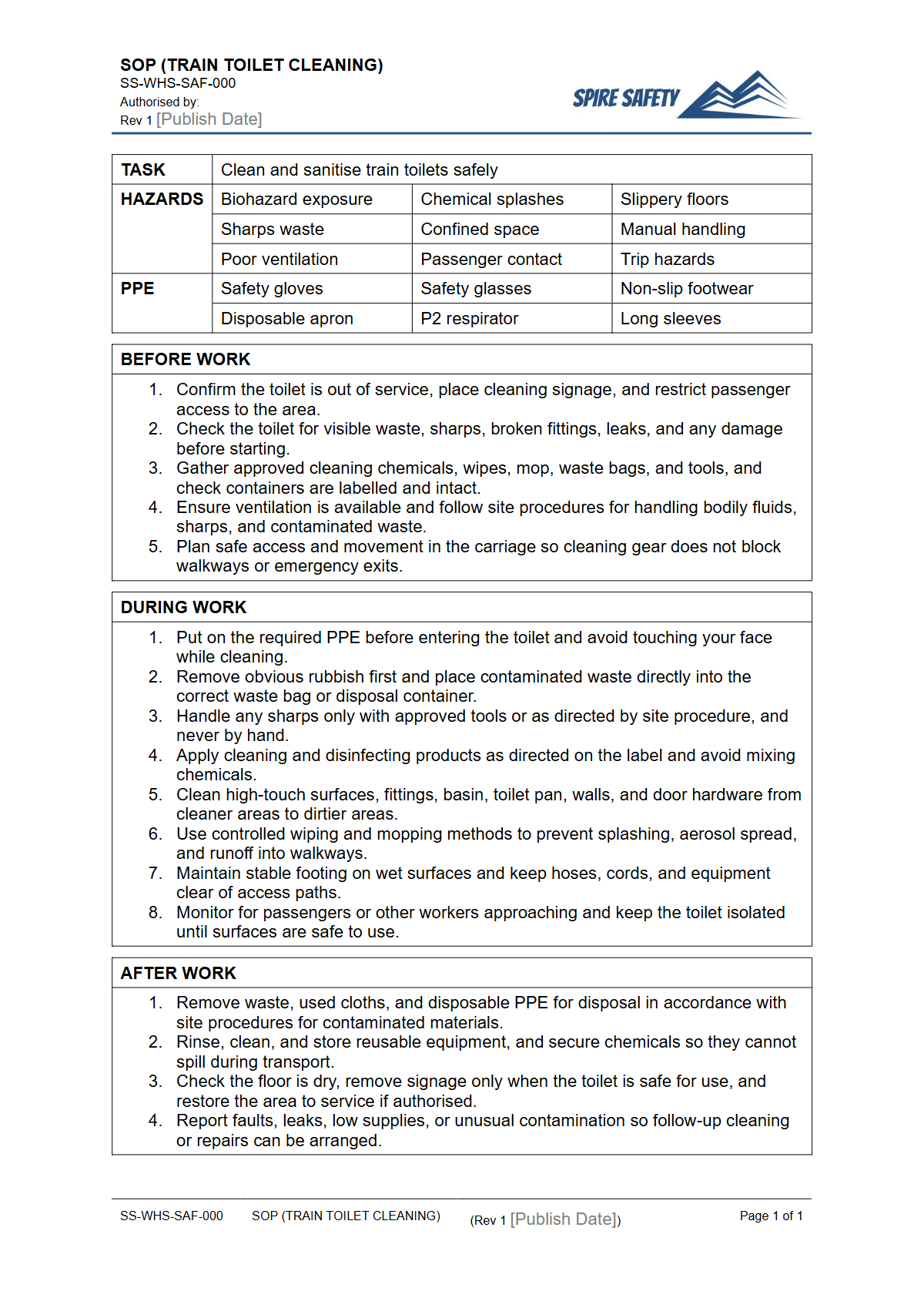
Download our free Safe Operating Procedure for train toilet cleaning. This customisable template helps you outline step-by-step safety controls.
Free Safe Operating Procedure (Train Toilet Cleaning) Template
DOCX • 126 KB + PDF
Updated Oct 2026
No signup required
Purpose of the Free Safe Operating Procedure (Train Toilet Cleaning) Template
This free Safe Operating Procedure (Train Toilet Cleaning) Template provides a structured framework for documenting the safety requirements for cleaning toilets on trains. This task involves significant risks, including exposure to biological hazards, hazardous chemicals, and ergonomic injuries, as well as common workplace hazards like slips, trips, and falls.
A documented SOP ensures that cleaning staff have clear, step-by-step instructions to perform the task safely and consistently.
Using this template helps a Person Conducting a Business or Undertaking (PCBU) fulfil their primary duty of care by managing risks associated with this specific work activity. A robust SOP is a fundamental component of an effective WHS management system, demonstrating a commitment to health and safety and providing a clear standard for training and supervision.
Video walkthrough
How to use the Free Safe Operating Procedure (Train Toilet Cleaning) Template
This document is a starting point, designed to be adapted to your specific operational context. To use it effectively, download the DOCX file and thoroughly review each section.
You will need to add details specific to your workplace, including the types of trains, the layout of the facilities, the exact cleaning chemicals used (referencing their Safety Data Sheets), and the specific Personal Protective Equipment (PPE) required.
IMPORTANT: This is a template only. We are not familiar with your unique business and operational environment.
You must customise this document to reflect the specific hazards, equipment, chemicals, and control measures that are relevant to your workplace. Consultation with workers who perform the task is essential to ensure the SOP is practical and effective.
If you need assistance tailoring safety documents to your needs, our WHS consulting team can provide expert guidance.
When to use this Safe Operating Procedure
A Safe Operating Procedure for train toilet cleaning should be used as a core part of your daily safety practices. Its primary applications include:
- Worker Training and Induction: Use the SOP as a training tool for new employees and for refresher training to ensure all workers understand the required safety measures.
- Pre-Task Planning: Workers should review the SOP before starting the cleaning task, especially if it is performed infrequently, to refresh their memory of the steps, hazards, and controls.
- Supervision and Monitoring: Supervisors can use the SOP as a benchmark to monitor work practices and ensure procedures are being followed correctly.
- Incident Investigation: If an incident occurs, the SOP serves as a reference to determine if procedures were followed and whether the procedure itself needs revision.
Regular reviews of all safety processes are crucial to maintaining a safe workplace. These reviews, which can be formalised through a WHS compliance auditing program, ensure that your SOP remains current with changing equipment, chemicals, or regulations.
Who should use this Safe Operating Procedure
This SOP is intended for several key roles within an organisation:
- Cleaning Staff: The primary users who follow the step-by-step procedure to perform their work safely.
- Supervisors and Team Leaders: Responsible for ensuring staff are trained on the SOP and adhere to it during their shifts. They also use it for performance monitoring and on-the-spot corrections.
- Work Health and Safety (WHS) Managers: Use the SOP as part of the overall risk management framework, ensuring it is properly developed, implemented, and reviewed.
Creating task-specific procedures is a recognised best practice for managing hazards effectively. Just as a commercial kitchen would require a Safe Operating Procedure for a deep fryer, the unique risks of train toilet cleaning demand their own dedicated SOP.
Find more templates covering a wide range of tasks and equipment in our free WHS resources library to help build out your safety systems.
Common mistakes
Common mistakes to avoid
- Using the incorrect type or rating of gloves and eyewear for the specific chemicals being handled.
- Failing to properly signpost the work area, leading to slip risks for other staff or the public.
- Mixing cleaning chemicals, which can create toxic gases and other dangerous chemical reactions.
- Not allowing disinfectants sufficient 'dwell time' to effectively kill germs, rendering the cleaning process less effective.
Legal references
Legal considerations
The following legal requirements may be relevant to this type of work.
- Work Health and Safety Act (Harmonised) — Provides the primary duties for protecting workers and other people from work health and safety risks.
- Work Health and Safety Regulations (Harmonised) — Sets out requirements supporting the management of workplace hazards and risks.
The following codes may be relevant to this type of work.
- Managing WHS Risks Code of Practice — Provides practical guidance on identifying hazards, assessing risks and applying effective controls.
- Work Health and Safety Consultation, Cooperation and Coordination Code of Practice — Provides practical guidance on consulting workers and coordinating with other duty holders.
- Managing the Work Environment and Facilities Code of Practice — Provides practical guidance on safe work environments, workplace facilities and related controls.
Did you know
Biohazard Risk
Train and aircraft toilets use vacuum systems that can aerosolise waste particles when flushed. This increases the risk of worker exposure to airborne pathogens during cleaning if proper PPE and ventilation controls are not used.
FAQ
Frequently asked questions
01What are the main hazards in train toilet cleaning?
02Is an SOP a legal requirement for cleaning tasks?
03How often should a Train Toilet Cleaning SOP be reviewed?
04What training is needed alongside this SOP?
Share this resource
Free Safe Operating Procedure (Train Toilet Cleaning) Template
Browse Categories
How To Use It
- 1Download and open in Word or PDF.
- 2Replace the placeholders with your business details.
- 3Get it reviewed by a WHS specialist before rollout.
Need it customised?
Our WHS consultants can adapt this template to your site, run a gap analysis, or audit what you already have in place.
Book a Free Consultation WHS consulting servicesor call 1300 156 382
Related templates
- Free Safe Operating Procedure (Transfer Belt Cleaning) Template
- Free Safe Operating Procedure (Transfer Board Cleaning) Template
- Free Safe Operating Procedure (Transfer Sling Storage) Template
- Free Safe Operating Procedure (Transfer Station Clean) Template
- Free Safe Operating Procedure (Transformer Oil Sample) Template
- Free Safe Operating Procedure (Transmission Jack) Template