
Free Safe Operating Procedure (Transfer Station Clean) Template
Download our Free Safe Operating Procedure (Transfer Station Clean) Template to formalise waste facility cleaning processes. Get your customisable DOCX and PDF.
Free Safe Operating Procedure (Transfer Station Clean) Template
DOCX • 126 KB + PDF
Updated Oct 2026
No signup required
Purpose of the Free Safe Operating Procedure (Transfer Station Clean) Template
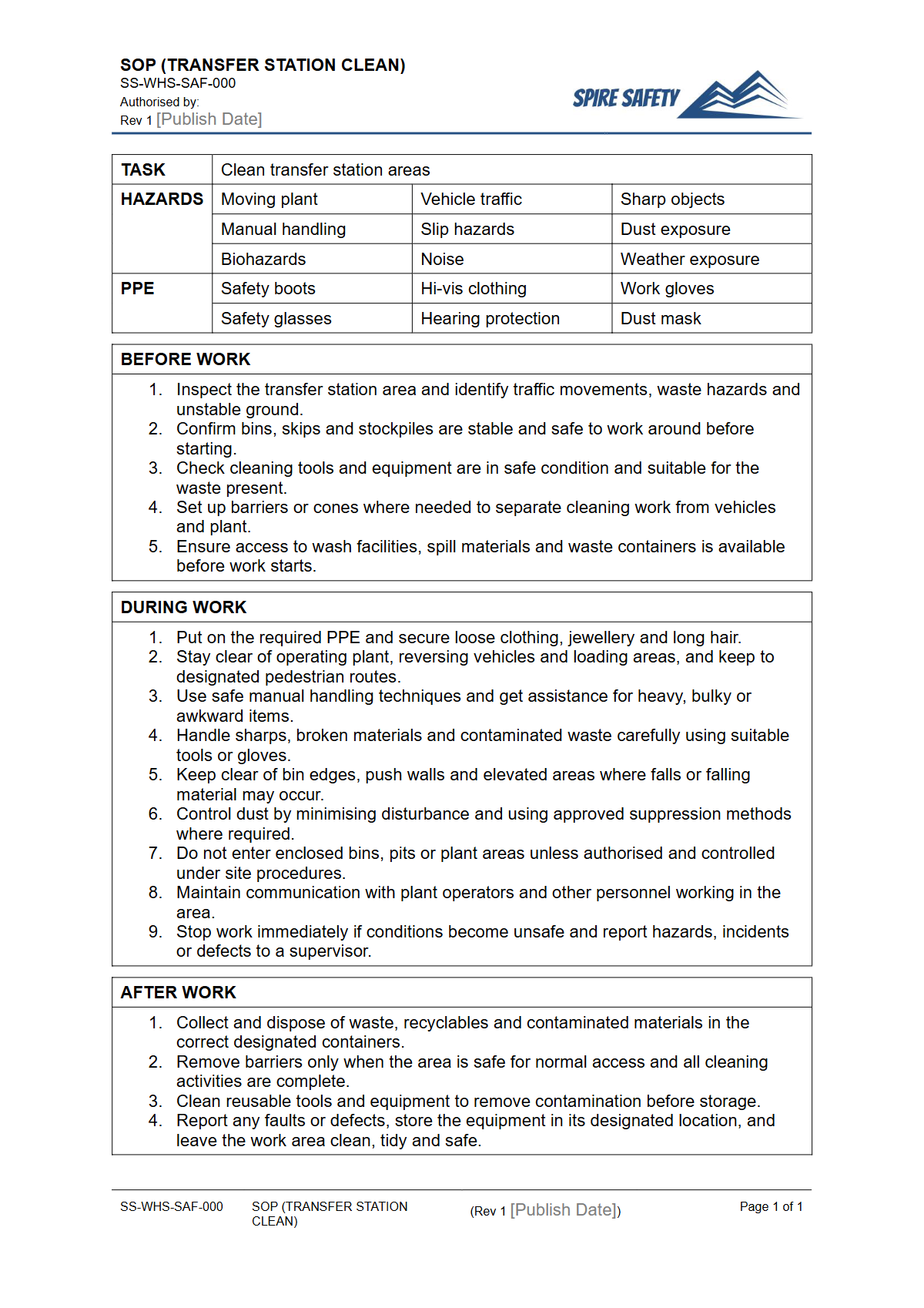
This Free Safe Operating Procedure (Transfer Station Clean) Template provides a structured framework for managing the significant health and safety risks associated with cleaning waste transfer stations. These environments present complex hazards, including exposure to biological agents, unidentified chemicals, airborne dust, sharps, and ergonomic strains from manual handling.
A documented SOP is crucial for standardising cleaning tasks, ensuring all control measures are consistently applied, and providing a clear basis for worker training and supervision.
Implementing a robust SOP for cleaning activities is a fundamental part of demonstrating due diligence and forms a critical component within broader WHS management systems. It helps your organisation systematically control risks, meet its duties under WHS legislation, and protect its workers from harm.
Video walkthrough
How to use the Free Safe Operating Procedure (Transfer Station Clean) Template
This downloadable document is a comprehensive starting point, not a finished procedure. To be effective, it must be adapted to the specific conditions of your workplace.
Download the DOCX file and work through each section, consulting with the workers who actually perform the cleaning tasks. Their input is invaluable for creating a practical and effective procedure that reflects on-the-ground realities.
IMPORTANT: This document is a template only. We have provided a structured outline based on common Australian WHS practices, but you must customise it with your site-specific details.
This includes the specific plant and equipment used (e.g., brand and model), chemicals on site (including Safety Data Sheets), emergency procedures, site layout, and the specific personnel responsibilities within your organisation.
Once customised, the SOP should be formally reviewed, approved, and then used as a tool for training, competency assessment, and ongoing performance monitoring. Periodic reviews and updates are essential, especially after an incident or when processes change.
Engaging in regular WHS compliance auditing can help verify that the procedures you've documented are being effectively implemented in practice.
When to use it
A transfer station cleaning SOP should be referenced before and during all cleaning activities. It provides guidance for various scenarios, including:
- Routine Cleaning: Daily or weekly housekeeping tasks to control dust, manage litter, and maintain clear access ways.
- Scheduled Deep Cleans: Periodic intensive cleaning of key areas like tipping floors, waste pits, hoppers, and sorting lines.
- Spill Response: Safely managing and cleaning up spills of liquid or solid waste materials to prevent slip hazards and environmental contamination.
- Machinery Clean-Downs: Procedures for safely isolating and cleaning plant and equipment. For tasks involving specific machinery, this SOP should be used alongside equipment-specific procedures, such as a conveyer system SOP, to ensure all energy sources are properly isolated.
Who should use it
This Safe Operating Procedure is intended for use by all personnel involved in the cleaning process at a waste transfer station. This includes:
- Site Managers and Supervisors: To understand the required process, assign tasks, provide supervision, and ensure the necessary resources (like PPE and equipment) are available.
- WHS Representatives and Officers: To assist in the development, review, and auditing of the procedure as part of their safety functions.
- Plant Operators and Cleaning Staff: As a direct guide for performing their work safely. They are the primary users who must be trained in and follow the documented steps.
During customisation, you must specify the exact plant and equipment used at your site for moving bulk materials during a clean-out. Operations may involve various types of heavy machinery, and each requires its own set of safety protocols. If your clean-up procedures involve using specific mobile plant, ensure operators are also familiar with the relevant safe operating procedures, such as those found in our free scraper SOP template.
Key Considerations for Customisation
When tailoring this template, pay close attention to specifying the required personal protective equipment (PPE), cleaning agents, and tools. Your risk assessment should inform the selection of PPE, which may include respiratory protection (e.g., P2 masks), eye protection, heavy-duty gloves, protective overalls, and steel-capped boots.
Also, detail the isolation and lock-out tag-out (LOTO) procedures for any machinery being cleaned. If mobile plant like a telehandler is used for clean-up assistance, its specific risks and controls must be incorporated.
Common mistakes
Common mistakes to avoid
- Using the template 'as is' without customising it for site-specific machinery, chemicals, and hazards.
- Failing to adequately train workers on the finalised SOP and verify their understanding.
- Neglecting to specify the correct type and class of Personal Protective Equipment (PPE) required for the tasks.
- Not reviewing and updating the procedure after an incident, near miss, or a change in the cleaning process.
Legal references
Legal considerations
The following legal requirements may be relevant to this type of work.
- Work Health and Safety Act (Harmonised) — Provides the primary duties for protecting workers and other people from work health and safety risks.
- Work Health and Safety Regulations (Harmonised) — Sets out requirements supporting the management of workplace hazards and risks.
The following codes may be relevant to this type of work.
- Managing WHS Risks Code of Practice — Provides practical guidance on identifying hazards, assessing risks and applying effective controls.
- Work Health and Safety Consultation, Cooperation and Coordination Code of Practice — Provides practical guidance on consulting workers and coordinating with other duty holders.
- Managing the Work Environment and Facilities Code of Practice — Provides practical guidance on safe work environments, workplace facilities and related controls.
Did you know
Waste Generation
In 2020-21, Australia generated an estimated 75.8 million tonnes of waste. Waste and recycling facility workers are on the front line of managing this volume, making standardised safety procedures essential.
FAQ
Frequently asked questions
01What are the key hazards during transfer station cleaning?
02How often should a transfer station cleaning SOP be reviewed?
03Who is responsible for providing the PPE for cleaning?
04Can I use this SOP template for cleaning other waste facilities?
Share this resource
Free Safe Operating Procedure (Transfer Station Clean) Template
Browse Categories
How To Use It
- 1Download and open in Word or PDF.
- 2Replace the placeholders with your business details.
- 3Get it reviewed by a WHS specialist before rollout.
Need it customised?
Our WHS consultants can adapt this template to your site, run a gap analysis, or audit what you already have in place.
Book a Free Consultation WHS consulting servicesor call 1300 156 382
Related templates
- Free Safe Operating Procedure (Transformer Oil Sample) Template
- Free Safe Operating Procedure (Transmission Jack) Template
- Free Safe Operating Procedure (Transmission Oil Change) Template
- Free Safe Operating Procedure (Transport Yard Cleanup) Template
- Free Safe Operating Procedure (Trash Pump) Template
- Free Safe Operating Procedure (Tray Clearing) Template