
Free Safe Operating Procedure (Transmission Jack) Template
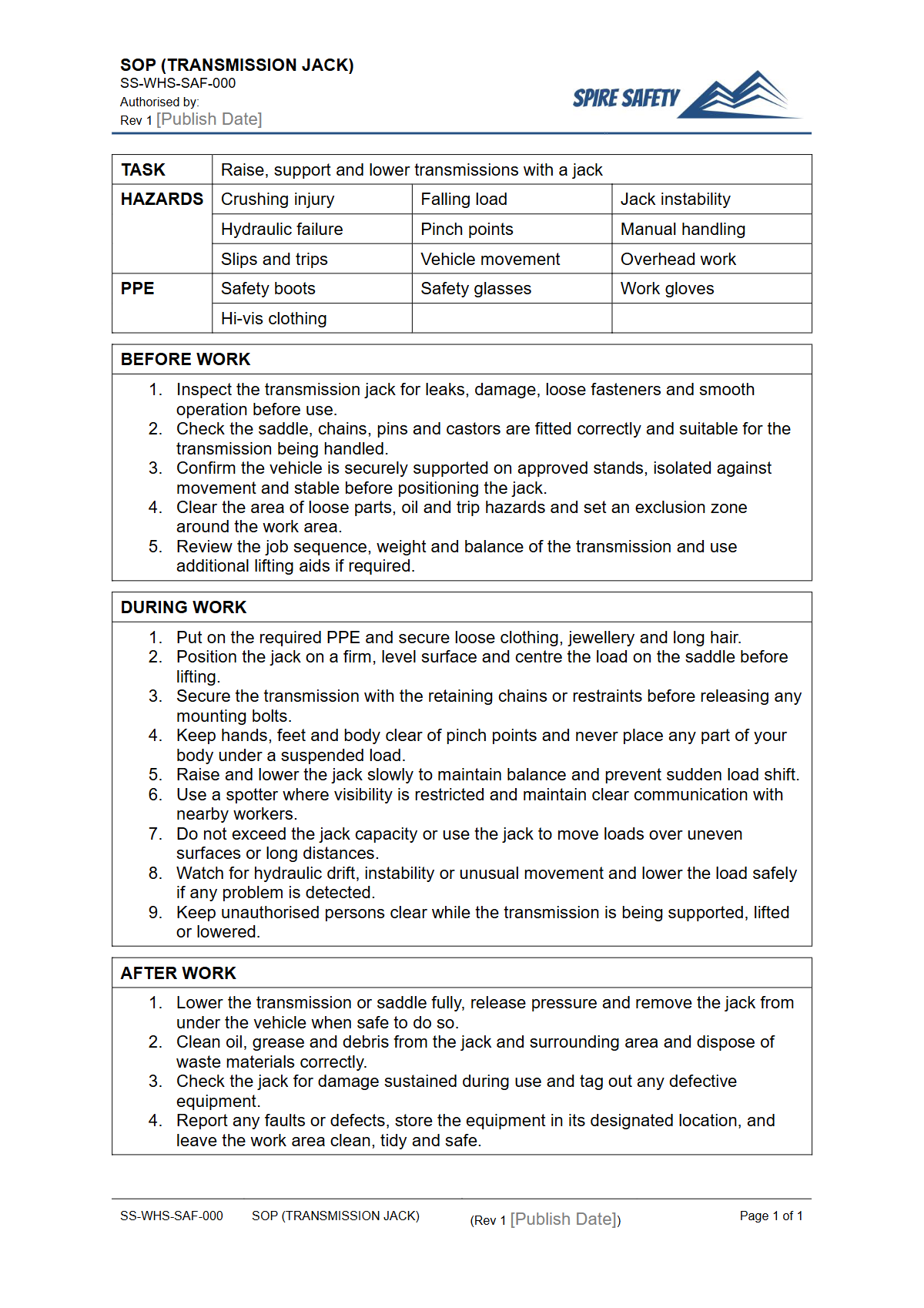
Formalise your workshop safety protocols with our free Transmission Jack Safe Operating Procedure template. Download the customisable DOCX to get started.
Free Safe Operating Procedure (Transmission Jack) Template
DOCX • 126 KB + PDF
Updated Oct 2026
No signup required
Purpose of the Free Safe Operating Procedure (Transmission Jack) Template
A transmission jack is essential for safely removing, installing, and transporting gearboxes in automotive workshops. Using this equipment without a documented process exposes workers to significant risks, including crushing injuries from dropped loads, instability, and hydraulic failure.
This Free Safe Operating Procedure (Transmission Jack) Template provides a structured framework for outlining the required steps to ensure safe operation, from pre-start checks to final shutdown.
Documenting a clear process helps your business meet its primary duty of care under Australian WHS legislation by controlling hazards associated with high-risk plant. An effective SOP serves as a vital training tool for new workers and a consistent reference for experienced operators, promoting safe work habits and reducing the likelihood of incidents. By implementing this procedure, you formalise expectations for operator behaviour, inspection routines, and emergency responses, integrating them into your broader WHS management system.
Video walkthrough
How to use the Free Safe Operating Procedure (Transmission Jack) Template
This template is available as a fully editable DOCX file, designed to be adapted to your specific operational context. Download the file and begin by filling in the site-specific details, such as company name, location, and the individuals responsible for authorising and reviewing the document.
Walk through each section, from 'Required PPE' to 'Step-by-Step Procedures', and modify the content to match the exact make and model of the transmission jacks used on your site, as well as the unique environmental conditions of your workshop.
It is crucial to remember that this is a template. We recommend you consult with operators and supervisors to ensure the steps accurately reflect practical, on-the-ground tasks.
Once customised, the SOP should be used as a key part of your worker training and induction program. We also suggest you review and update all your safe operating procedures as part of regular WHS compliance auditing activities, especially after an incident or when new equipment is introduced.
When to use a Safe Operating Procedure
An SOP for a transmission jack should be developed and implemented before the equipment is ever used. It forms the basis of all training and competency assessments for operators.
The procedure must be readily accessible to workers in the areas where the jack is used, serving as a constant reference for safe work practices.
This document is particularly important during high-risk tasks like removing or installing a heavy transmission, where the risk of component slippage or jack instability is highest. It should also be consulted during routine maintenance and inspection activities.
Standardising procedures for all workshop equipment is best practice; for instance, tasks involving compressed air should be governed by a document like our free Air Compressor SOP template to ensure consistency in your safety approach.
In complex repair jobs that may involve fabrication or cutting, other procedures must be followed in conjunction with this one. For example, if any hot work is required near the vehicle, a specific FREE Oxy Acetylene SOP (Safe Operating Procedure) Template would need to be in place to manage fire and explosion hazards. You can find more templates for common plant and equipment in our free WHS resources library.
Who should use this document
This Safe Operating Procedure should be used by several key groups within your organisation:
- PCBU/Employers: To fulfil their legal obligation to provide and maintain a safe system of work.
- Managers and Supervisors: To train workers, enforce safe practices, and conduct safety observations and incident investigations.
- Workers/Operators: As a guide for performing their tasks safely and consistently, and as a reference for pre-operational checks and emergency procedures.
- WHS Professionals: To integrate into the overall safety management system, use during risk assessments, and to establish a baseline for workplace inspections and audits.
Successfully implementing and maintaining a culture of safety around workshop equipment requires clear documentation and consistent application. If your organisation needs assistance developing and rolling out a suite of customised SOPs, our WHS consulting team can provide expert support tailored to your business needs.
Common mistakes
Common mistakes to avoid
- Exceeding the jack's specified safe working load (SWL).
- Using the jack on soft, uneven, or sloping ground, leading to instability.
- Failing to properly secure the transmission to the jack's saddle with chains or straps.
- Moving a raised load over long distances or rough surfaces instead of lowering it first.
Legal references
Legal considerations
The following legal requirements may be relevant to this type of work.
- Work Health and Safety Act (Harmonised) — Provides the primary duties for protecting workers and other people from work health and safety risks.
- Work Health and Safety Regulations (Harmonised) — Sets out requirements supporting the management of workplace hazards and risks.
The following codes may be relevant to this type of work.
- Managing WHS Risks Code of Practice — Provides practical guidance on identifying hazards, assessing risks and applying effective controls.
- Work Health and Safety Consultation, Cooperation and Coordination Code of Practice — Provides practical guidance on consulting workers and coordinating with other duty holders.
- Managing the Work Environment and Facilities Code of Practice — Provides practical guidance on safe work environments, workplace facilities and related controls.
Did you know
Designed for Instability
Transmission jacks are specifically engineered to handle the awkward shape and unbalanced centre of gravity of a gearbox. Unlike a standard floor jack, their saddles are designed to securely cradle the transmission to prevent it from tipping during removal or installation.
Hydraulic vs. Mechanical Failure
A sudden loss of hydraulic pressure can cause a load to drop without warning. This is why many procedures forbid working under a load supported only by hydraulics and mandate the use of mechanical locks or supports as a secondary failsafe.
FAQ
Frequently asked questions
01What are the main hazards of using a transmission jack?
02Is a Safe Operating Procedure legally required for a transmission jack in Australia?
03How often should a transmission jack be inspected?
04Who is authorised to operate a transmission jack?
Share this resource
Free Safe Operating Procedure (Transmission Jack) Template
Browse Categories
How To Use It
- 1Download and open in Word or PDF.
- 2Replace the placeholders with your business details.
- 3Get it reviewed by a WHS specialist before rollout.
Need it customised?
Our WHS consultants can adapt this template to your site, run a gap analysis, or audit what you already have in place.
Book a Free Consultation WHS consulting servicesor call 1300 156 382
Related templates
- Free Safe Operating Procedure (Transmission Oil Change) Template
- Free Safe Operating Procedure (Transport Yard Cleanup) Template
- Free Safe Operating Procedure (Trash Pump) Template
- Free Safe Operating Procedure (Tray Clearing) Template
- Free Safe Operating Procedure (Tray Return Handling) Template
- Free Safe Operating Procedure (Tray Sealer) Template