
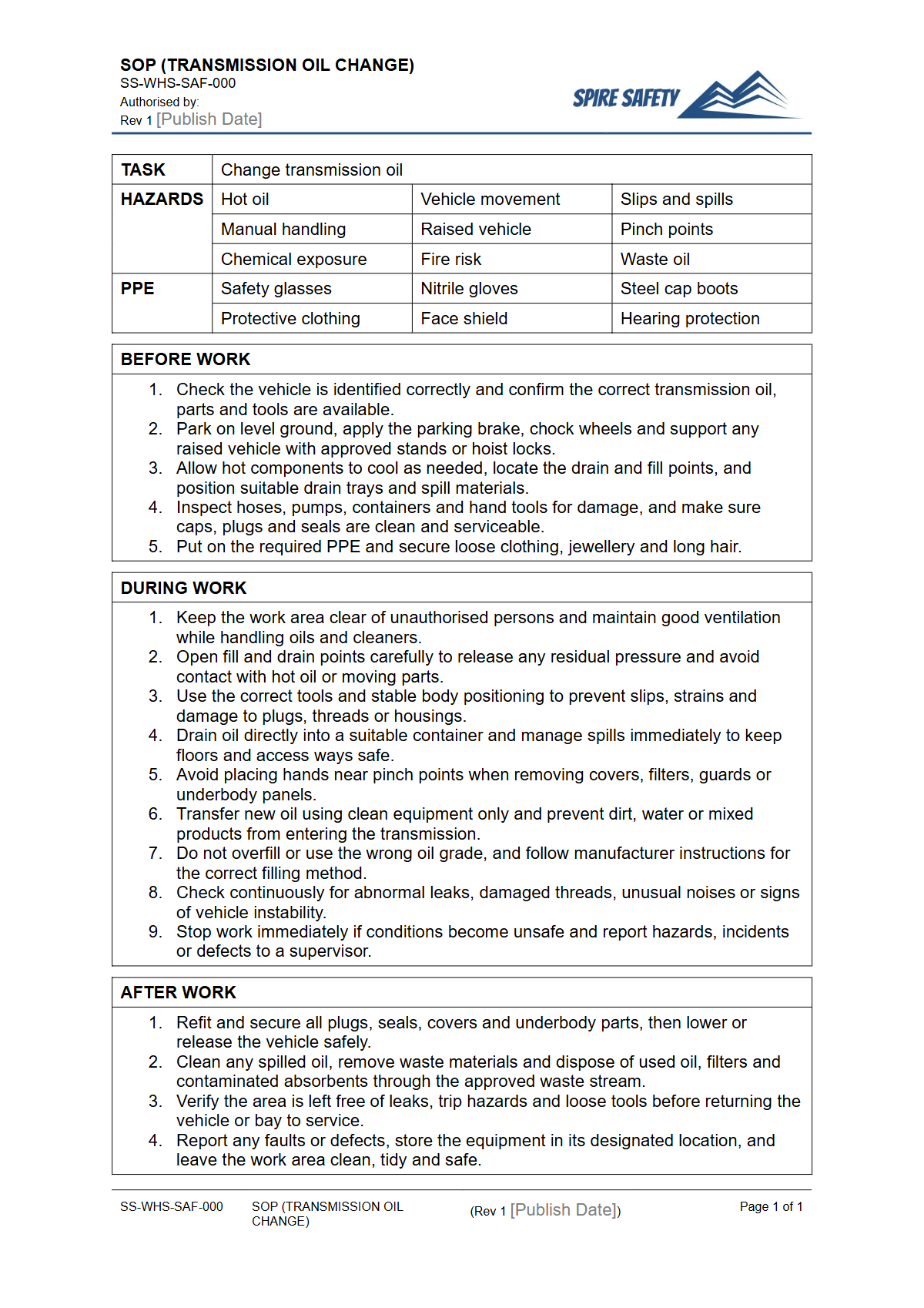
Free Safe Operating Procedure (Transmission Oil Change) Template
Download our Free Safe Operating Procedure for Transmission Oil Change to formalise your maintenance tasks.
Free Safe Operating Procedure (Transmission Oil Change) Template
DOCX • 126 KB + PDF
Updated Oct 2026
No signup required
Purpose of the Free Safe Operating Procedure (Transmission Oil Change) Template
Changing transmission oil is a common maintenance task, but it carries significant risks if not performed correctly. This Free Safe Operating Procedure (Transmission Oil Change) Template provides a structured framework for documenting the safe steps required to complete the job.
Using a formal SOP helps standardise your process, reducing the risk of injuries from crushing, burns from hot components, chemical exposure from fluids, and environmental contamination from spills. It serves as an essential tool for training new mechanics and reinforcing safe work practices for experienced personnel, ensuring everyone follows a consistent, risk-assessed method.
By clearly outlining potential hazards, required Personal Protective Equipment (PPE), and emergency procedures, the SOP becomes a critical part of your overall safety management. It supports a proactive safety culture by moving beyond informal knowledge to a documented, reviewable process.
Integrating this procedure is a key component of building a robust WHS management system, demonstrating a commitment to worker safety and operational excellence. This document helps ensure that every transmission service is performed with safety as the primary consideration.
Video walkthrough
How to use the Free Safe Operating Procedure (Transmission Oil Change) Template
This downloadable document is provided in both DOCX and PDF formats. The DOCX file is fully editable, allowing you to tailor it specifically to the vehicles, equipment, and environmental conditions at your workplace.
It is crucial to adapt the content to reflect your site-specific hazards and control measures. The template includes sections for outlining responsibilities, listing required PPE, detailing the step-by-step process, and outlining waste disposal and emergency response protocols. For related workshop activities, you may also find value in our Free Air Compressor SOP.
Important: This is a template, not a finished document. To be effective, you must customise it to your specific operational context.
We recommend a competent person, such as a senior mechanic or WHS advisor, leads a review involving the workers who actually perform the task. This collaborative approach ensures the final SOP is practical, accurate, and reflects the real-world challenges of the job.
Once finalised, the SOP should be used for training and be readily accessible to all relevant workers.
When to use it
A Safe Operating Procedure for a transmission oil change should be used in several key situations. It is essential during the induction and training of new employees or apprentices to ensure they learn the correct, safe method from the outset.
It should also be used as a refresher for existing staff to prevent complacency and bad habits from developing. The SOP is a valuable reference tool before starting the task, especially if it is performed infrequently.
Furthermore, the SOP should be reviewed and referenced after any incident or near miss related to vehicle maintenance to identify gaps in the procedure. It can also be used as a basis for workplace inspections and observations to verify that safe work practices are being followed consistently.
The effectiveness of such procedures can be verified through WHS compliance auditing, ensuring they remain relevant and are actively used by your team.
Who should use it
This template is designed for a range of personnel within organisations that service or maintain vehicles and heavy machinery. Workshop managers and supervisors can use it to establish and enforce a benchmark for safe work.
Mechanics and maintenance technicians are the primary end-users, following the procedure to guide their work and ensure their own safety and that of their colleagues. This is especially true when dealing with specialised equipment covered by documents like our scraper SOP template.
Work Health and Safety (WHS) officers and consultants will find the template useful as a starting point for developing comprehensive safety documentation for their clients or organisation. It can also be used by trainers and assessors to structure competency-based training programs.
Ultimately, anyone responsible for the safety and management of vehicle maintenance operations will benefit from implementing a detailed SOP like this one. For other high-risk tasks, you can explore our Oxy Acetylene SOP or browse our complete free WHS resources library for more templates.
Common mistakes
Common mistakes to avoid
- Working under a vehicle supported only by a jack, without using certified jack stands.
- Incorrect handling or disposal of waste oil, leading to environmental contamination and fines.
- Failing to clean and inspect the drain plug and surrounding area, causing leaks after the job is complete.
- Using the wrong type or amount of transmission fluid, which can cause serious damage to the transmission.
Legal references
Legal considerations
The following legal requirements may be relevant to this type of work.
- Work Health and Safety Act (Harmonised) — Provides the primary duties for protecting workers and other people from work health and safety risks.
- Work Health and Safety Regulations (Harmonised) — Sets out requirements supporting the management of workplace hazards and risks.
The following codes may be relevant to this type of work.
- Managing WHS Risks Code of Practice — Provides practical guidance on identifying hazards, assessing risks and applying effective controls.
- Work Health and Safety Consultation, Cooperation and Coordination Code of Practice — Provides practical guidance on consulting workers and coordinating with other duty holders.
- Managing the Work Environment and Facilities Code of Practice — Provides practical guidance on safe work environments, workplace facilities and related controls.
Did you know
Hidden Contaminants
Used automotive fluids, including transmission oil, can contain heavy metals like lead and cadmium that accumulate during use. Proper handling and PPE are essential to prevent exposure to these toxic substances.
Spills are a Major Hazard
Slips, trips, and falls are one of the leading causes of injury in automotive workshops. A small amount of spilled transmission fluid can create a significant slip hazard, making spill control and cleanup a critical safety step.
FAQ
Frequently asked questions
01What PPE is required for a transmission oil change?
02How do you safely dispose of used transmission oil in Australia?
03Why is a Safe Operating Procedure better than a simple checklist for this task?
04Can this SOP template be used for both manual and automatic transmissions?
Share this resource
Free Safe Operating Procedure (Transmission Oil Change) Template
Browse Categories
How To Use It
- 1Download and open in Word or PDF.
- 2Replace the placeholders with your business details.
- 3Get it reviewed by a WHS specialist before rollout.
Need it customised?
Our WHS consultants can adapt this template to your site, run a gap analysis, or audit what you already have in place.
Book a Free Consultation WHS consulting servicesor call 1300 156 382
Related templates
- Free Safe Operating Procedure (Transport Yard Cleanup) Template
- Free Safe Operating Procedure (Trash Pump) Template
- Free Safe Operating Procedure (Tray Clearing) Template
- Free Safe Operating Procedure (Tray Return Handling) Template
- Free Safe Operating Procedure (Tray Sealer) Template
- Free Safe Operating Procedure (Tray Washing) Template