
Free Safe Operating Procedure (Trash Pump) Template
Download our free Safe Operating Procedure for trash pumps to outline safety steps and controls. Start documenting your site-specific work methods today.
Free Safe Operating Procedure (Trash Pump) Template
DOCX • 126 KB + PDF
Updated Oct 2026
No signup required
Purpose of the Free Safe Operating Procedure (Trash Pump) Template
Operating a trash pump, whether for dewatering a construction site, managing floodwater, or transferring sludge, involves significant risks. This includes mechanical hazards from moving parts, noise exposure, manual handling strains, and potential contact with contaminated fluids.
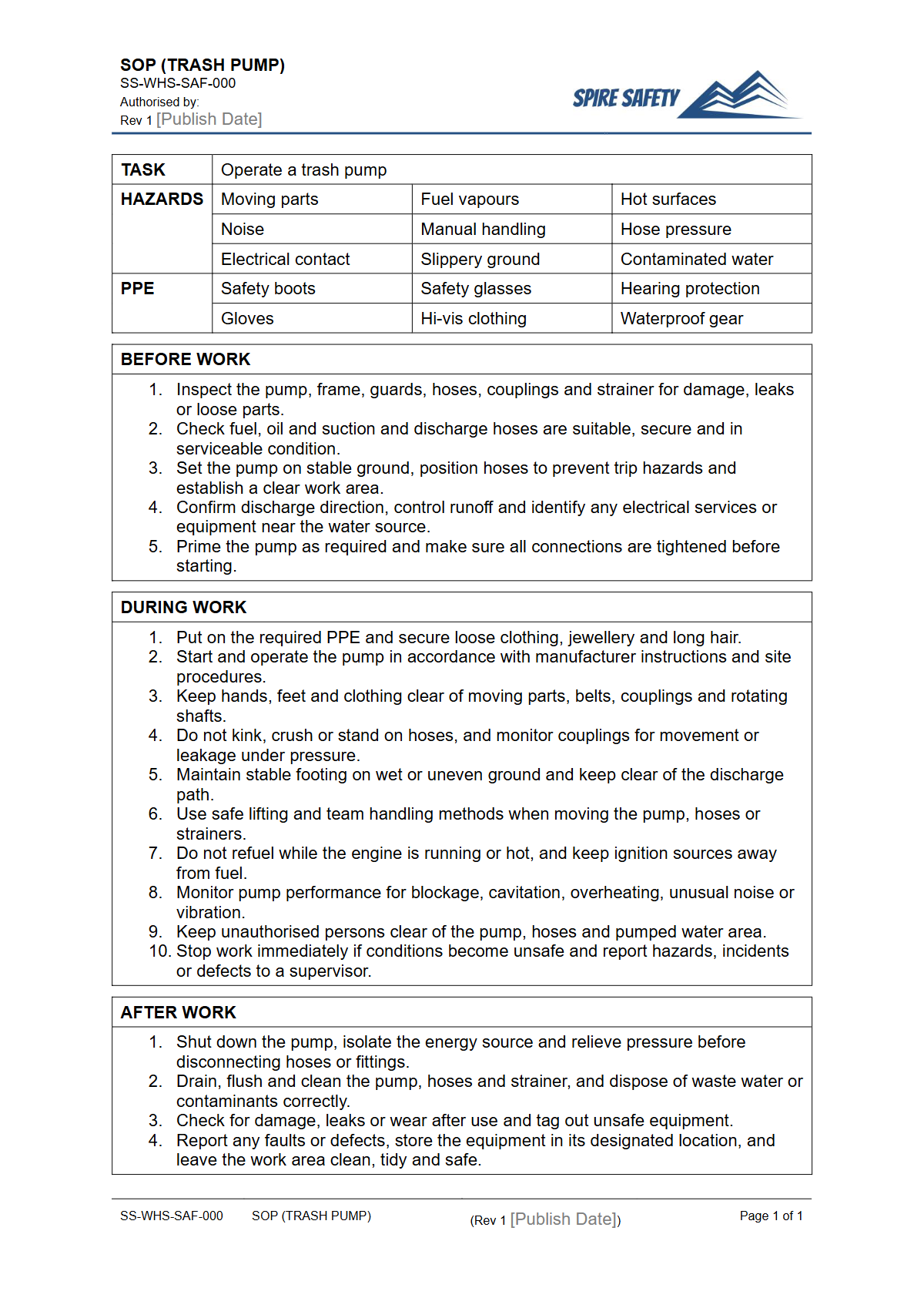
This Free Safe Operating Procedure (Trash Pump) Template provides a structured framework for documenting the specific steps required to perform this task safely. Its primary purpose is to help Persons Conducting a Business or Undertaking (PCBUs) standardise work methods, train workers, and meet their duty of care under Australian WHS laws.
A well-developed SOP is a critical component of a proactive safety culture. It transforms verbal instructions into a reliable, documented process that can be consistently applied and improved over time.
Using this template helps ensure that all potential hazards are identified, assessed, and controlled before work begins. It forms a key part of your overall safety documentation, integrating with broader WHS management systems to demonstrate a systematic approach to risk management.
Video walkthrough
How to use the Free Safe Operating Procedure (Trash Pump) Template
This template is provided in both DOCX and PDF formats for your convenience. The DOCX version is fully editable, allowing you to tailor the content to the specific make and model of trash pump used at your workplace, the environment it's used in, and your organisation's existing policies.
A generic procedure is never enough; you must adapt it to reflect your unique operational realities. The document includes sections for pre-start checks, operational steps, shutdown procedures, and emergency responses.
Important: We have created this document as a starting point. It is essential that you consult with the pump operators, supervisors, and any health and safety representatives to ensure the final SOP is practical and comprehensive.
Your final document should be specific to your site, your equipment, and your people. While this SOP covers trash pumps, other powered equipment on site will require its own documentation, such as our Free Air Compressor SOP template.
When to use a Safe Operating Procedure
A Safe Operating Procedure for a trash pump should be developed and implemented before the equipment is ever used on site. It should be the primary reference document for any worker tasked with setting up, operating, or maintaining the pump.
It is particularly crucial in situations involving high-risk factors, such as working near open excavations, handling hazardous liquids, or operating in noisy environments. The SOP should be readily accessible to operators at all times during the work.
This procedure is vital during worker induction, onboarding, and task-specific training. It also serves as a benchmark for competency assessments and a guide for supervisors monitoring work practices.
For complex jobs, like large-scale dewatering during earthworks, this SOP should be used in conjunction with other planning documents. For instance, if the dewatering is for a trench, you may also need a FREE Trencher SOP Template to manage associated risks.
Who should use this SOP Template
This template is designed for use by safety managers, project managers, supervisors, and PCBUs who are responsible for creating and implementing workplace safety documentation. They will use this resource to draft a site-specific procedure. Once finalised, the SOP itself should be used by all personnel involved with the trash pump, including:
- Operators: Workers who physically set up, start, monitor, and shut down the pump.
- Spotters and assistants: Any worker supporting the operation, such as managing hoses or monitoring the discharge area.
- Supervisors: For monitoring compliance, conducting safety observations, and leading incident investigations.
- Maintenance personnel: To understand the safe shutdown and isolation procedures required before performing maintenance or repairs.
Ensuring that SOPs for all high-risk plant are developed and followed is a key responsibility for management. Procedures for other powerful hydraulic equipment, like those detailed in our FREE Boom Pump SOP, follow similar principles of risk control and documentation. The effectiveness of these procedures can be verified through a systematic process of WHS compliance auditing.
By customising and implementing this Safe Operating Procedure, you create a safer environment for your team and build a more robust safety system. Explore our complete free WHS resources library for more templates and guides to support your safety management efforts.
Common mistakes
Common mistakes to avoid
- Using the wrong pump type for the fluid (e.g., a dewatering pump for slurry).
- Failing to properly prime the pump before starting, which can damage the pump's seal.
- Placing the pump on unstable or uneven ground, leading to vibration and potential movement during operation.
- Neglecting to secure hoses and fittings, which can result in leaks or dangerous high-pressure blowouts.
Legal references
Legal considerations
The following legal requirements may be relevant to this type of work.
- Work Health and Safety Act (Harmonised) — Provides the primary duties for protecting workers and other people from work health and safety risks.
- Work Health and Safety Regulations (Harmonised) — Sets out requirements supporting the management of workplace hazards and risks.
The following codes may be relevant to this type of work.
- Managing WHS Risks Code of Practice — Provides practical guidance on identifying hazards, assessing risks and applying effective controls.
- Work Health and Safety Consultation, Cooperation and Coordination Code of Practice — Provides practical guidance on consulting workers and coordinating with other duty holders.
- Managing the Work Environment and Facilities Code of Practice — Provides practical guidance on safe work environments, workplace facilities and related controls.
Did you know
Pump Classification
Trash pumps are designed to handle water with hard and soft solids like mud, leaves, and twigs. Semi-trash pumps handle smaller solids, while standard dewatering pumps are only for relatively clean water.
Noise Hazard
Petrol or diesel-powered trash pumps often operate at noise levels well above the 85 dB(A) exposure standard. This makes hearing protection a critical piece of personal protective equipment for anyone working in the vicinity.
FAQ
Frequently asked questions
01What should be included in a trash pump SOP?
02Is a Safe Operating Procedure a legal requirement for trash pumps in Australia?
03How often should a trash pump SOP be reviewed?
04Who is responsible for writing a trash pump SOP?
Share this resource
Free Safe Operating Procedure (Trash Pump) Template
Browse Categories
How To Use It
- 1Download and open in Word or PDF.
- 2Replace the placeholders with your business details.
- 3Get it reviewed by a WHS specialist before rollout.
Need it customised?
Our WHS consultants can adapt this template to your site, run a gap analysis, or audit what you already have in place.
Book a Free Consultation WHS consulting servicesor call 1300 156 382
Related templates
- Free Safe Operating Procedure (Tray Clearing) Template
- Free Safe Operating Procedure (Tray Return Handling) Template
- Free Safe Operating Procedure (Tray Sealer) Template
- Free Safe Operating Procedure (Tray Washing) Template
- Free Safe Operating Procedure (Tree Basin Weeding) Template
- Free Safe Operating Procedure (Tree Climbing) Template