
Free Safe Operating Procedure (Tray Sealer) Template
Establish clear safety protocols for your food production or packaging line with our tray sealer SOP template. Download the customisable DOCX to get started.
Free Safe Operating Procedure (Tray Sealer) Template
DOCX • 126 KB + PDF
Updated Oct 2026
No signup required
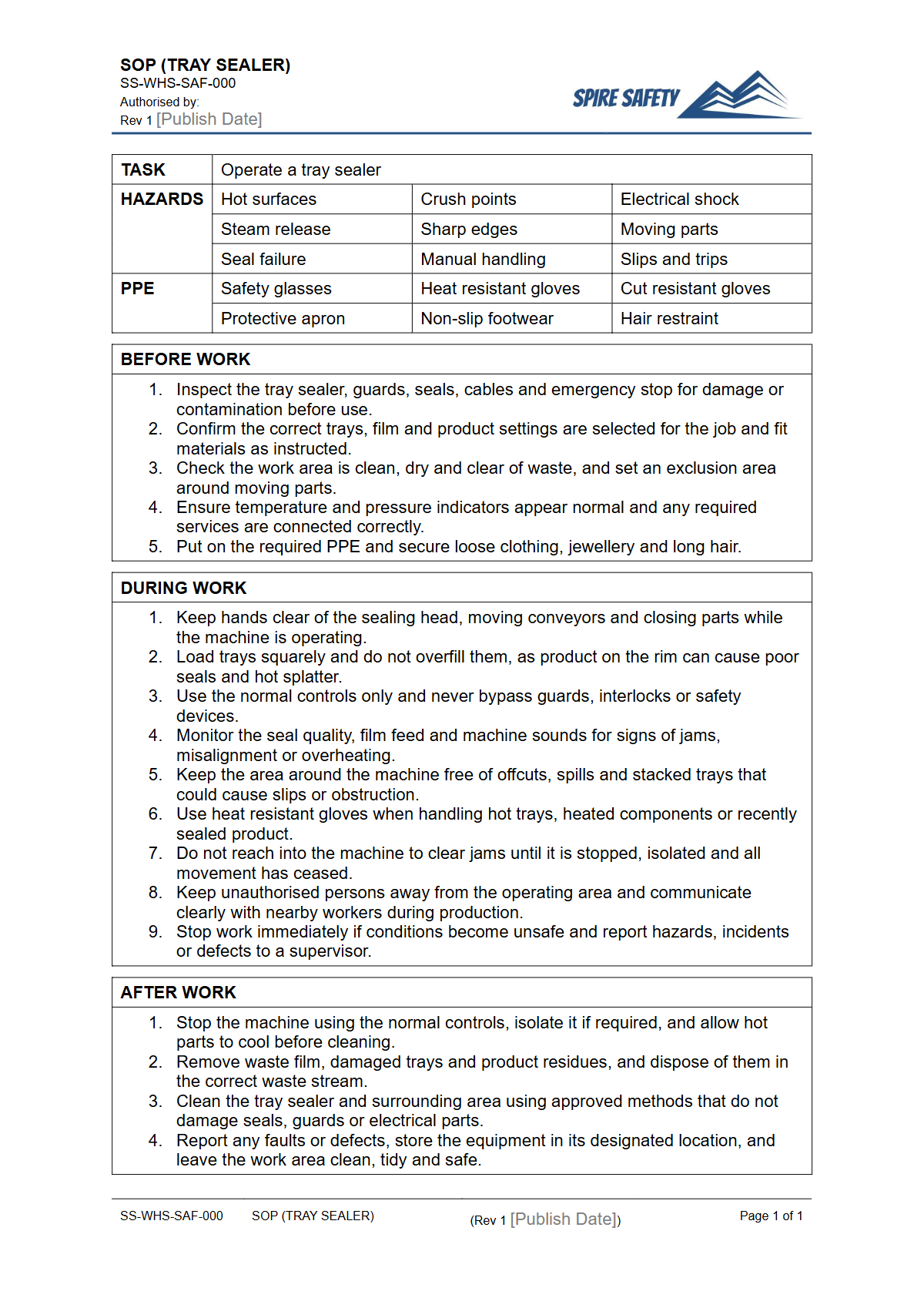
Purpose of the Free Safe Operating Procedure (Tray Sealer) Template
A tray sealer is a common piece of equipment in food manufacturing, hospitality, and packaging industries, but it presents significant hazards if not used correctly. This Free Safe Operating Procedure (Tray Sealer) Template provides a structured framework for documenting the safe use of your specific machine.
It helps you formally outline step-by-step instructions to control risks such as severe burns from heated sealing elements, cuts from film cutting blades, crushing injuries from moving parts, and electrical hazards. By implementing a clear SOP, you establish a consistent, safe method for all operators, reducing the likelihood of incidents and injuries.
A well-drafted Safe Operating Procedure serves as a critical training tool and a reference point for workers. It formalises your risk control measures, ensuring that safety is integrated into the operational workflow.
This is particularly important for equipment used across different shifts or by multiple team members. For similar equipment in a food preparation environment, you might also require documents like our Safe Operating Procedure for deep fryers to ensure comprehensive safety coverage.
Video walkthrough
How to use the Free Safe Operating Procedure (Tray Sealer) Template
This resource is provided in both DOCX and PDF formats. We recommend using the DOCX file to add, remove, and modify the content to suit your specific workplace.
Your SOP must accurately reflect the make and model of the tray sealer in use, the specific tasks operators perform, the required Personal Protective Equipment (PPE), and the emergency shutdown and cleaning procedures relevant to your site. Generic procedures are not sufficient to meet your WHS obligations.
Please note: This document is a template and must be customised to reflect the specific equipment, chemicals, and processes used in your workplace. We recommend a competent person reviews and validates the final SOP before implementation.
If you require assistance in developing site-specific documentation, our team provides expert WHS consulting to help tailor solutions for your business.
When to use a Safe Operating Procedure
A Safe Operating Procedure for a tray sealer should be a living document, integrated into your daily operations. It is essential during the induction and training of new employees to ensure they understand the correct and safe way to operate the machinery from day one.
It should also be used for refresher training to prevent complacency and reinforce safe work habits among experienced staff. Furthermore, the SOP must be reviewed and updated whenever a new model of tray sealer is introduced, if the process changes, or following any incident or near miss involving the equipment.
This ensures the procedure remains relevant and effective.
Integrating SOPs into your daily workflow is a cornerstone of proactive safety management. These documents are not just for training; they should be readily accessible near the equipment for quick reference.
This practice supports the development of robust WHS management systems by embedding safety directly into operational tasks.
Who should use this Tray Sealer SOP
This template is designed for use by Persons Conducting a Business or Undertaking (PCBUs), managers, supervisors, and WHS professionals. It is the PCBU's responsibility to ensure safe systems of work are in place, and this SOP is a tool to help fulfil that duty.
Supervisors should use the finalised document to train and oversee workers, ensuring the specified procedures are followed consistently. Operators are the end-users who must understand and adhere to the SOP to protect themselves and their colleagues from harm.
By involving operators in the customisation and review process, you can capture practical insights and improve user buy-in, making the procedure more effective. In many production facilities, tray sealers are integrated into a larger packaging line. To manage associated risks, consider implementing procedures for adjacent equipment, such as our Conveyer System SOP.
Key Elements of a Tray Sealer Safe Operating Procedure
A comprehensive SOP for a tray sealer should cover the entire lifecycle of its use. Our template prompts you to detail several critical areas:
- Pre-Operational Checks: This section outlines the safety inspections that must be completed before starting the machine. This includes verifying that all guards are in place and functional, checking the condition of the power cord, ensuring emergency stop buttons are accessible and working, and confirming the sealing area is clear of foreign objects.
- Step-by-Step Operating Instructions: This core section details the sequence for safely operating the machine. It covers loading film, placing trays, initiating the sealing cycle, and removing the finished product. Instructions should be clear, concise, and unambiguous.
- Shutdown and Cleaning Procedures: Documenting the correct shutdown sequence is vital for safety. This section should also include specific instructions for cleaning, emphasising lockout-tagout (LOTO) procedures to ensure the machine is de-energised and cannot be started accidentally during maintenance or cleaning tasks. Many production lines also rely on other powered equipment, and managing their operational safety with documents like our free Air Compressor SOP is equally important.
By thoroughly completing each section, you create a holistic safety document that addresses all foreseeable risks associated with the equipment. You can find this and many other templates in our free WHS resources library to help build out your safety documentation.
Common mistakes
Common mistakes to avoid
- Using a generic SOP template without customising it for the specific make and model of the tray sealer.
- Failing to adequately train all operators on the finalised SOP, especially casual or new staff.
- Neglecting to include lockout-tagout (LOTO) procedures for cleaning and maintenance tasks.
- Forgetting to review and update the SOP after a near miss, incident, or change in process.
Legal references
Legal considerations
The following legal requirements may be relevant to this type of work.
- Work Health and Safety Act (Harmonised) — Provides the primary duties for protecting workers and other people from work health and safety risks.
- Work Health and Safety Regulations (Harmonised) — Sets out requirements supporting the management of workplace hazards and risks.
The following codes may be relevant to this type of work.
- Managing WHS Risks Code of Practice — Provides practical guidance on identifying hazards, assessing risks and applying effective controls.
- Work Health and Safety Consultation, Cooperation and Coordination Code of Practice — Provides practical guidance on consulting workers and coordinating with other duty holders.
- Managing the Work Environment and Facilities Code of Practice — Provides practical guidance on safe work environments, workplace facilities and related controls.
Did you know
Sealing Temperatures
The sealing heads on industrial tray sealers can reach temperatures well over 150°C to create an effective seal. Contact with these surfaces, even for a moment, can cause severe burns, highlighting the need for strict operating procedures and guarding.
Machinery Injuries
According to Safe Work Australia, machinery and fixed plant are leading causes of serious injury claims in the manufacturing industry. Implementing detailed SOPs is a critical control measure to prevent these incidents.
FAQ
Frequently asked questions
01What is a Safe Operating Procedure for a tray sealer?
02Are Safe Operating Procedures legally required in Australia?
03How often should a tray sealer SOP be reviewed?
04Who is responsible for writing a tray sealer SOP?
Share this resource
Free Safe Operating Procedure (Tray Sealer) Template
Browse Categories
How To Use It
- 1Download and open in Word or PDF.
- 2Replace the placeholders with your business details.
- 3Get it reviewed by a WHS specialist before rollout.
Need it customised?
Our WHS consultants can adapt this template to your site, run a gap analysis, or audit what you already have in place.
Book a Free Consultation WHS consulting servicesor call 1300 156 382
Related templates
- Free Safe Operating Procedure (Tray Washing) Template
- Free Safe Operating Procedure (Tree Basin Weeding) Template
- Free Safe Operating Procedure (Tree Climbing) Template
- Free Safe Operating Procedure (Tree Guard Installation) Template
- Free Safe Operating Procedure (Tree Hand Pruning) Template
- Free Safe Operating Procedure (Tree Mulching) Template