
Free Safe Operating Procedure (Tree Hand Pruning) Template
Download our free Safe Operating Procedure for tree hand pruning. This template helps document safety controls for arboricultural tasks. Get your DOCX today.
Free Safe Operating Procedure (Tree Hand Pruning) Template
DOCX • 126 KB + PDF
Updated Oct 2026
No signup required
Purpose of the Free Safe Operating Procedure (Tree Hand Pruning) Template
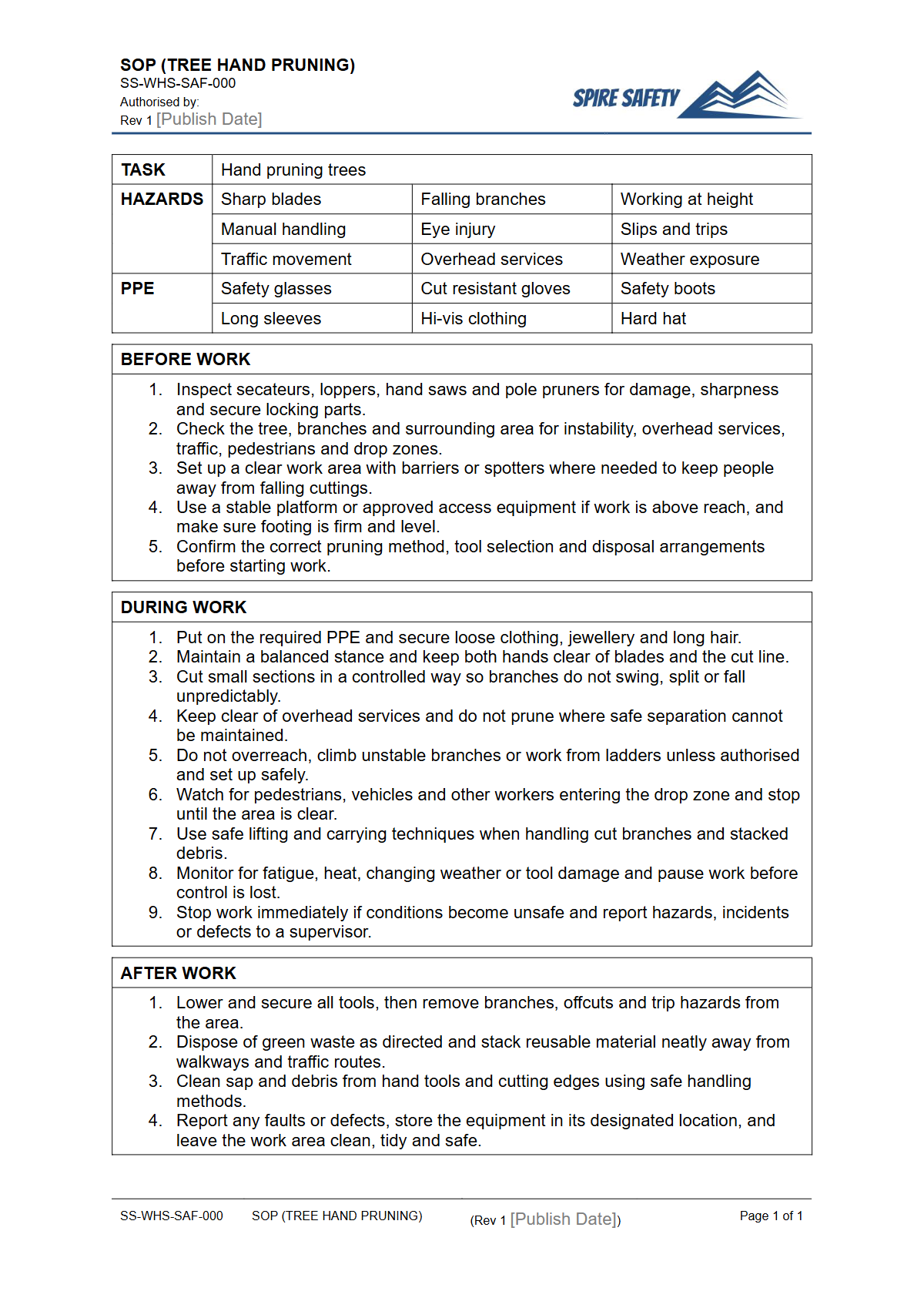
This Free Safe Operating Procedure (Tree Hand Pruning) Template provides a structured framework for documenting the safety requirements for pruning trees and large shrubs using hand tools. Hand pruning, while seemingly straightforward, carries risks such as cuts, sprains, falls, and eye injuries.
A well-defined SOP helps your organisation manage these risks by outlining a consistent, safe method for every worker to follow. Implementing a formal procedure promotes a strong safety culture, minimises the likelihood of incidents, and forms a key component of your overall WHS management system.
Video walkthrough
How to Use the Free Safe Operating Procedure (Tree Hand Pruning) Template
To effectively use this template, you must adapt it to the specific context of your workplace. It is not a complete, ready-to-use document.
Start by downloading the DOCX file and adding your company logo and details. Then, conduct a thorough risk assessment for your specific hand pruning tasks, considering the types of trees, the tools used (secateurs, loppers, pruning saws), and the work environment (e.g., working at heights, on uneven ground).
Your documented controls should reflect these unique hazards, similar to how our Circular Saw SOP template details specific guards and operational checks. We have designed this resource as a starting point; your final SOP must reflect your specific operational risks and control measures.
When to Use a Tree Hand Pruning SOP
A Safe Operating Procedure for tree hand pruning should be used before any such work commences. It is an essential document for worker inductions, pre-start meetings, and refresher training sessions.
It should be readily accessible to all personnel involved in the task, whether they are full-time employees or contractors. Having a documented procedure is particularly critical for high-risk scenarios, such as pruning near power lines (requiring specific controls), working on ladders or elevated work platforms, or handling diseased plant material that may pose a biological hazard.
Who Should Use This SOP Template
This template is designed for use by Persons Conducting a Business or Undertaking (PCBUs), including business owners, managers, and safety officers in industries like landscaping, arboriculture, horticulture, and grounds maintenance. It is the PCBU's responsibility to ensure safe systems of work are in place.
Team leaders and supervisors should use the finalised SOP to train and supervise workers, ensuring the documented procedures are followed correctly. Performing regular checks on procedural adherence can be a key part of your safety assurance program, which can be verified through a formal WHS compliance audit.
Key Elements to Customise in Your SOP
- Required PPE: Specify the exact type of gloves (e.g., cut-resistant), safety glasses or goggles, sturdy footwear, and any head protection required.
- Pre-operational Checks: Detail the inspection process for all hand tools. Checks should include sharpness, cleanliness, and the integrity of handles and locking mechanisms.
- Step-by-Step Procedure: Clearly outline the safe sequence of work, from assessing the tree and work area to making the final cut and cleaning up. Include instructions on proper cutting techniques to prevent tool slippage and worker injury.
- Specific Hazards & Controls: Address risks unique to your sites, such as uneven ground, public access areas, overhead electrical lines, or insect/animal habitats within the tree. This process mirrors the hazard identification needed for other hazardous tasks, like those covered in an Oxy Acetylene SOP.
- Emergency Procedures: Document the response for common incidents, including cuts, falls from height, eye injuries, and contact with hazardous fauna like snakes or wasps.
Maintaining and Reviewing Your Procedure
An SOP is a living document that requires regular review to remain effective. It should be reviewed whenever there is a change to the task, equipment, or work environment.
Furthermore, it must be reviewed after any incident or near-miss to identify and correct any procedural gaps. Best practice, as outlined in the model WHS framework, suggests a periodic review schedule (e.g., every 1-2 years) even if no changes have occurred.
For businesses with diverse operations, managing a library of SOPs for various tasks, such as those covered in our FREE Trencher SOP Template, requires a systematic approach to version control and updates. You can find many more templates to build out your safety documentation in our free WHS resources library.
Common mistakes
Common mistakes to avoid
- Using the template without site-specific risk assessment and customisation.
- Failing to mandate and check for appropriate PPE, especially cut-resistant gloves and eye protection.
- Neglecting to train workers on the specific procedures outlined in the SOP.
- Not including clear emergency procedures for cuts, falls, or contact with venomous creatures.
Legal references
Legal considerations
The following legal requirements may be relevant to this type of work.
- Work Health and Safety Act (Harmonised) — Provides the primary duties for protecting workers and other people from work health and safety risks.
- Work Health and Safety Regulations (Harmonised) — Sets out requirements supporting the management of workplace hazards and risks.
The following codes may be relevant to this type of work.
- Managing WHS Risks Code of Practice — Provides practical guidance on identifying hazards, assessing risks and applying effective controls.
- Work Health and Safety Consultation, Cooperation and Coordination Code of Practice — Provides practical guidance on consulting workers and coordinating with other duty holders.
- Managing the Work Environment and Facilities Code of Practice — Provides practical guidance on safe work environments, workplace facilities and related controls.
Did you know
Ergonomic Risk
Repetitive hand pruning with poorly maintained or blunt tools significantly increases the risk of musculoskeletal disorders (MSDs), such as tendonitis and carpal tunnel syndrome.
Fall from Height
According to Safe Work Australia, falls from height remain a leading cause of fatalities and serious injuries, making ladder and platform safety a critical part of any pruning procedure.
FAQ
Frequently asked questions
01What should be included in a Safe Operating Procedure for hand pruning?
02Is a Safe Operating Procedure legally required for tree pruning in Australia?
03Who is responsible for creating and implementing an SOP for tree pruning?
04How often should an SOP for hand pruning be reviewed?
Share this resource
Free Safe Operating Procedure (Tree Hand Pruning) Template
Browse Categories
How To Use It
- 1Download and open in Word or PDF.
- 2Replace the placeholders with your business details.
- 3Get it reviewed by a WHS specialist before rollout.
Need it customised?
Our WHS consultants can adapt this template to your site, run a gap analysis, or audit what you already have in place.
Book a Free Consultation WHS consulting servicesor call 1300 156 382
Related templates
- Free Safe Operating Procedure (Tree Mulching) Template
- Free Safe Operating Procedure (Tree Pit Cleaning) Template
- Free Safe Operating Procedure (Tree Planting) Template
- Free Safe Operating Procedure (Tree Rigging) Template
- Free Safe Operating Procedure (Tree Root Zone Mulching) Template
- Free Safe Operating Procedure (Tree Stake Installation) Template