
Free Safe Operating Procedure (Tree Stake Installation) Template
Streamline your safety process with our free Safe Operating Procedure for tree stake installation. Download the customisable template to get started today.
Free Safe Operating Procedure (Tree Stake Installation) Template
DOCX • 126 KB + PDF
Updated Oct 2026
No signup required
Purpose of the Free Safe Operating Procedure (Tree Stake Installation) Template
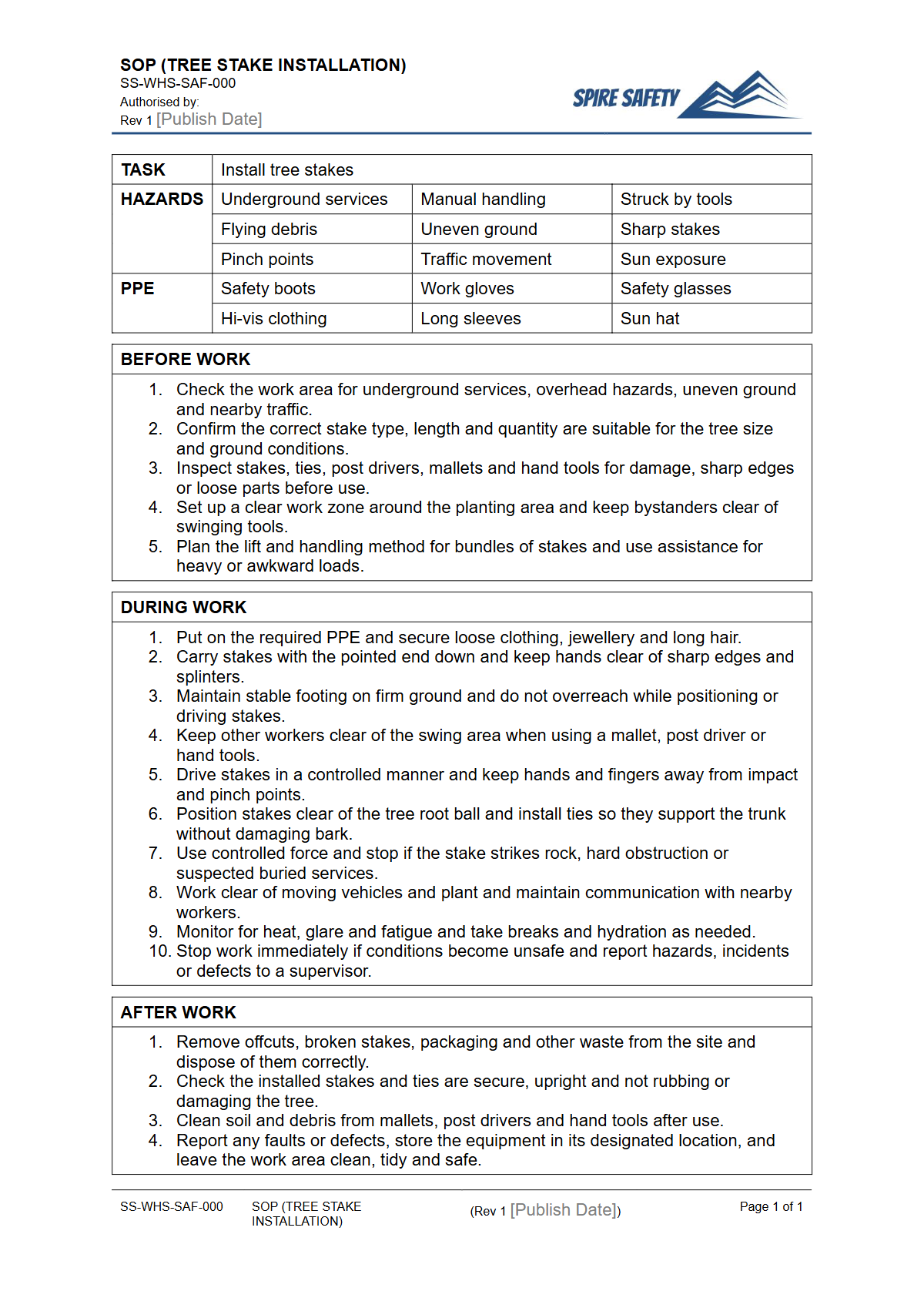
Installing tree stakes is a common task in landscaping, horticulture, and civil works, but it involves manual handling and striking hazards that can lead to serious injuries if not managed correctly. This free Safe Operating Procedure (Tree Stake Installation) template provides a structured framework for documenting the safest way to perform this task.
It helps organisations standardise their approach, manage WHS risks, and provide clear, step-by-step instructions to workers. Using a formal Safe Operating Procedure (SOP) is a fundamental part of demonstrating due diligence and fostering a proactive safety culture.
This document is designed to be a key component of your overall safety management system, ensuring that all personnel are aware of the required equipment, potential hazards, and the control measures needed to work safely. It serves as an excellent tool for training, inductions, and ongoing competency assessments.
Video walkthrough
How to use the Free Safe Operating Procedure (Tree Stake Installation) Template
This downloadable resource is a template, not a finished document. To make it effective, you must customise it to reflect the specific circumstances of your workplace.
Follow these steps:
- Download the DOCX file and add your company name, logo, and other relevant details.
- In consultation with your workers, identify the specific tools used at your site (e.g., specific sledgehammer weight, type of stake, post driver).
- Conduct a site-specific risk assessment to identify all potential hazards, including ground conditions, proximity to traffic, and underground services.
- Detail the step-by-step procedure from pre-operational checks to cleanup, ensuring the instructions are clear and easy to follow.
- List the required Personal Protective Equipment (PPE), such as steel-capped boots, gloves, and eye protection.
- Outline your site's emergency procedures and contacts.
Important: We have developed this template as a starting point. Your organisation is responsible for ensuring the final document is tailored to your unique operational environment and integrated into your robust WHS management systems to be effective.
Key Hazards in Tree Stake Installation
A thorough risk assessment should precede any work. Common hazards associated with installing tree stakes include:
- Manual Handling: Lifting and carrying heavy stakes, repetitive hammering, and awkward postures can lead to musculoskeletal injuries.
- Striking Hazards: Inaccurate swings with a sledgehammer or mallet can result in injury to the operator or nearby personnel. Mallet heads can also detach if equipment is poorly maintained.
- Slips, Trips, and Falls: Uneven ground, discarded materials, and poor housekeeping create significant trip hazards.
- Underground Services: Driving stakes into the ground without knowing what lies beneath risks striking electrical cables, water pipes, or gas lines. Always 'Dial Before You Dig'.
- Foreign Bodies in Eyes: Splinters from wooden stakes or debris from the ground can cause eye injuries, particularly when hammering.
If stakes need to be cut or modified on-site, additional risks are introduced. Ensure you have procedures for related tasks by using resources like our FREE Circular Saw SOP Template.
Implementing Effective Risk Controls
Based on the identified hazards, your SOP should detail specific control measures. The hierarchy of controls should guide your decisions. For example:
- Substitution: Where feasible, use a mechanical or petrol-powered post driver instead of a sledgehammer to reduce manual handling strain and striking hazards.
- Engineering Controls: Ensure the work area is clearly demarcated with barriers or cones to keep unauthorised personnel out of the swing zone.
- Administrative Controls: This SOP is itself an administrative control. Other controls include providing proper training on safe hammering techniques, implementing job rotation to reduce repetitive strain, and ensuring workers check for underground services before starting. For larger landscaping projects, a free Trencher SOP Template may also be necessary to formalise procedures for associated earthmoving tasks.
- Personal Protective Equipment (PPE): Mandate the use of appropriate PPE, such as high-impact safety glasses, protective gloves, long sleeves and pants, and steel-capped safety boots.
When to use a Safe Operating Procedure for Tree Stake Installation
An SOP for this task should be used consistently as a reference and training tool. It is particularly important to refer to it:
- During the induction and training of new employees or contractors.
- Before starting work in a new location with different ground conditions.
- As a guide for pre-start meetings or toolbox talks to review risks.
- During incident investigations to understand if procedures were followed.
- As part of a periodic review cycle (typically annually) to ensure it remains current.
For organisations managing diverse agricultural or landscaping equipment, this SOP can work alongside others, like a free Spreader SOP Template, to build a comprehensive safety library.
Who should use it
This template is designed for use by a range of personnel within an organisation, including:
- Persons Conducting a Business or Undertaking (PCBUs): To meet their primary duty of care to provide safe systems of work.
- WHS Managers and Safety Officers: To develop, implement, and review workplace safety documentation.
- Supervisors and Team Leaders: To train their teams, supervise the work, and ensure procedures are followed correctly on the ground.
- Workers: As a clear guide on how to perform their tasks safely and consistently.
If your business lacks the in-house expertise to adapt this template or develop a comprehensive safety system, consider engaging specialist WHS consulting services for tailored support. You can find this and many other resources in our complete free WHS resources library.
Common mistakes
Common mistakes to avoid
- Using a sledgehammer that is too heavy for the operator, leading to poor control and strain.
- Failing to inspect tools like mallets and hammers for cracks or loose heads before use.
- Not assessing ground conditions, including stability and the presence of underground services.
- Working too close to other personnel, creating a risk of being struck by the tool or stake.
Legal references
Legal considerations
The following legal requirements may be relevant to this type of work.
- Work Health and Safety Act (Harmonised) — Provides the primary duties for protecting workers and other people from work health and safety risks.
- Work Health and Safety Regulations (Harmonised) — Sets out requirements supporting the management of workplace hazards and risks.
The following codes may be relevant to this type of work.
- Managing WHS Risks Code of Practice — Provides practical guidance on identifying hazards, assessing risks and applying effective controls.
- Work Health and Safety Consultation, Cooperation and Coordination Code of Practice — Provides practical guidance on consulting workers and coordinating with other duty holders.
- Managing the Work Environment and Facilities Code of Practice — Provides practical guidance on safe work environments, workplace facilities and related controls.
Did you know
Manual Handling Impact
According to Safe Work Australia, manual handling injuries account for a significant portion of all serious workers' compensation claims. A well-documented SOP is a key administrative control to mitigate these common and costly risks.
Underground Dangers
Striking underground assets is a major risk when driving stakes. The 'Dial Before You Dig' service is a free national referral service that provides plans for underground pipes and cables, helping prevent damage and injury.
FAQ
Frequently asked questions
01What are the most common hazards when installing tree stakes?
02Is a Safe Operating Procedure legally required for installing tree stakes in Australia?
03How often should an SOP for tree stake installation be reviewed?
04What PPE is generally required for tree stake installation?
Share this resource
Free Safe Operating Procedure (Tree Stake Installation) Template
Browse Categories
How To Use It
- 1Download and open in Word or PDF.
- 2Replace the placeholders with your business details.
- 3Get it reviewed by a WHS specialist before rollout.
Need it customised?
Our WHS consultants can adapt this template to your site, run a gap analysis, or audit what you already have in place.
Book a Free Consultation WHS consulting servicesor call 1300 156 382
Related templates
- Free Safe Operating Procedure (Tree Watering Bag) Template
- Free Safe Operating Procedure (Tree Watering) Template
- Free Safe Operating Procedure (Tree Winch) Template
- Free Safe Operating Procedure (Trellis Installation) Template
- Free Safe Operating Procedure (Trellis Maintenance) Template
- Free Safe Operating Procedure (Trestle Platform) Template