
Free Safe Operating Procedure (Tree Winch) Template
Formalise safety protocols for tree felling and removal with our free Safe Operating Procedure (Tree Winch) template. Download the customisable DOCX or PDF now.
Free Safe Operating Procedure (Tree Winch) Template
DOCX • 126 KB + PDF
Updated Oct 2026
No signup required
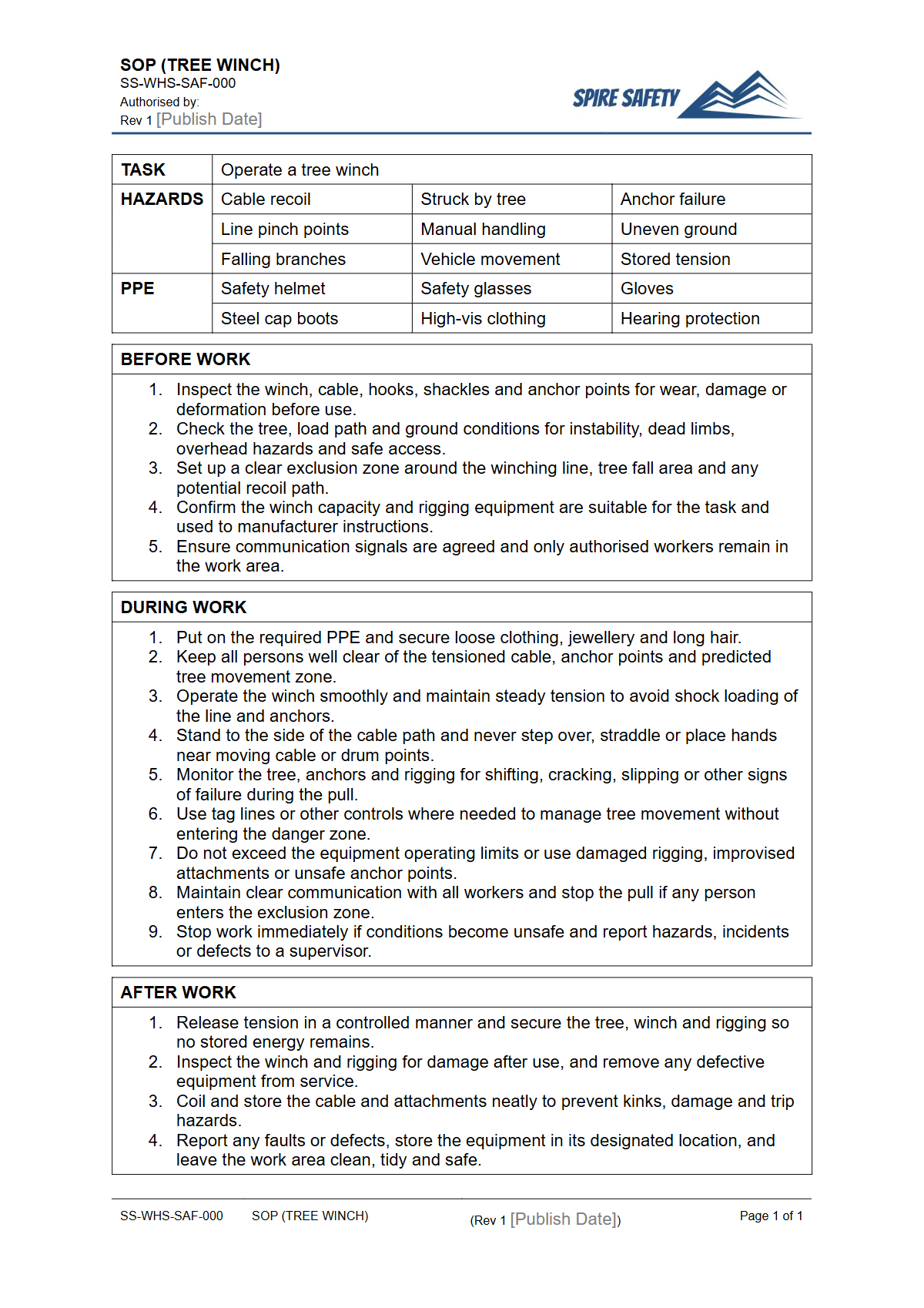
Purpose of the Free Safe Operating Procedure (Tree Winch) Template
Operating a tree winch involves significant risks, including equipment failure, improper rigging, and the unpredictable behaviour of falling or moving trees. This free Safe Operating Procedure (Tree Winch) template provides a structured starting point for your business to formalise its safety protocols for these high-risk tasks.
By documenting a clear, step-by-step process, you can systematically identify hazards, assess risks, and implement effective control measures. A well-developed SOP is a critical tool for ensuring every tree winching operation is planned and executed with the highest regard for worker safety.
This document guides users through pre-operational checks, site assessment, defining exclusion zones, correct anchoring and rigging techniques, communication protocols, and emergency response. It is designed to be adapted into a practical tool that helps meet your safety obligations and promote a consistent, safe approach to tree winching across all teams and projects.
Ultimately, this SOP helps embed safety into your operational culture, reducing the likelihood of incidents and injuries. Implementing this procedure is a key part of your broader WHS management systems, demonstrating a proactive commitment to risk management.
Video walkthrough
How to use the Free Safe Operating Procedure (Tree Winch) Template
Simply download the template in your preferred format—DOCX for easy editing or PDF for straightforward printing and distribution. This document is a foundational template, not a finished, document.
To make it effective and relevant, you must customise it to reflect the specific circumstances of your workplace.
This involves:
- Identifying the specific models of winches, cables, ropes, and rigging equipment your teams use.
- Assessing the unique environmental conditions and types of terrain where you operate.
- Incorporating feedback from your experienced operators and ground crew who perform the work.
- Aligning the procedure with your state or territory’s specific WHS regulations and codes of practice.
We strongly recommend consulting with your workers during the customisation process. Their hands-on experience is invaluable for creating a practical and effective procedure that people will actually use.
Once finalised, the SOP should be used as a primary document for training and competency verification.
When to use a Tree Winch SOP
A Safe Operating Procedure for tree winching should be a constant reference point for your operations. It is not a document to be filed away and forgotten.
It should be actively used in several key situations, including before any tree winching task is commenced to guide the setup and risk assessment process. It is an essential resource during the induction and training of new employees who will be involved in tree felling or removal operations.
The SOP should also be used for regular refresher training to ensure established safety standards are maintained over time. Furthermore, it serves as an on-site guide for supervisors and workers to consult, reinforcing correct methods and sequences.
Following a near-miss or incident, the SOP should be reviewed as part of the investigation to identify any gaps or areas for improvement. This continuous use ensures it remains a living document that actively contributes to workplace safety, much like similar procedural documentation for other equipment, such as our free Telehandler SOP template.
Who should use it
This SOP template is intended for a broad range of personnel within any organisation that performs arboricultural or land-clearing work. Persons Conducting a Business or Undertaking (PCBUs) and company directors can use it to fulfil their duty of care by ensuring a formalised, safe system of work is in place.
WHS managers and safety officers will find it an essential tool for developing, implementing, and monitoring safety protocols.
Site supervisors and team leaders are responsible for ensuring the procedures are followed on the ground and that all workers are competent to perform their tasks. Finally, the winch operators and ground crew are the primary end-users.
The SOP gives them clear, unambiguous instructions on how to perform their work safely, empowering them to identify and control hazards effectively. Adherence to these documented procedures is often a key focus of regular WHS compliance auditing.
While this SOP is specific to winching, the principles of documenting safe procedures apply to all equipment used on site. Consistency is key, and you should ensure clear instructions are available for all plant and tools, including those covered in documents like our FREE Circular Saw SOP Template.
Effective site management also requires considering how different operations interact. For example, tree winching on a site where groundwork is also occurring means coordinating activities to prevent new hazards from emerging.
This might require additional documentation, such as a free Trencher SOP template for any excavation work. For more templates and safety resources, you can browse our complete free WHS resources library.
Common mistakes
Common mistakes to avoid
- Failing to establish and enforce a sufficiently large exclusion zone around the operation.
- Using an anchor point (tree, vehicle, or ground anchor) that is not strong enough for the load.
- Neglecting to inspect winch cables, ropes, shackles, and slings for wear, damage, or corrosion before each use.
- Side-pulling a load at a sharp angle, which can damage the winch and cause the cable to spool unevenly and bind.
Legal references
Legal considerations
The following legal requirements may be relevant to this type of work.
- Work Health and Safety Act (Harmonised) — Provides the primary duties for protecting workers and other people from work health and safety risks.
- Work Health and Safety Regulations (Harmonised) — Sets out requirements supporting the management of workplace hazards and risks.
The following codes may be relevant to this type of work.
- Managing WHS Risks Code of Practice — Provides practical guidance on identifying hazards, assessing risks and applying effective controls.
- Work Health and Safety Consultation, Cooperation and Coordination Code of Practice — Provides practical guidance on consulting workers and coordinating with other duty holders.
- Managing the Work Environment and Facilities Code of Practice — Provides practical guidance on safe work environments, workplace facilities and related controls.
Did you know
The Danger Zone
A winch rope or cable under tension stores an enormous amount of kinetic energy. If it breaks or a connection fails, it can whip back with enough force to cause fatal injuries, travelling faster than a person can react. This is why defined exclusion zones are non-negotiable.
Anchor Strength
A common mistake is underestimating the force applied to anchor points. The anchor point (e.g., another tree or a vehicle) must be able to withstand at least twice the pulling capacity of the winch to provide an adequate safety margin.
FAQ
Frequently asked questions
01What is a Safe Operating Procedure for a tree winch?
02Why is a specific SOP for tree winching so important?
03Who is responsible for developing a tree winch SOP?
04How often should a tree winch SOP be reviewed?
Share this resource
Free Safe Operating Procedure (Tree Winch) Template
Browse Categories
How To Use It
- 1Download and open in Word or PDF.
- 2Replace the placeholders with your business details.
- 3Get it reviewed by a WHS specialist before rollout.
Need it customised?
Our WHS consultants can adapt this template to your site, run a gap analysis, or audit what you already have in place.
Book a Free Consultation WHS consulting servicesor call 1300 156 382
Related templates
- Free Safe Operating Procedure (Trellis Installation) Template
- Free Safe Operating Procedure (Trellis Maintenance) Template
- Free Safe Operating Procedure (Trestle Platform) Template
- Free Safe Operating Procedure (Trommel Screen) Template
- Free Safe Operating Procedure (Truck Queue Control) Template
- Free Safe Operating Procedure (Truck Tail Lift) Template