
Free Safe Operating Procedure (Truck Tail Lift) Template
Manage the risks of using truck tail lifts with our detailed Safe Operating Procedure template. Download your free DOCX and PDF resource to get started.
Free Safe Operating Procedure (Truck Tail Lift) Template
DOCX • 126 KB + PDF
Updated Oct 2026
No signup required
Purpose of the Free Safe Operating Procedure (Truck Tail Lift) Template
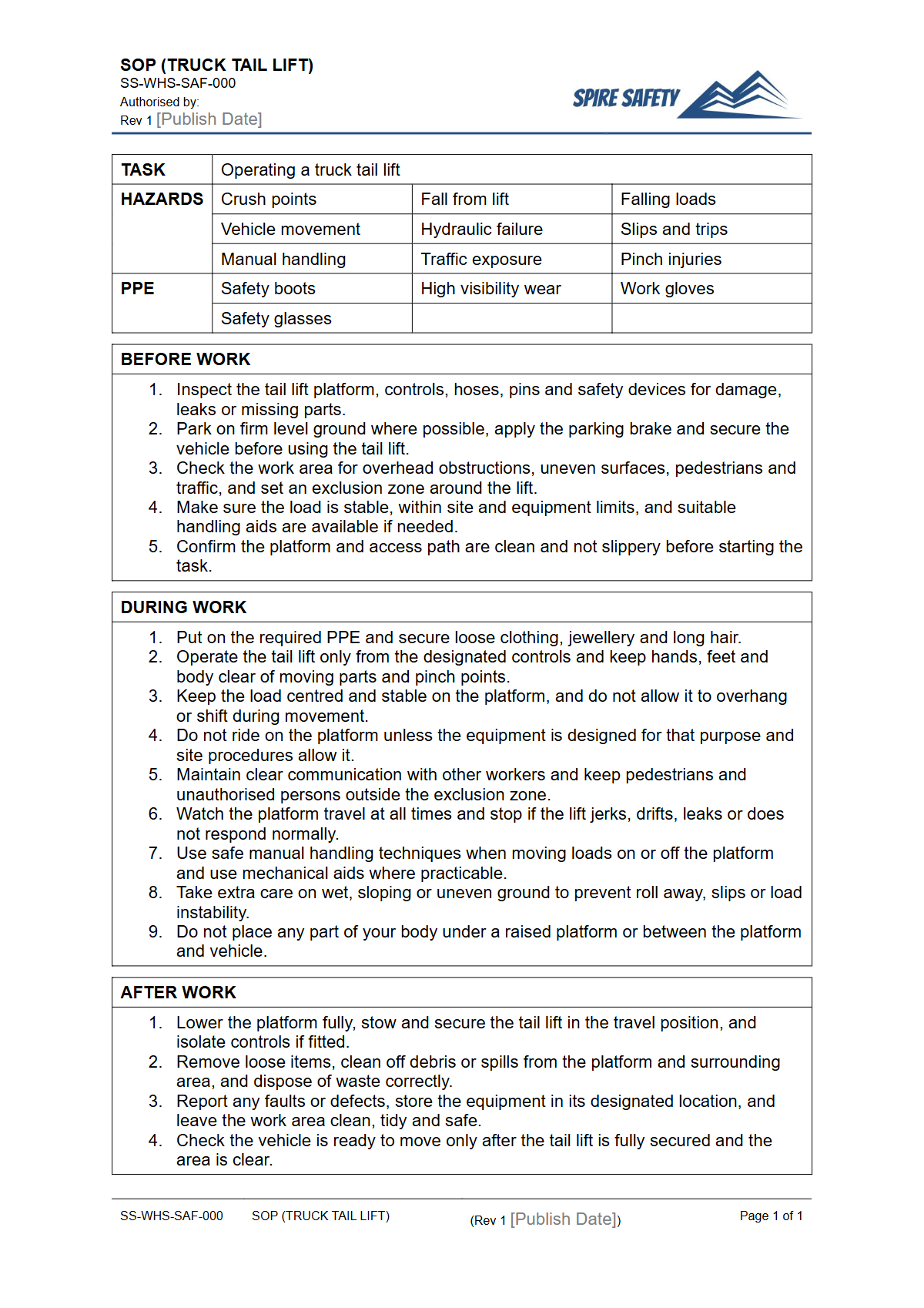
Operating a truck tail lift presents significant risks, including crushing, falls, and musculoskeletal injuries. This free Safe Operating Procedure (Truck Tail Lift) Template provides a structured framework for documenting a safe system of work, helping your organisation manage these hazards effectively.
A well-developed SOP is a critical tool for demonstrating compliance with Australian WHS duties, providing clear, step-by-step instructions to workers to ensure tasks are performed safely and consistently. It forms a foundational component of training, competency assessments, and overall risk management.
Implementing robust SOPs is a key part of developing comprehensive WHS management systems. They translate risk assessments into practical, actionable guidance for your team, ensuring safety protocols are understood and followed. This template helps formalise your processes, moving beyond verbal instructions to a documented, reviewable system that protects both workers and the business.
Video walkthrough
How to use the Free Safe Operating Procedure (Truck Tail Lift) Template
This resource is provided as a fully editable DOCX file, allowing for straightforward customisation. To use the template effectively, download the document and methodically work through each section, adapting the content to your specific operational context.
This involves detailing the exact make and model of the tail lifts in use, the types of loads being handled, and the unique environmental conditions of your worksites, such as loading docks or public spaces.
Important Customisation Note
This document is a template and is not a complete Safe Operating Procedure. You must customise it to reflect the specific truck and tail lift models used at your workplace, the types of loads handled, the operating environment, and your organisation's specific procedures.
We strongly recommend consulting with operators, supervisors, and other relevant personnel during this process to ensure the final SOP is practical and effective. If you require assistance in tailoring safety documents, consider engaging specialist WHS consulting support.
When to use this Safe Operating Procedure
A truck tail lift SOP should be a central part of your daily transport and logistics operations. It must be used as the primary reference document for training any new worker tasked with operating the equipment.
It should also be used during refresher training sessions to reinforce safe behaviours and address any complacency. Furthermore, this document serves as a vital reference tool for supervisors conducting safety observations and for investigators analysing the root causes of an incident or near miss. For vehicles where the tail lift is an integrated part, this SOP should be used alongside the broader Safe Operating Procedure for a body truck.
Who should use it
This SOP template is designed for use by a range of personnel within an organisation. Persons Conducting a Business or Undertaking (PCBUs) and managers can use it to fulfil their duty of care by establishing a formal safe work method.
WHS managers and safety officers will use it to standardise procedures and facilitate training. Supervisors are responsible for implementing the SOP on the ground, ensuring workers adhere to its instructions.
Finally, the operators themselves must be thoroughly familiar with the SOP, as it directly governs their safe interaction with the equipment. This is true for all vehicle classes, from smaller rigid trucks to those requiring an SOP for a heavy combination truck.
Key Hazards and Control Measures
Identifying potential hazards is the first step in creating a safe work environment. This SOP template guides you in documenting controls for common risks associated with tail lift use:
- Crushing and Pinch Points: The area between the platform and the truck body, or the platform and the ground, creates significant crush zones. Controls include marking exclusion zones, using spotters where necessary, and ensuring operators have a clear line of sight.
- Falls from Height: Operators or goods can fall from the platform edge. Controls include prohibiting personnel from riding on the platform, using trolleys or pallet jacks to move goods, and ensuring the platform surface is non-slip and free from contaminants.
- Manual Handling Injuries: Incorrectly moving heavy or awkward loads onto and off the platform can cause sprains and strains. Controls involve providing mechanical aids, training in safe lifting techniques, and respecting load weight limits.
- Mechanical or Hydraulic Failure: A sudden failure can lead to catastrophic platform collapse. Key controls are rigorous pre-start checks, adhering to a scheduled maintenance program performed by a competent person, and immediately taking faulty equipment out of service. Regular WHS compliance audits can help verify that maintenance and inspection schedules are being properly followed.
- Unsecured Loads: Goods shifting or falling during lifting or lowering can cause injury or damage. Controls include using load restraints, ensuring even weight distribution, and never exceeding the tail lift's rated capacity. In a warehouse context, this principle is just as vital as it is for an SOP for conveyor systems.
By systematically addressing these and other site-specific hazards in your customised SOP, you create a robust defence against incidents. For more templates and safety guides, feel free to browse our library of free WHS resources.
Common mistakes
Common mistakes to avoid
- Using a generic SOP without customising it for the specific tail lift model, loads, and workplace conditions.
- Failing to conduct and document pre-operational checks before the first use each day.
- Allowing personnel to ride on the tail lift platform, with or without a load.
- Overlooking the importance of regular inspection and maintenance by a competent person as per manufacturer specifications.
Legal references
Legal considerations
The following legal requirements may be relevant to this type of work.
- Work Health and Safety Act (Harmonised) — Provides the primary duties for protecting workers and other people from work health and safety risks.
- Work Health and Safety Regulations (Harmonised) — Sets out requirements supporting the management of workplace hazards and risks.
The following codes may be relevant to this type of work.
- Managing WHS Risks Code of Practice — Provides practical guidance on identifying hazards, assessing risks and applying effective controls.
- Work Health and Safety Consultation, Cooperation and Coordination Code of Practice — Provides practical guidance on consulting workers and coordinating with other duty holders.
- Managing the Work Environment and Facilities Code of Practice — Provides practical guidance on safe work environments, workplace facilities and related controls.
Did you know
Load Capacity
Most tail lift incidents are not caused by catastrophic failure, but by operators trying to lift loads that exceed the platform's safe working load, often combined with uneven weight distribution.
The Crush Zone
The space between a rising tail lift platform and the truck's body is a critical high-risk 'crush zone'. Establishing clear exclusion zones and maintaining situational awareness during operation are fundamental safety controls.
FAQ
Frequently asked questions
01What is a Safe Operating Procedure for a truck tail lift?
02Is a SOP a legal requirement in Australia for using tail lifts?
03Who needs to be trained on the truck tail lift SOP?
04How often should a tail lift SOP be reviewed?
Share this resource
Free Safe Operating Procedure (Truck Tail Lift) Template
Browse Categories
How To Use It
- 1Download and open in Word or PDF.
- 2Replace the placeholders with your business details.
- 3Get it reviewed by a WHS specialist before rollout.
Need it customised?
Our WHS consultants can adapt this template to your site, run a gap analysis, or audit what you already have in place.
Book a Free Consultation WHS consulting servicesor call 1300 156 382
Related templates
- Free Safe Operating Procedure (Truck Wash) Template
- Free Safe Operating Procedure (Tube Bender) Template
- Free Safe Operating Procedure (Tube Notcher) Template
- Free Safe Operating Procedure (Turbidity Meter) Template
- Free Safe Operating Procedure (Turf Divot Repair) Template
- Free Safe Operating Procedure (Turf Moisture Check) Template