
Free Safe Operating Procedure (Tube Bender) Template
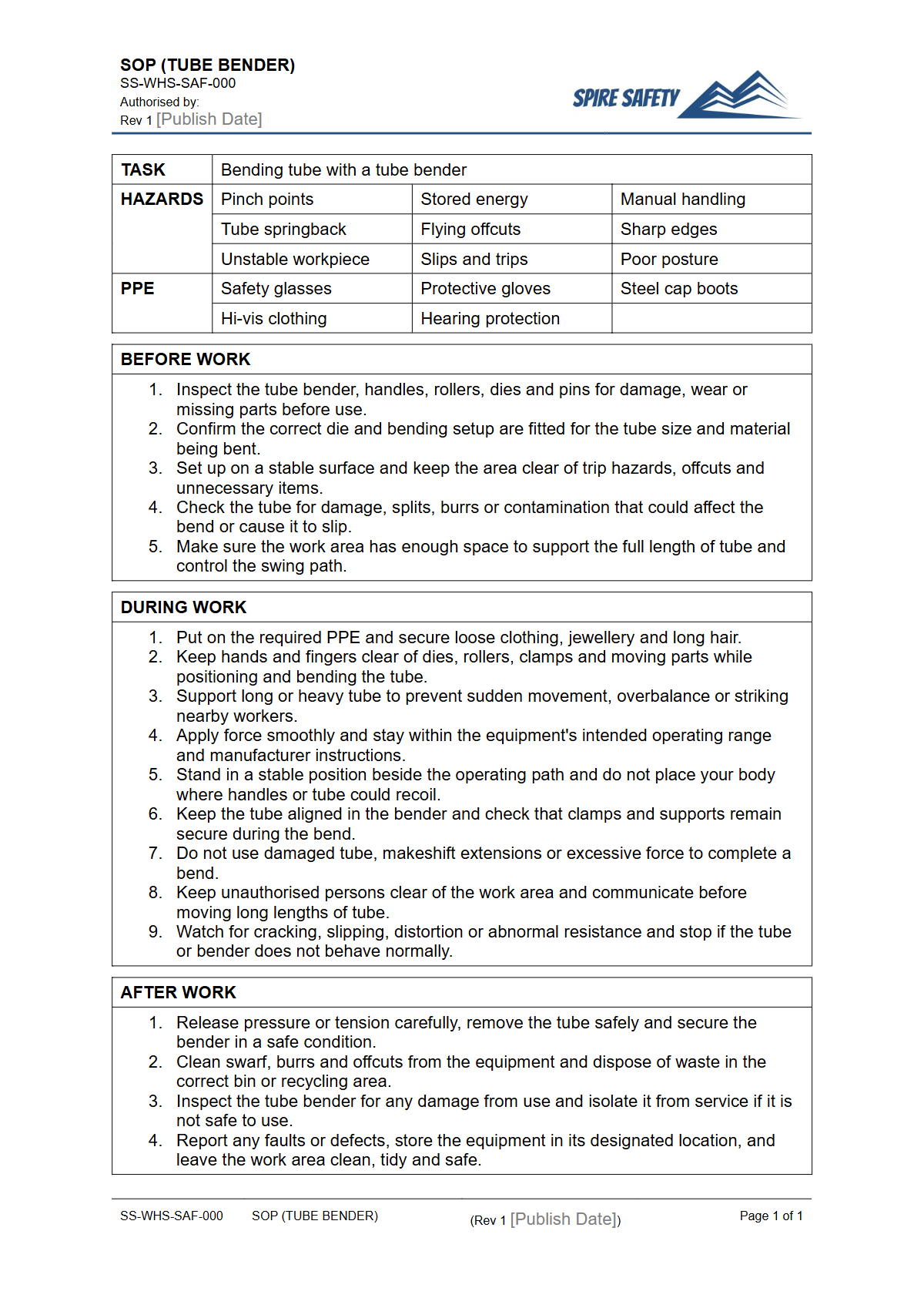
Download our Free Safe Operating Procedure (Tube Bender) Template to manage hazards associated with tube bending equipment.
Free Safe Operating Procedure (Tube Bender) Template
DOCX • 126 KB + PDF
Updated Oct 2026
No signup required
Purpose of the Free Safe Operating Procedure (Tube Bender) Template
Operating machinery like a tube bender introduces specific risks that must be controlled to ensure worker safety. This Free Safe Operating Procedure (Tube Bender) Template provides a structured starting point for your organisation to develop a comprehensive document outlining the safest way to perform this task.
An SOP formalises a safe system of work, detailing step-by-step instructions from pre-start checks to shutdown procedures. Its primary purpose is to minimise risks such as crushing, entanglement, ergonomic strain, and uncontrolled movement of materials.
By implementing a clear SOP, you establish a consistent benchmark for operator training, competency assessment, and workplace inspections. It serves as a vital tool for communicating hazards and control measures, forming a key part of your overall safety management system.
Much like a detailed circular saw SOP template helps manage risks with cutting tools, this document focuses specifically on the unique hazards of bending metal tubes and pipes.
Key Hazards of Tube Benders
Tube benders, whether manual, hydraulic, or electric, present several potential hazards. A thorough SOP should address:
- Mechanical Hazards: Moving parts, forming dies, and clamping mechanisms create significant pinch, crush, and shear points.
- Manual Handling: Lifting and positioning heavy pipes or tubes can lead to musculoskeletal injuries if not performed with correct technique or mechanical aids.
- Hydraulic/Pneumatic Hazards: High-pressure fluid or air lines can fail, leading to injection injuries or unexpected machine movement.
- Electrical Hazards: Faulty wiring, improper grounding, or lack of maintenance on electric benders can result in electric shock.
Video walkthrough
How to use the Free Safe Operating Procedure (Tube Bender) Template
This template is available for download as a DOCX file for easy editing, as well as a print-ready PDF. To use it effectively, you must adapt its contents to reflect the specific circumstances of your workplace.
A generic document is not sufficient; customisation is essential for managing your specific risks. The process should involve consulting with the workers who actually operate the equipment to ensure the procedure is practical and reflects how the work is done.
Important: This is a template only. We are not WHS consultants, and this document does not constitute legal advice.
You MUST customise this Safe Operating Procedure with your own site-specific details, including the make and model of your equipment, the specific hazards identified through your risk assessment, and your company's emergency procedures.
A well-drafted SOP is a critical element within broader WHS management systems. It demonstrates a proactive approach to safety by documenting and standardising safe work practices, making it easier to train new staff and verify ongoing competency.
When to use a Safe Operating Procedure
An SOP for a tube bender should be developed and implemented before any worker is permitted to use the equipment. It is a foundational training document for new operators and a valuable refresher for experienced staff.
The SOP should be readily accessible to all relevant personnel at all times, typically located near the machine itself.
Furthermore, the SOP should be formally reviewed and updated whenever:
- A new model of tube bender is introduced.
- The process or materials used for bending change.
- A risk assessment identifies new or previously unconsidered hazards.
- An incident, accident, or near-miss involving the tube bender occurs.
- Legislative requirements or industry best practices evolve.
Regular reviews, often conducted during internal or external WHS compliance auditing, ensure the procedure remains relevant and effective at controlling risk.
Who should use it
This Safe Operating Procedure template is designed for use by a range of personnel within an organisation:
- Managers and Supervisors: To ensure a documented, safe system of work is in place and to use as a tool for training and supervision.
- WHS/HSE Professionals: To integrate into the organisation's safety management system and use as a basis for risk assessments and incident investigations.
- Workers/Operators: As a primary reference document to understand the approved, safe method for operating the tube bender, including pre-start checks, operation, and shutdown.
Using documented procedures for high-risk equipment is a cornerstone of good safety practice. Many workshops perform a variety of fabrication tasks, each requiring its own documented procedure, such as our Oxy Acetylene SOP for hot work.
This ensures all hazardous tasks are covered. Many benders are powered by compressed air, making our Free Air Compressor SOP another relevant resource for managing associated plant risks. For more templates and checklists, browse our complete free WHS resources library.
Common mistakes
Common mistakes to avoid
- Using a generic procedure without customising it for the specific make and model of the bender.
- Failing to include detailed pre-start checks and lockout/tagout procedures for cleaning and maintenance.
- Neglecting to train operators on the specific contents of the finalised SOP and verifying their understanding.
- Not specifying the correct Personal Protective Equipment (PPE) required for the task and materials.
Legal references
Legal considerations
The following legal requirements may be relevant to this type of work.
- Work Health and Safety Act (Harmonised) — Provides the primary duties for protecting workers and other people from work health and safety risks.
- Work Health and Safety Regulations (Harmonised) — Sets out requirements supporting the management of workplace hazards and risks.
The following codes may be relevant to this type of work.
- Managing WHS Risks Code of Practice — Provides practical guidance on identifying hazards, assessing risks and applying effective controls.
- Work Health and Safety Consultation, Cooperation and Coordination Code of Practice — Provides practical guidance on consulting workers and coordinating with other duty holders.
- Managing the Work Environment and Facilities Code of Practice — Provides practical guidance on safe work environments, workplace facilities and related controls.
Did you know
Ergonomic Risk
Repetitive tasks on manual tube benders can lead to significant musculoskeletal disorders. Proper workstation design, job rotation, and mechanical aids are crucial controls to mitigate this long-term risk.
Hydraulic Power
Hydraulic tube benders can exert thousands of kilograms of force. A small leak in a high-pressure hydraulic line can inject fluid under the skin, a serious medical emergency requiring immediate attention.
FAQ
Frequently asked questions
01What hazards are associated with operating a tube bender?
02Is a Safe Operating Procedure a legal requirement for a tube bender in Australia?
03How often should a tube bender SOP be reviewed?
04Can this template be used for both manual and hydraulic tube benders?
Share this resource
Free Safe Operating Procedure (Tube Bender) Template
Browse Categories
How To Use It
- 1Download and open in Word or PDF.
- 2Replace the placeholders with your business details.
- 3Get it reviewed by a WHS specialist before rollout.
Need it customised?
Our WHS consultants can adapt this template to your site, run a gap analysis, or audit what you already have in place.
Book a Free Consultation WHS consulting servicesor call 1300 156 382
Related templates
- Free Safe Operating Procedure (Tube Notcher) Template
- Free Safe Operating Procedure (Turbidity Meter) Template
- Free Safe Operating Procedure (Turf Divot Repair) Template
- Free Safe Operating Procedure (Turf Moisture Check) Template
- Free Safe Operating Procedure (Turf Roll Handling) Template
- Free Safe Operating Procedure (Turnstile Cleaning) Template