
Free Safe Operating Procedure (Turf Roll Handling) Template
Manage risks associated with turf roll handling using our structured Safe Operating Procedure template. Download your customisable DOCX and PDF to get started.
Free Safe Operating Procedure (Turf Roll Handling) Template
DOCX • 126 KB + PDF
Updated Oct 2026
No signup required
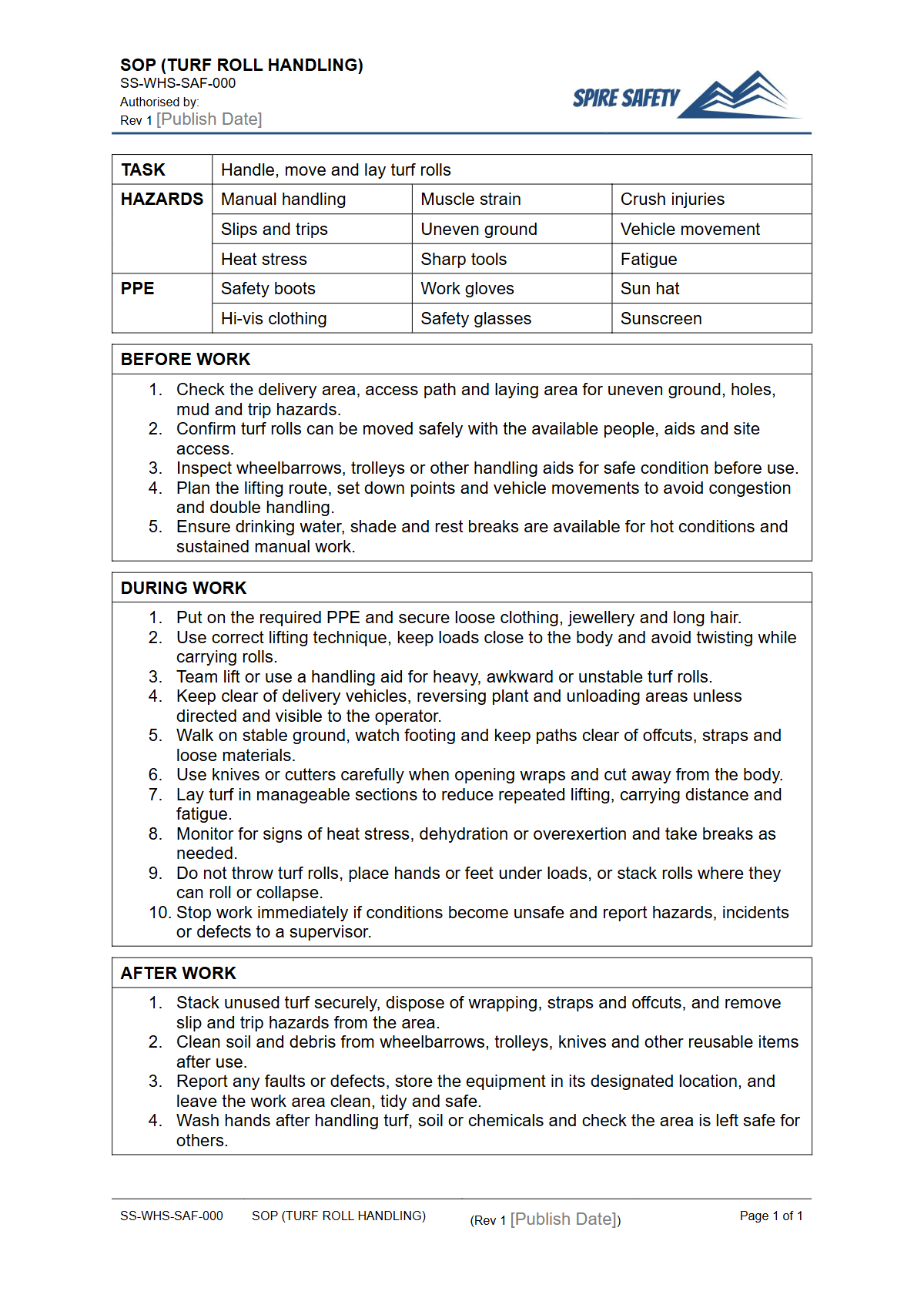
Purpose of the Free Safe Operating Procedure (Turf Roll Handling) Template
Handling large turf rolls, whether manually or with machinery, presents significant workplace health and safety risks. This Free Safe Operating Procedure (Turf Roll Handling) Template provides a structured starting point for your organisation to document a safe system of work for this common task in landscaping, agriculture, and construction.
The primary purpose of this Safe Operating Procedure is to control hazards and reduce the risk of injury to workers. Key hazards include musculoskeletal injuries from manual handling, crush injuries from moving machinery, and trips or falls on uneven terrain.
By implementing a clear, step-by-step procedure, you formalise safety expectations and provide a reliable reference for workers. A documented SOP ensures that critical safety checks, required personal protective equipment (PPE), and emergency responses are consistently applied.
Using heavy machinery like forklifts or telehandlers is common for moving large rolls. Our Telehandler SOP template provides specific guidance for that type of plant, which can be used alongside this procedure.
Video walkthrough
How to use the Free Safe Operating Procedure (Turf Roll Handling) Template
This document is a template and must be adapted to your specific workplace. Before use, you need to conduct a risk assessment to identify all relevant hazards associated with turf handling activities on your site.
The content should then be customised to reflect your unique environment, the specific types of turf and machinery used, and your existing safety protocols. An effective SOP forms a critical part of your overall WHS management systems, helping to demonstrate your commitment to a safe work environment.
To effectively use this template:
- Consult with your workers: Involve the people who perform the task. Their direct experience is invaluable for identifying practical hazards and effective control measures.
- Add site-specific details: Include details about the make and model of machinery used, specific site layouts, ground conditions, and emergency contact information.
- Train your team: Once the SOP is finalised, all relevant workers must be trained on its contents to ensure they understand the procedures before starting work.
- Review and update: The SOP should be a living document, reviewed regularly and updated after any incident or when processes or equipment change.
Important Customisation Note
This is a template document designed to serve as a starting point. We have provided a framework aligned with Australian WHS principles, but we cannot know the specific hazards of your worksite.
You MUST customise this document by incorporating your site-specific information, risk assessment findings, and control measures. Responsibility for ensuring the final document is suitable for your workplace rests with the user.
When to use a Safe Operating Procedure
A Safe Operating Procedure for turf roll handling should be used as a primary tool for training and task execution. It is particularly important to reference the SOP:
- During the induction of new employees or contractors.
- When providing refresher training for existing workers.
- Before commencing any turf handling task for the first time or after a long break.
- As a reference guide during work to ensure all steps are followed.
- During incident investigations to determine if procedures were followed.
- When planning high-risk turf installation jobs.
The SOP should be readily accessible to all workers in the area where the task is performed. It is a control measure, similar to procedures for other landscaping or earthmoving equipment, such as our Scraper SOP template.
Who should use it
This Safe Operating Procedure template is intended for use by anyone responsible for safety in workplaces where turf rolls are handled. This includes:
- Persons Conducting a Business or Undertaking (PCBUs): To meet their primary duty of care to ensure the health and safety of workers.
- Managers and Supervisors: To train workers, oversee tasks, and enforce safe work practices detailed in the procedure.
- Workers: As a guide to perform their tasks safely and correctly. They should also be involved in the development and review of the SOP.
- WHS Professionals: To assist in developing, implementing, and reviewing risk controls as part of the broader safety management system.
Regular checks or audits can verify that procedures are being followed correctly by all parties. Our WHS compliance auditing services can assist in this verification process.
Workers in these industries often operate a variety of equipment, so having clear procedures for each, like this turf handling SOP and our free Spreader SOP template, is essential for safety. For more downloadable documents, you can browse our complete free WHS resources library.
Common mistakes
Common mistakes to avoid
- Using a generic SOP without customising it for site-specific machinery and conditions.
- Failing to consult with workers who actually perform the turf handling tasks.
- Neglecting to provide practical training on the finalised SOP to all relevant employees.
- Treating the SOP as a 'set and forget' document instead of reviewing and updating it regularly.
Legal references
Legal considerations
The following legal requirements may be relevant to this type of work.
- Work Health and Safety Act (Harmonised) — Provides the primary duties for protecting workers and other people from work health and safety risks.
- Work Health and Safety Regulations (Harmonised) — Sets out requirements supporting the management of workplace hazards and risks.
The following codes may be relevant to this type of work.
- Managing WHS Risks Code of Practice — Provides practical guidance on identifying hazards, assessing risks and applying effective controls.
- Work Health and Safety Consultation, Cooperation and Coordination Code of Practice — Provides practical guidance on consulting workers and coordinating with other duty holders.
- Managing the Work Environment and Facilities Code of Practice — Provides practical guidance on safe work environments, workplace facilities and related controls.
Did you know
The Weight of Turf
A single roll of turf can weigh between 15kg and 40kg, depending on its size and moisture content. Larger commercial rolls used for sports fields can weigh over 500kg, making mechanical handling essential.
Manual Handling Injuries
According to Safe Work Australia, body stressing, which includes hazardous manual tasks, is the leading cause of serious workers' compensation claims in Australia.
FAQ
Frequently asked questions
01What are the main hazards of handling turf rolls?
02Is this turf handling SOP template enough for WHS compliance?
03Who is responsible for creating a Safe Operating Procedure for turf handling?
04How often should an SOP be reviewed?
Share this resource
Free Safe Operating Procedure (Turf Roll Handling) Template
Browse Categories
How To Use It
- 1Download and open in Word or PDF.
- 2Replace the placeholders with your business details.
- 3Get it reviewed by a WHS specialist before rollout.
Need it customised?
Our WHS consultants can adapt this template to your site, run a gap analysis, or audit what you already have in place.
Book a Free Consultation WHS consulting servicesor call 1300 156 382
Related templates
- Free Safe Operating Procedure (Turnstile Cleaning) Template
- Free Safe Operating Procedure (Turnstile Operation) Template
- Free Safe Operating Procedure (Turret Punch) Template
- Free Safe Operating Procedure (Tyre Changer) Template
- Free Safe Operating Procedure (Tyre Inflation) Template
- Free Safe Operating Procedure (Tyre Recycling Intake) Template