
Free Safe Operating Procedure (Turnstile Operation) Template
Standardise safe turnstile use in your workplace with our customisable template. Download our free Safe Operating Procedure for turnstile operation today.
Free Safe Operating Procedure (Turnstile Operation) Template
DOCX • 126 KB + PDF
Updated Oct 2026
No signup required
Purpose of the Free Safe Operating Procedure (Turnstile Operation) Template
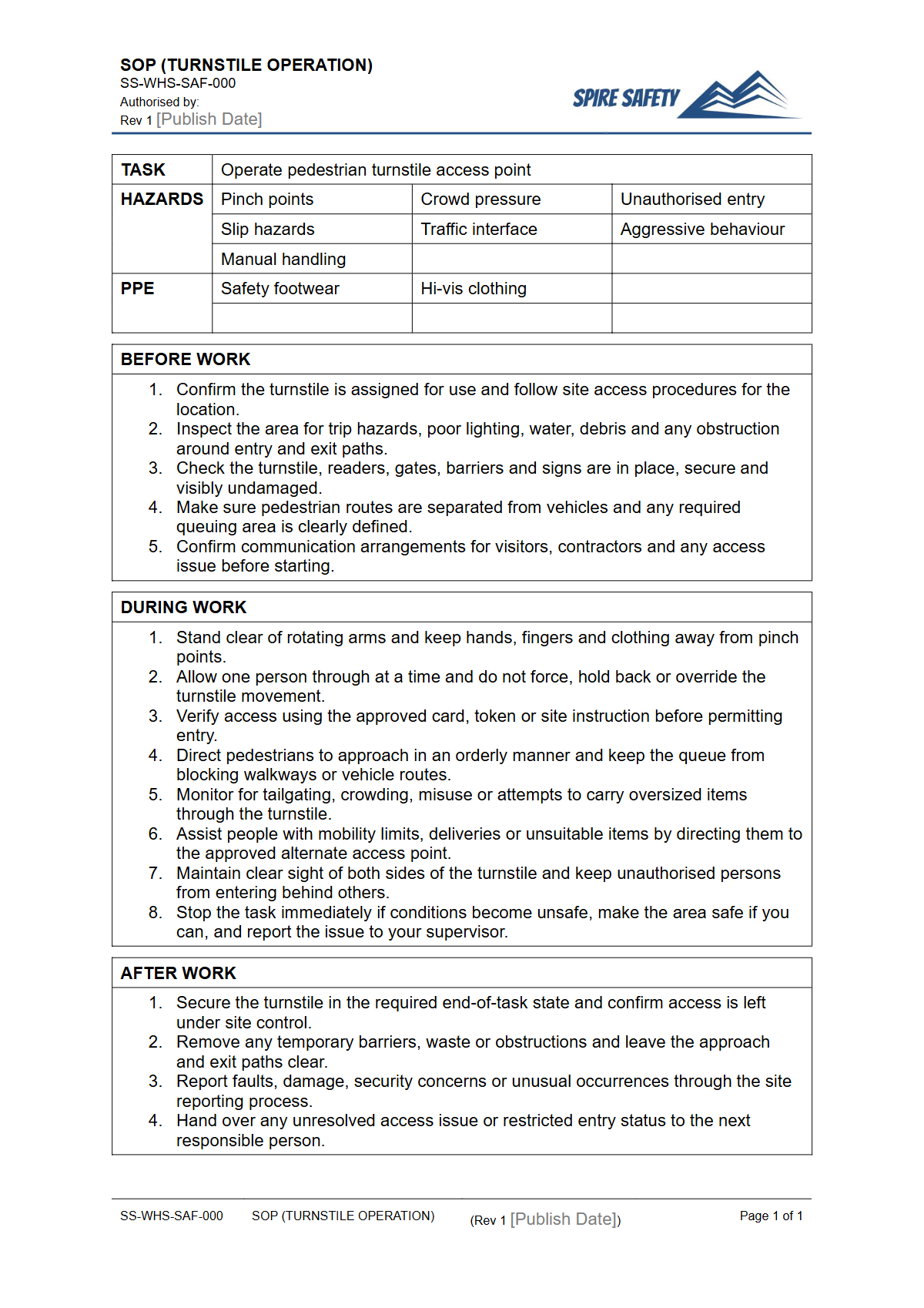
A Safe Operating Procedure (SOP) for turnstile operation provides clear, step-by-step instructions to ensure all personnel can use access control systems safely and effectively. This document is a critical tool for managing foot traffic, preventing unauthorised entry, and minimising risks associated with automated barriers, such as pinching, entrapment, or slips and falls.
Implementing a formal SOP demonstrates a commitment to workplace safety by standardising procedures for normal use, malfunctions, and emergencies. It serves as a foundational document within your broader safety framework, clarifying responsibilities and safe work expectations for everyone on site, from employees to contractors and visitors.
By documenting these processes, your organisation can streamline training, simplify incident investigations, and ensure operational consistency across different locations or shifts. This procedure forms an essential part of robust WHS management systems, helping to systematically control risks associated with site access and egress.
Video walkthrough
How to use the Free Safe Operating Procedure (Turnstile Operation) Template
Our free Safe Operating Procedure for turnstile operation is provided as a starting point. It is designed to be adapted to the specific context of your workplace, including the type of turnstiles you use (e.g., tripod, optical, full-height) and your operational environment.
To use the template effectively, download the DOCX file and begin by reviewing each section. Insert company-specific information such as site addresses, emergency contact details, and the names or positions of responsible personnel.
It is vital that you customise this document to reflect your actual processes and equipment. We are not familiar with your unique operational environment, so you must modify the template by adding details about your specific turnstile models, access control software, and site-specific emergency plans.
Once customised, this SOP can support a range of facility management tasks, much like our Free Safe Operating Procedure (Floor Scrubber Operation) Template helps standardise cleaning tasks.
When to use it
This SOP is not a one-time document; it should be integrated into your daily operations and safety management lifecycle. Key times to use and refer to the procedure include:
- New Employee and Contractor Induction: To ensure all personnel understand how to use site access systems correctly from day one.
- Refresher Training: As part of regular, scheduled safety training to reinforce correct procedures and address any complacency.
- Following an Incident: To review and improve procedures after a near miss or incident involving a turnstile.
- During Safety Audits: As evidence of a documented and implemented control measure for managing site access risks. Periodic reviews are crucial for maintaining safety standards, a process that can be validated through formal WHS compliance auditing.
- Installation of New Equipment: When new turnstiles are installed or existing ones are upgraded, the SOP must be reviewed and updated to reflect any changes in operation.
Who should use it
Various roles within an organisation have a responsibility to use or manage this Safe Operating Procedure:
- WHS Managers/Advisors: Responsible for drafting, reviewing, and updating the SOP to ensure it aligns with current legislation and best practice.
- Facility Managers and Security Personnel: Responsible for implementing the procedure, providing training, and overseeing the day-to-day operation and maintenance of the turnstiles.
- Workers, Contractors, and Visitors: Responsible for following the procedure to ensure their own safety and the safety of others when entering or exiting the site.
- Maintenance Staff: Responsible for following the specified maintenance and inspection schedules outlined within the SOP to ensure equipment remains in safe working order.
Key Elements of a Turnstile Operation Procedure
A comprehensive turnstile SOP should cover several critical areas to be effective. These elements provide users with all the information they need to interact with the system safely.
Pre-Operational Checks
Before use, particularly at the start of a shift, a quick inspection should be conducted. This includes visually checking for any physical damage, ensuring the pathway is clear of obstructions, verifying that indicator lights are working, and testing the card reader or biometric scanner to confirm it is operational.
Safe Operation Steps
This section details the core process. It should instruct users to approach one at a time, present their credentials (card, fob, or biometric data) clearly, and wait for the barrier to open fully before proceeding.
It should also forbid tailgating or attempting to force the barriers. This controlled movement is similar to how other automated systems manage flow, and procedures for those systems, such as our FREE Conveyer System SOP, also require clear, sequential instructions.
Emergency and Malfunction Response
This is arguably the most critical section. It must clearly outline what to do in case of a power failure, explaining whether the turnstiles will fail-safe (unlock) or fail-secure (lock) and the procedure for manual override.
It should also cover steps to take if someone is trapped, the system becomes unresponsive, or a fire alarm is activated. Having clear emergency protocols for all workplace plant, including items like air compressors, is a hallmark of a safe system of work, and our Free Air Compressor SOP provides another example of documenting such responses.
Integrating your SOP into a Wider Safety Framework
A single document is only effective when supported by a comprehensive safety culture and system. This SOP should be linked to your site's risk assessment for access and egress.
It must be supported by practical training sessions, verifiable training records, and scheduled maintenance logs. Regular reviews and updates are essential to keep the procedure relevant and effective.
If developing a holistic safety system feels overwhelming, engaging expert advice can help ensure all components work together seamlessly.
For organisations looking to build out their safety documentation, Spire Safety offers a wide range of templates and guides. You can explore our entire collection in our free WHS resources library. For tailored support in developing a complete safety management system, consider our professional WHS consulting services.
Common mistakes
Common mistakes to avoid
- Forgetting to customise the template with site-specific emergency contacts and procedures.
- Failing to include clear instructions for power failures or emergency evacuations.
- Neglecting to train staff on what to do if the turnstile malfunctions or traps someone.
- Not establishing and following a regular schedule for inspection and maintenance.
Legal references
Legal considerations
The following legal requirements may be relevant to this type of work.
- Work Health and Safety Act (Harmonised) — Provides the primary duties for protecting workers and other people from work health and safety risks.
- Work Health and Safety Regulations (Harmonised) — Sets out requirements supporting the management of workplace hazards and risks.
The following codes may be relevant to this type of work.
- Managing WHS Risks Code of Practice — Provides practical guidance on identifying hazards, assessing risks and applying effective controls.
- Work Health and Safety Consultation, Cooperation and Coordination Code of Practice — Provides practical guidance on consulting workers and coordinating with other duty holders.
- Managing the Work Environment and Facilities Code of Practice — Provides practical guidance on safe work environments, workplace facilities and related controls.
Did you know
Agricultural Origins
The term 'turnstile' originates from a simple device used in agriculture. It consisted of a rotating cross of wood on a post set in a fence, allowing a person to pass through but keeping livestock from escaping.
Fail-Safe vs. Fail-Secure
Modern turnstiles are designed with specific emergency modes. 'Fail-safe' systems automatically unlock during a power outage to allow free egress, while 'fail-secure' systems remain locked to maintain security.
FAQ
Frequently asked questions
01What should be included in an SOP for turnstile operation?
02Are turnstiles considered a hazard in the workplace?
03How often should workers be trained on turnstile safety procedures?
04Who is responsible for maintaining turnstiles?
Share this resource
Free Safe Operating Procedure (Turnstile Operation) Template
Browse Categories
How To Use It
- 1Download and open in Word or PDF.
- 2Replace the placeholders with your business details.
- 3Get it reviewed by a WHS specialist before rollout.
Need it customised?
Our WHS consultants can adapt this template to your site, run a gap analysis, or audit what you already have in place.
Book a Free Consultation WHS consulting servicesor call 1300 156 382
Related templates
- Free Safe Operating Procedure (Turret Punch) Template
- Free Safe Operating Procedure (Tyre Changer) Template
- Free Safe Operating Procedure (Tyre Inflation) Template
- Free Safe Operating Procedure (Tyre Recycling Intake) Template
- Free Safe Operating Procedure (ULD Handling) Template
- Free Safe Operating Procedure (Ultrasonic Cleaner) Template