
Free Safe Operating Procedure (Tyre Changer) Template
Download our free Tyre Changer Safe Operating Procedure template to formalise your workshop safety processes. This structured document helps identify hazards.
Free Safe Operating Procedure (Tyre Changer) Template
DOCX • 126 KB + PDF
Updated Oct 2026
No signup required
Purpose of the Free Safe Operating Procedure (Tyre Changer) Template
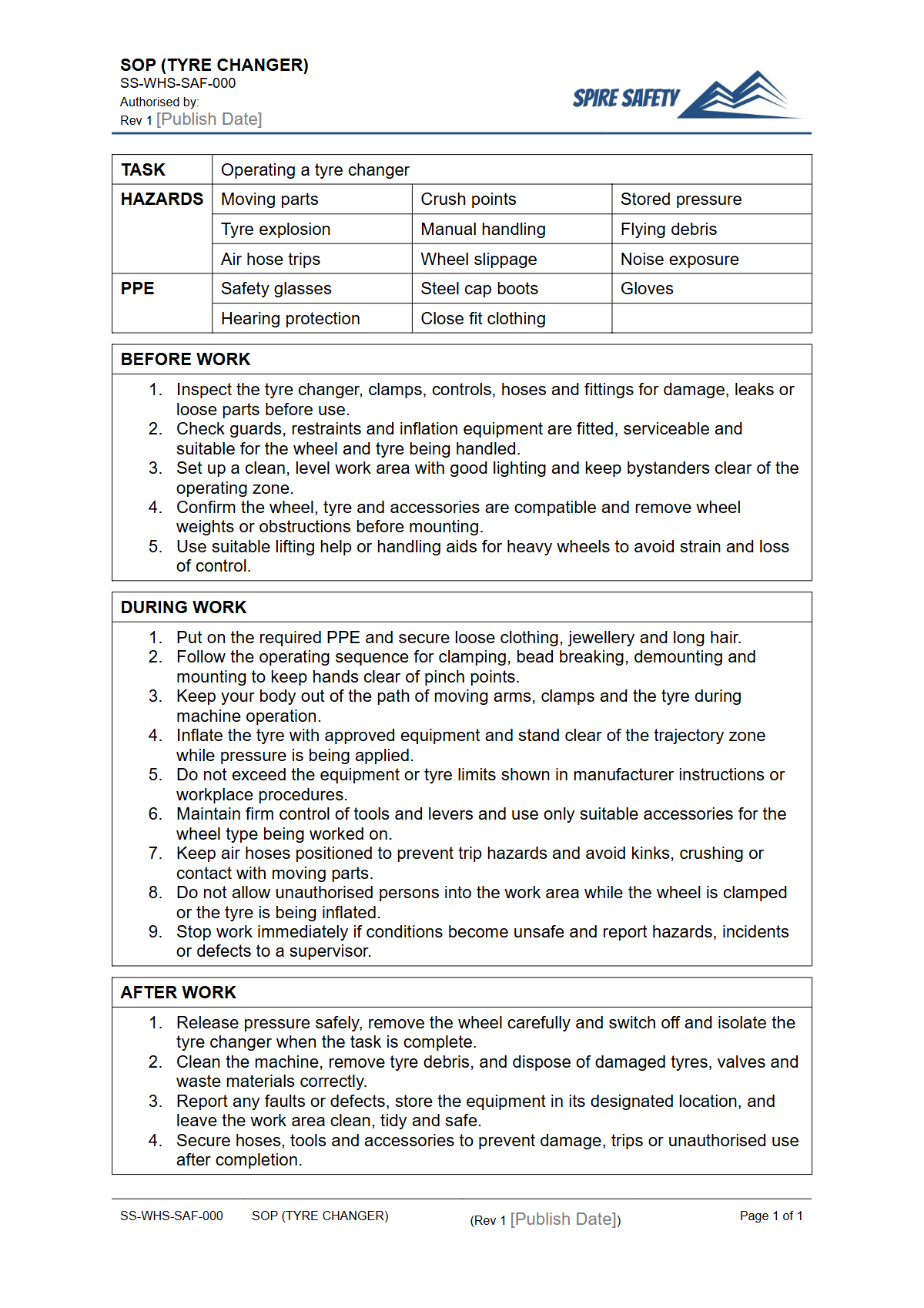
This free Safe Operating Procedure (Tyre Changer) template provides a structured starting point for developing a comprehensive workplace safety document. Using a tyre changer involves significant risks, including crush injuries from moving parts, musculoskeletal strain from manual handling, and the uncontrolled release of stored energy from pressurised tyres.
A documented SOP helps your organisation systematically identify these hazards, implement control measures, and provide clear, step-by-step instructions for workers to follow, ensuring tasks are performed safely and consistently.
A formal SOP is a critical tool for training new employees, inducting contractors, and verifying the ongoing competency of experienced operators. It serves as a foundation for safe work practices in any automotive workshop, tyre fitting bay, or vehicle maintenance facility. Many workshops also require procedures for associated equipment, such as our Free Air Compressor SOP (Safe Operating Procedure) Template.
Video walkthrough
How to use the Free Safe Operating Procedure (Tyre Changer) Template
Our template is available for download as a DOCX file for easy customisation, and a PDF for immediate use once completed. To effectively use this resource, you must adapt it to the specific context of your workplace.
It is not a one-size-fits-all solution.
Please note: This is a template, not a finished document. We have designed it as a comprehensive starting point, but you must customise it with your specific equipment models, workshop layout, and operational procedures to ensure it is effective for your workplace.
This involves consulting with the operators who actually use the equipment daily.
Key sections to customise include:
- Required Personal Protective Equipment (PPE): Specify the exact types of safety glasses, gloves, and protective footwear required.
- Pre-Operational Checks: List the specific checks for your machine, such as inspecting hoses for leaks, checking guards are in place, and ensuring the clamping mechanism is functional.
- Step-by-Step Procedure: Detail every action from preparing the wheel and deflating the tyre to operating the bead breaker, demounting, mounting, and re-inflating the new tyre. Include specific pressure limits and techniques.
- Post-Operational Checks & Clean-up: Outline shutdown procedures, tool storage, and housekeeping requirements.
By thoroughly completing these sections, you create a document that is truly relevant and effective. For tasks involving cutting or heating rims, it is vital to have separate procedures like our FREE Oxy Acetylene SOP (Safe Operating Procedure) Template.
When to use a Tyre Changer Safe Operating Procedure
A Safe Operating Procedure for a tyre changer should be a living document, referenced regularly within your organisation. It is essential during the induction and training of new mechanics and tyre fitters to establish a baseline of safe behaviour.
The SOP should be readily accessible in the work area, either as a hard copy or digitally, for operators to consult at any time.
It also serves as a crucial reference tool for supervisors conducting safety observations or for refresher training sessions. In the unfortunate event of an incident or near miss, the SOP becomes a key document in any investigation to understand if procedures were followed and if they need improvement.
Integrating SOPs into broader WHS management systems ensures they are part of a systematic approach to safety rather than standalone documents.
Who should use this SOP
This SOP is intended for all individuals involved with the use and supervision of tyre changing equipment. This includes:
- Operators: Mechanics, apprentices, and tyre fitters must be trained on the SOP and follow its instructions to perform their work safely.
- Supervisors and Foremen: They are responsible for ensuring operators are trained, deemed competent, and adhere to the SOP. They also use it to conduct inspections and performance reviews.
- WHS Managers and Officers: These professionals use the SOP as a tool for risk assessment, training development, and demonstrating procedural compliance. Supervisors and WHS officers can use SOPs as a benchmark during routine inspections and formal WHS compliance auditing.
In yards that handle larger plant and vehicles, staff may also need to consult task-specific documents like our FREE Telehandler SOP (Safe Operating Procedure) Template to manage associated risks. You can explore our full free WHS resources library for more templates to support your safety management system.
Common mistakes
Common mistakes to avoid
- Failing to fully deflate the tyre before attempting to remove it from the rim.
- Standing directly over the tyre during inflation, placing the operator in the line of fire.
- Using excessive force or incorrect tools, leading to damage to the tyre, rim, or machine.
- Neglecting to inspect the tyre and rim for pre-existing damage before commencing work.
Legal references
Legal considerations
The following legal requirements may be relevant to this type of work.
- Work Health and Safety Act (Harmonised) — Provides the primary duties for protecting workers and other people from work health and safety risks.
- Work Health and Safety Regulations (Harmonised) — Sets out requirements supporting the management of workplace hazards and risks.
The following codes may be relevant to this type of work.
- Managing WHS Risks Code of Practice — Provides practical guidance on identifying hazards, assessing risks and applying effective controls.
- Work Health and Safety Consultation, Cooperation and Coordination Code of Practice — Provides practical guidance on consulting workers and coordinating with other duty holders.
- Managing the Work Environment and Facilities Code of Practice — Provides practical guidance on safe work environments, workplace facilities and related controls.
Did you know
Stored Energy
A standard truck tyre inflated to 100 psi contains a huge amount of stored energy. If it were to rupture, the resulting explosion can be equivalent to detonating a stick of dynamite, capable of throwing a person several metres.
FAQ
Frequently asked questions
01What are the main hazards of using a tyre changer?
02Is training required to use a tyre changer?
03How often should a Tyre Changer SOP be reviewed?
04Does a Safe Operating Procedure replace the manufacturer's manual?
Share this resource
Free Safe Operating Procedure (Tyre Changer) Template
Browse Categories
How To Use It
- 1Download and open in Word or PDF.
- 2Replace the placeholders with your business details.
- 3Get it reviewed by a WHS specialist before rollout.
Need it customised?
Our WHS consultants can adapt this template to your site, run a gap analysis, or audit what you already have in place.
Book a Free Consultation WHS consulting servicesor call 1300 156 382
Related templates
- Free Safe Operating Procedure (Tyre Inflation) Template
- Free Safe Operating Procedure (Tyre Recycling Intake) Template
- Free Safe Operating Procedure (ULD Handling) Template
- Free Safe Operating Procedure (Ultrasonic Cleaner) Template
- Free Safe Operating Procedure (Ultrasonic Weld Test) Template
- Free Safe Operating Procedure (Underground Service Scan) Template