
Free Safe Operating Procedure (Ultrasonic Weld Test) Template
Download our free Safe Operating Procedure (Ultrasonic Weld Test) Template to formalise safety protocols for non-destructive testing. Get your DOCX and PDF now.
Free Safe Operating Procedure (Ultrasonic Weld Test) Template
DOCX • 126 KB + PDF
Updated Oct 2026
No signup required
Purpose of the Free Safe Operating Procedure (Ultrasonic Weld Test) Template
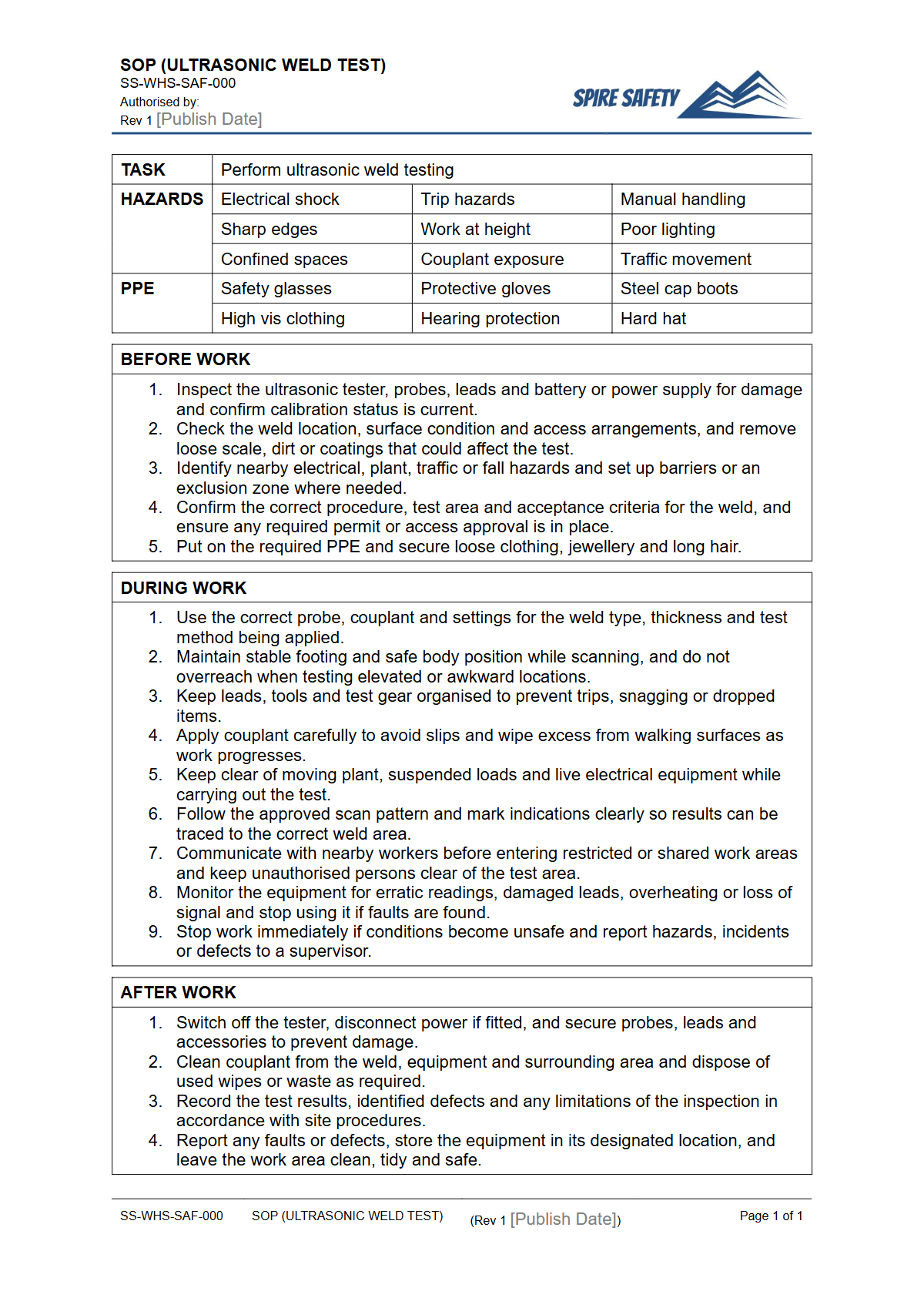
This Free Safe Operating Procedure (Ultrasonic Weld Test) Template provides a structured framework for documenting the safety protocols involved in non-destructive testing of welds. Ultrasonic testing is a specialised task with unique hazards, including electrical risks, ergonomic strain, and exposure to coupling agents.
Formalising your process in an SOP is a critical step in managing these risks and ensuring a consistent, safe method of work is followed by all personnel.
A well-developed SOP demonstrates a commitment to proactive safety management. It forms an essential part of your overall WHS management system, providing clear instructions that reduce the chance of incidents and improve the quality and reliability of test results on critical plant.
This process is vital for ensuring the structural integrity of equipment across many industries. For instance, the integrity of welded components on large machinery can be verified with this method, complementing documents like our FREE Conveyer System SOP (Safe Operating Procedure) Template to ensure all aspects of plant safety are covered.
Video walkthrough
How to use the Free Safe Operating Procedure (Ultrasonic Weld Test) Template
This template is designed to be a starting point, not a finished document. It must be customised to reflect the specific equipment, environment, and organisational procedures of your workplace.
Download the DOCX file and fill in the designated sections with your company's details, the specific ultrasonic testing equipment used, and the types of welds being inspected.
Key Customisation Steps:
- Conduct a thorough risk assessment for the task at your specific location.
- Consult with the operators who perform the ultrasonic tests.
- Incorporate the equipment manufacturer’s operating and safety instructions.
- Clearly define the required Personal Protective Equipment (PPE), such as safety glasses, gloves, and protective footwear.
- Detail the step-by-step emergency procedures, including shutdown and first aid.
- Obtain formal sign-off from management and the relevant safety committee members.
Important Note: We provide this template as a guide. You must adapt it to your unique circumstances.
The final responsibility for creating a safe system of work rests with the PCBU (Person Conducting a Business or Undertaking).
For tasks that involve fabrication or repair before testing, ensure you have documented procedures for those as well. Our FREE Oxy Acetylene SOP Template can provide a useful starting point for related hot work processes.
When to use this Safe Operating Procedure
An SOP for ultrasonic weld testing should be implemented and used before any work begins. It is a foundational document for several key activities:
- Training and inducting new operators or technicians on safe work methods.
- Conducting pre-start checks and task planning before commencing testing.
- Serving as an on-the-job reference for competent personnel to ensure consistency.
- Assisting in incident investigations to understand procedural deviations.
- Guiding periodic reviews of safety performance and procedural effectiveness.
Regularly reviewing and updating your SOPs is also a key part of maintaining safety standards, especially when new equipment is introduced. This process is often scrutinised during a formal WHS compliance audit.
Who should use this document
This procedure is intended for use by multiple roles within an organisation to ensure a unified approach to safety:
- WHS Managers and Safety Officers: To standardise procedures and integrate them into the broader safety framework.
- Supervisors and Team Leaders: To manage daily work, conduct toolbox talks, and supports your compliance efforts on the workshop floor.
- Competent Operators: As a clear, step-by-step guide for performing the task safely and consistently.
- Maintenance and Asset Integrity Planners: To schedule Non-Destructive Testing (NDT) as part of a preventative maintenance program.
For other common workshop equipment that may be found alongside testing apparatus, it is equally important to have clear operating procedures. You can download our Free Air Compressor SOP Template to help cover these complementary tasks.
This is just one of many templates we offer to support Australian businesses. You can explore our complete free WHS resources library for more checklists, procedures, and safety guides.
Common mistakes
Common mistakes to avoid
- Using a generic SOP without customising it for specific equipment and workplace conditions.
- Failing to properly calibrate the ultrasonic equipment before each use, leading to inaccurate results.
- Neglecting to consult with experienced operators when drafting or reviewing the procedure.
- Inadequate management of coupling agents (gels), leading to slip, trip, and fall hazards.
Legal references
Legal considerations
The following legal requirements may be relevant to this type of work.
- Work Health and Safety Act (Harmonised) — Provides the primary duties for protecting workers and other people from work health and safety risks.
- Work Health and Safety Regulations (Harmonised) — Sets out requirements supporting the management of workplace hazards and risks.
The following codes may be relevant to this type of work.
- Managing WHS Risks Code of Practice — Provides practical guidance on identifying hazards, assessing risks and applying effective controls.
- Work Health and Safety Consultation, Cooperation and Coordination Code of Practice — Provides practical guidance on consulting workers and coordinating with other duty holders.
- Managing the Work Environment and Facilities Code of Practice — Provides practical guidance on safe work environments, workplace facilities and related controls.
Did you know
Sounding Out Flaws
Ultrasonic testing doesn't use X-rays. It sends high-frequency sound waves into a material and measures the time it takes for echoes to return, revealing hidden cracks, voids, or discontinuities.
Medical Roots
The principles behind ultrasonic flaw detection are very similar to those used in medical ultrasonography, with both technologies evolving from sonar developments during World War II.
FAQ
Frequently asked questions
01What is an SOP for ultrasonic weld testing?
02Is ultrasonic weld testing dangerous?
03Who is qualified to perform ultrasonic weld testing?
04How often should I review my Ultrasonic Weld Test SOP?
Share this resource
Free Safe Operating Procedure (Ultrasonic Weld Test) Template
Browse Categories
How To Use It
- 1Download and open in Word or PDF.
- 2Replace the placeholders with your business details.
- 3Get it reviewed by a WHS specialist before rollout.
Need it customised?
Our WHS consultants can adapt this template to your site, run a gap analysis, or audit what you already have in place.
Book a Free Consultation WHS consulting servicesor call 1300 156 382
Related templates
- Free Safe Operating Procedure (Underground Service Scan) Template
- Free Safe Operating Procedure (Upholstery Cleaning) Template
- Free Safe Operating Procedure (UPS Battery Change) Template
- Free Safe Operating Procedure (Urinal Bottle Cleaning) Template
- Free Safe Operating Procedure (Urinal Descaling) Template
- Free Safe Operating Procedure (Used Oil Dropoff Intake) Template