
Free Safe Operating Procedure (Urinal Bottle Cleaning) Template
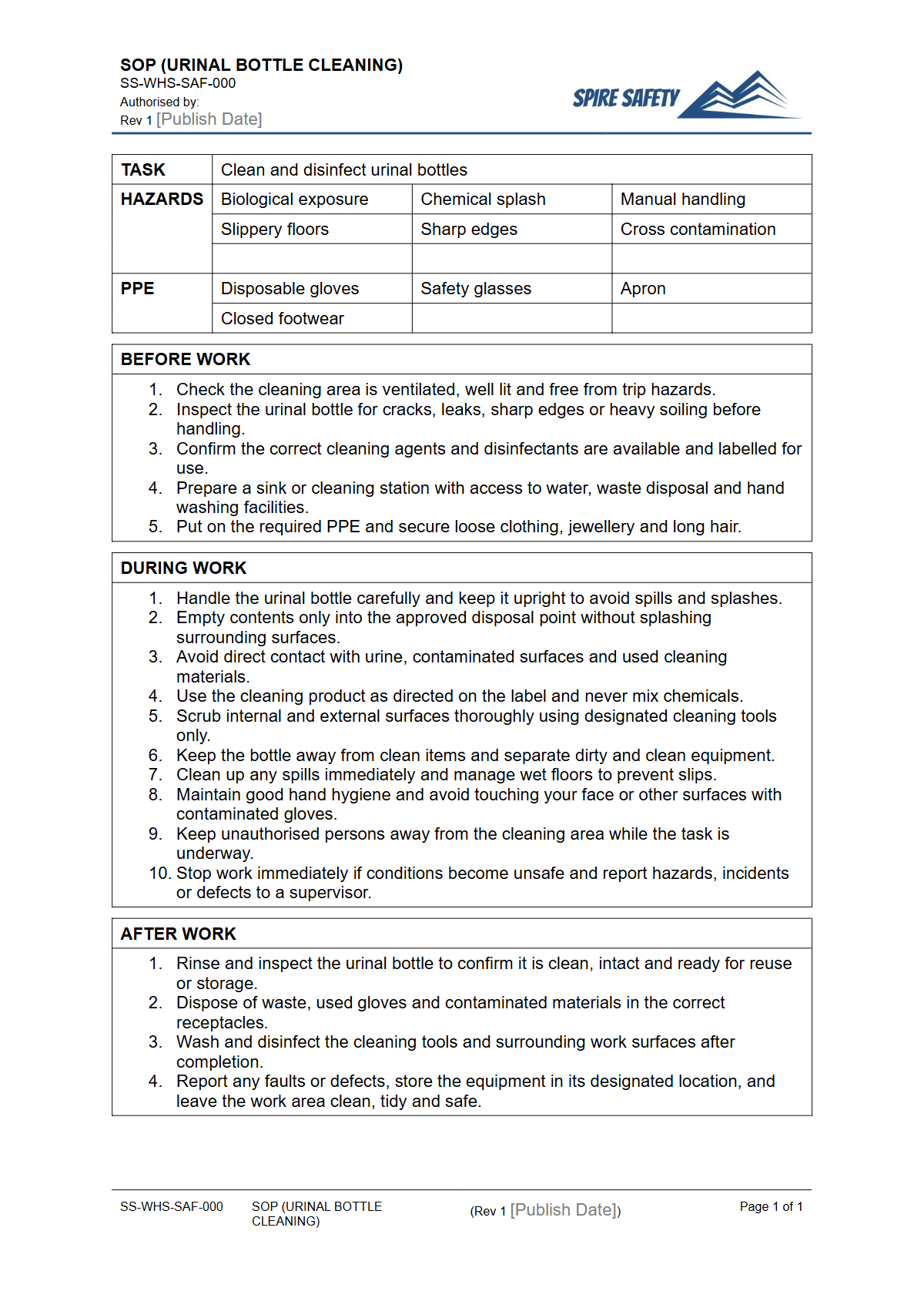
Download our free Safe Operating Procedure (Urinal Bottle Cleaning) Template to formalise your cleaning process and manage biological hazards.
Free Safe Operating Procedure (Urinal Bottle Cleaning) Template
DOCX • 126 KB + PDF
Updated Oct 2026
No signup required
Purpose of the Free Safe Operating Procedure (Urinal Bottle Cleaning) Template
Effectively cleaning and sanitising urinal bottles is a critical task in healthcare, aged care, and home care settings to prevent cross-contamination and the spread of infectious diseases. This Free Safe Operating Procedure (Urinal Bottle Cleaning) Template provides a structured framework for documenting the required steps to perform this task safely and consistently.
Using a formal SOP helps standardise your organisation's approach, ensuring every worker follows the same approved method, minimising exposure to biological hazards and harsh cleaning chemicals. It serves as a vital tool for worker training, competency assessment, and risk management.
Implementing clear, documented procedures is a fundamental component of effective health and safety management. A well-drafted SOP demonstrates a commitment to meeting Work Health and Safety (WHS) obligations by actively managing identified risks.
Formalising processes like this is a cornerstone of building robust WHS management systems that protect both workers and the people in their care.
Video walkthrough
How to use the Free Safe Operating Procedure (Urinal Bottle Cleaning) Template
This Safe Operating Procedure (SOP) is provided as a user-friendly template in both DOCX and PDF formats. To use it, simply download the file and adapt it to the specific requirements of your workplace.
You will need to insert site-specific information, such as the exact cleaning agents and disinfectants used, the location of cleaning stations and safety equipment (like eye wash stations), and contact details for supervisors or first aid officers. The template includes sections for outlining potential hazards, required personal protective equipment (PPE), a step-by-step cleaning procedure, and emergency protocols.
It is crucial to understand that this is a template, not a finished document. You must customise it to reflect your unique operational context.
We strongly recommend that a competent person, such as a WHS manager or an experienced supervisor, reviews and approves the final version before it is implemented. This ensures the procedure is practical, effective, and addresses all relevant risks specific to your organisation. The process of customising and verifying procedures is often a key focus during WHS compliance auditing.
When to use this Safe Operating Procedure
An SOP for urinal bottle cleaning should be readily available and referenced in several situations. It is the primary training document for new employees assigned to cleaning duties, ensuring they learn the correct, safe method from the outset.
It should also be used for periodic refresher training for all relevant staff to reinforce correct practices and communicate any updates to the procedure. Displaying the SOP prominently in the designated cleaning area (such as a sluice room or dirty utility room) provides an immediate on-the-job reference guide for workers, helping to prevent procedural drift and maintain high standards of hygiene.
This procedure is just one example of how a standardised process can mitigate risk for a specific task. The same principle applies to countless other workplace activities, from kitchen hygiene tasks detailed in a free Safe Operating Procedure for deep fryer operation to technical maintenance work.
Who should implement this procedure?
This SOP should be implemented and followed by any person responsible for cleaning and sanitising reusable urinal bottles. This typically includes healthcare assistants, personal care workers, nurses, hospital cleaners, and environmental services staff.
It is essential that these individuals are not only given the document but are also properly trained on its contents and can demonstrate their understanding and competency in performing the task as described.
Supervisors and managers hold the responsibility for implementation. Their role is to ensure that workers are trained, have access to the required PPE and cleaning supplies, and consistently adhere to the established procedure.
They are also responsible for reviewing the SOP periodically to ensure it remains current and effective. Having documented procedures for all hazardous tasks is a key principle of workplace safety, applying to everything from cleaning to the operation of workshop equipment, as shown in our free Air Compressor SOP.
By establishing and enforcing clear procedures, your organisation can significantly reduce the risk of incidents and create a safer environment for everyone. For more templates and safety documents, browse our complete free WHS resources library.
Common mistakes
Common mistakes to avoid
- Using hot water for the initial rinse, which can cause proteins in urine to coagulate and adhere to the surface.
- Failing to wear appropriate PPE, especially eye protection, leading to risk of splashes with contaminated fluids.
- Confusing cleaning with disinfection; skipping the disinfection step or using a product that is not a registered disinfectant.
- Improper storage of cleaned bottles, leading to re-contamination before they are used again.
Legal references
Legal considerations
The following legal requirements may be relevant to this type of work.
- Work Health and Safety Act (Harmonised) — Provides the primary duties for protecting workers and other people from work health and safety risks.
- Work Health and Safety Regulations (Harmonised) — Sets out requirements supporting the management of workplace hazards and risks.
The following codes may be relevant to this type of work.
- Managing WHS Risks Code of Practice — Provides practical guidance on identifying hazards, assessing risks and applying effective controls.
- Work Health and Safety Consultation, Cooperation and Coordination Code of Practice — Provides practical guidance on consulting workers and coordinating with other duty holders.
- Managing the Work Environment and Facilities Code of Practice — Provides practical guidance on safe work environments, workplace facilities and related controls.
Did you know
The Importance of Disinfection
Cleaning with detergent removes visible soil, but it doesn't kill all microorganisms. A separate disinfection step using an appropriate TGA-approved, hospital-grade disinfectant is essential to eliminate pathogens and prevent the spread of infection.
FAQ
Frequently asked questions
01What are the main hazards when cleaning urinal bottles?
02Why is a specific SOP needed for urinal bottle cleaning?
03Can this template be used in a hospital or aged care setting?
04What Personal Protective Equipment (PPE) is typically required?
Share this resource
Free Safe Operating Procedure (Urinal Bottle Cleaning) Template
Browse Categories
How To Use It
- 1Download and open in Word or PDF.
- 2Replace the placeholders with your business details.
- 3Get it reviewed by a WHS specialist before rollout.
Need it customised?
Our WHS consultants can adapt this template to your site, run a gap analysis, or audit what you already have in place.
Book a Free Consultation WHS consulting servicesor call 1300 156 382
Related templates
- Free Safe Operating Procedure (Urinal Descaling) Template
- Free Safe Operating Procedure (Used Oil Dropoff Intake) Template
- Free Safe Operating Procedure (Vacant Unit Cleaning) Template
- Free Safe Operating Procedure (Vacuum Excavation) Template
- Free Safe Operating Procedure (Vacuum Leak Test) Template
- Free Safe Operating Procedure (Vacuum Lifter) Template