
Free Safe Operating Procedure (Used Oil Dropoff Intake) Template
Safely manage used oil drop-offs with our structured template. This customisable SOP helps you document procedures and minimise workplace risks.
Free Safe Operating Procedure (Used Oil Dropoff Intake) Template
DOCX • 126 KB + PDF
Updated Oct 2026
No signup required
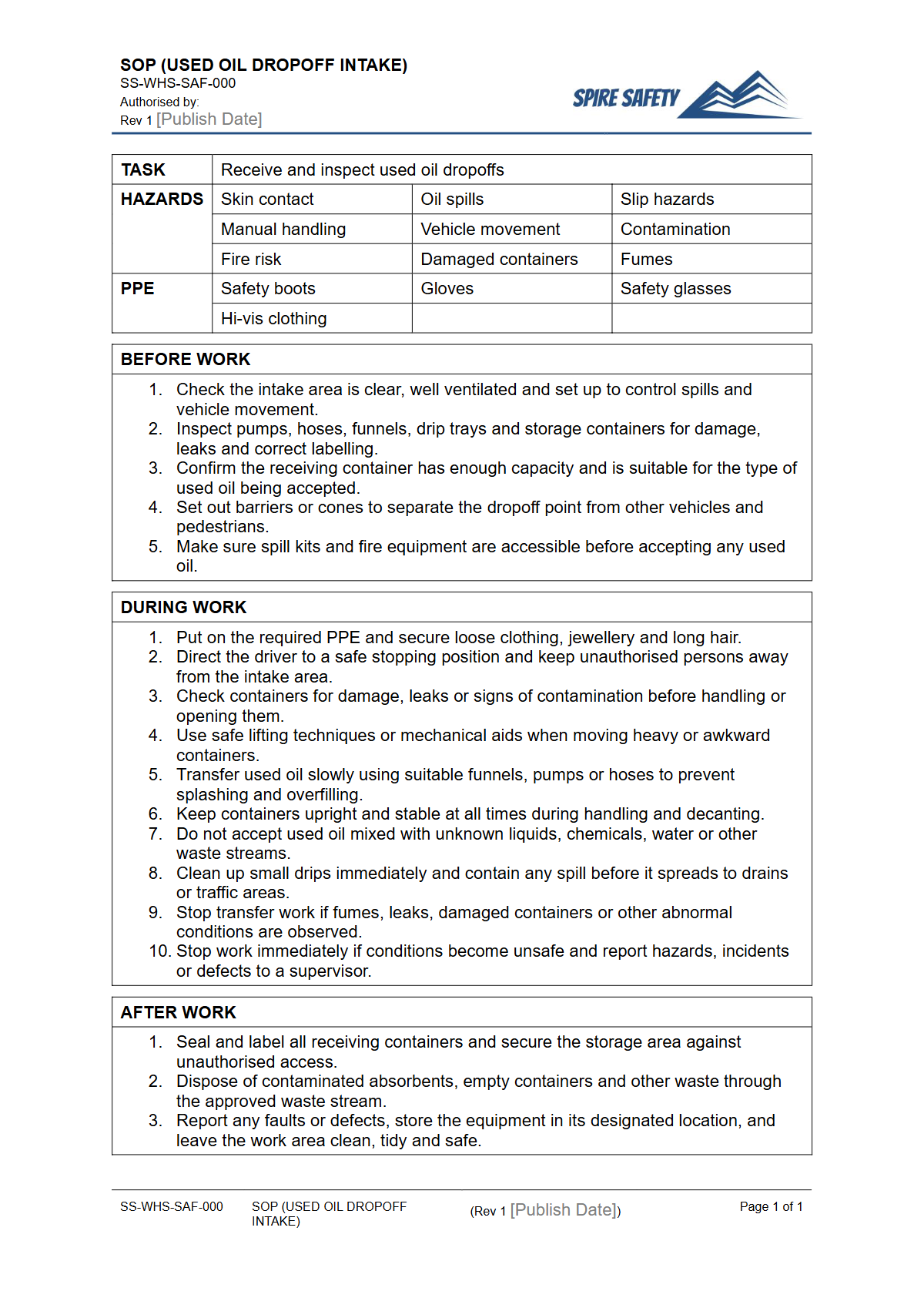
Effectively managing the intake of used oil is a critical task for automotive workshops, depots, and waste management facilities. This process, while routine, carries significant risks including chemical exposure, fire, and environmental contamination.
Our Free Safe Operating Procedure (Used Oil Dropoff Intake) Template provides a comprehensive starting point for documenting a safe system of work. Developing clear procedures is a fundamental component of robust WHS management systems, ensuring tasks are performed consistently and safely every time.
Video walkthrough
Purpose of the Free Safe Operating Procedure (Used Oil Dropoff Intake) Template
A Safe Operating Procedure (SOP) serves as a clear, instructional guide for workers. The purpose of this template is to help your organisation establish a standardised process for accepting and handling used oil.
By clearly defining the steps, required personal protective equipment (PPE), and emergency responses, you can significantly reduce the likelihood of incidents. This document formalises your commitment to safety, provides essential material for worker training and induction, and acts as a reference point for day-to-day operations.
Using a structured SOP ensures all team members, regardless of experience, understand the specific hazards associated with used oil—such as skin irritation, flammability, and toxicity—and the control measures in place to mitigate them. Just as a commercial kitchen requires a procedure for handling hot oil from a deep fryer, an automotive workshop needs one for used oil.
It creates a baseline for safe behaviour and is an invaluable tool during safety audits and incident investigations.
How to use the Free Safe Operating Procedure (Used Oil Dropoff Intake) Template
This document is a template that requires customisation. It is not a complete, ready-to-use procedure.
You must adapt it to the specific equipment, layout, and risks present in your workplace.
Follow these steps for effective implementation:
- Download and Review: Download the DOCX or PDF and familiarise yourself with the sections.
- Consult Your Team: Involve workers who will be performing the task. Their direct experience is invaluable for identifying practical risks and effective controls.
- Conduct a Risk Assessment: Analyse the entire process at your site, from the customer arriving to the final storage of the oil. Identify all potential hazards.
- Customise the Content: Fill in the blank sections with your site-specific information. This includes details about your spill kits, emergency contact numbers, specific PPE brands or types, and the location of your oil storage tanks.
- Train All Relevant Staff: Once the SOP is finalised, conduct formal training to ensure every worker understands the procedure. For other common workshop tasks, you might use a specific procedure like our Free Air Compressor SOP to ensure consistent safety practices.
- Review and Sign: Have workers sign an acknowledgement form to confirm they have been trained and understand the SOP. Keep this for your training records.
When to use it
This Safe Operating Procedure should be the primary reference document for any worker tasked with receiving used oil. It should be kept in a visible and easily accessible location near the drop-off point, so it can be consulted before and during the task.
It is also a critical tool for several other key WHS activities, including new employee induction, refresher training sessions, and toolbox talks focused on hazardous substance management.
Furthermore, the SOP should be formally reviewed on a regular schedule (e.g., annually) or whenever there is a change in equipment, process, or legislation. It must also be reviewed immediately following any incident or near miss involving used oil handling to identify and implement corrective actions. This process of continual improvement is central to maintaining a safe workplace and is a core principle in frameworks supported by ISO 45001 consulting.
Who should use it
The primary users of this SOP are the frontline workers who physically perform the task of accepting, inspecting, and transferring used oil. This includes mechanics, workshop apprentices, depot operators, and waste transfer station attendants.
Their understanding and adherence to the procedure are paramount for preventing incidents.
Supervisors and managers also have a critical role. They must use the SOP to train their teams, monitor compliance, and enforce safe work practices.
During workplace inspections or safety observations, supervisors can use the SOP as a checklist to ensure the correct procedure is being followed. Ensuring procedures like this are properly implemented is a key focus of formal WHS compliance auditing.
Finally, WHS and management personnel should use this template as a foundational document within their overall safety management system. Standardising procedures for all hazardous tasks, such as those covered in our FREE Oxy Acetylene SOP for handling flammable gases, creates a more predictable and safer working environment.
You can explore more templates in our free WHS resources library to build out your documentation.
Common mistakes
Common mistakes to avoid
- Assuming all containers from the public are safe and properly labelled.
- Failing to have an adequately stocked and accessible spill kit near the intake area.
- Using the wrong type of gloves that degrade when exposed to hydrocarbons.
- Neglecting to bund storage areas, leading to environmental contamination risk.
Legal references
Legal considerations
The following legal requirements may be relevant to this type of work.
- Work Health and Safety Act (Harmonised) — Provides the primary duties for protecting workers and other people from work health and safety risks.
- Work Health and Safety Regulations (Harmonised) — Sets out requirements supporting the management of workplace hazards and risks.
The following codes may be relevant to this type of work.
- Managing WHS Risks Code of Practice — Provides practical guidance on identifying hazards, assessing risks and applying effective controls.
- Work Health and Safety Consultation, Cooperation and Coordination Code of Practice — Provides practical guidance on consulting workers and coordinating with other duty holders.
- Managing the Work Environment and Facilities Code of Practice — Provides practical guidance on safe work environments, workplace facilities and related controls.
Did you know
Recycling Power
Just one litre of used oil can contaminate one million litres of water. Recycling used oil not only prevents pollution but also saves energy, as it takes significantly less energy to re-refine oil than to produce it from crude.
Not Just Oil
Used engine oil contains heavy metals and toxic chemicals like benzene and arsenic, which are picked up during engine operation. These contaminants are why direct contact and improper disposal are so hazardous.
FAQ
Frequently asked questions
01What PPE is required for handling used oil?
02How do I correctly store used oil after drop-off?
03Is a Safe Operating Procedure a legal requirement in Australia?
04What's the difference between a SWMS and an SOP?
Share this resource
Free Safe Operating Procedure (Used Oil Dropoff Intake) Template
Browse Categories
How To Use It
- 1Download and open in Word or PDF.
- 2Replace the placeholders with your business details.
- 3Get it reviewed by a WHS specialist before rollout.
Need it customised?
Our WHS consultants can adapt this template to your site, run a gap analysis, or audit what you already have in place.
Book a Free Consultation WHS consulting servicesor call 1300 156 382
Related templates
- Free Safe Operating Procedure (Vacant Unit Cleaning) Template
- Free Safe Operating Procedure (Vacuum Excavation) Template
- Free Safe Operating Procedure (Vacuum Leak Test) Template
- Free Safe Operating Procedure (Vacuum Lifter) Template
- Free Safe Operating Procedure (Vacuum Lifting Beam) Template
- Free Safe Operating Procedure (Vacuum Packer) Template