
Free Safe Operating Procedure (Vacuum Lifting Beam) Template
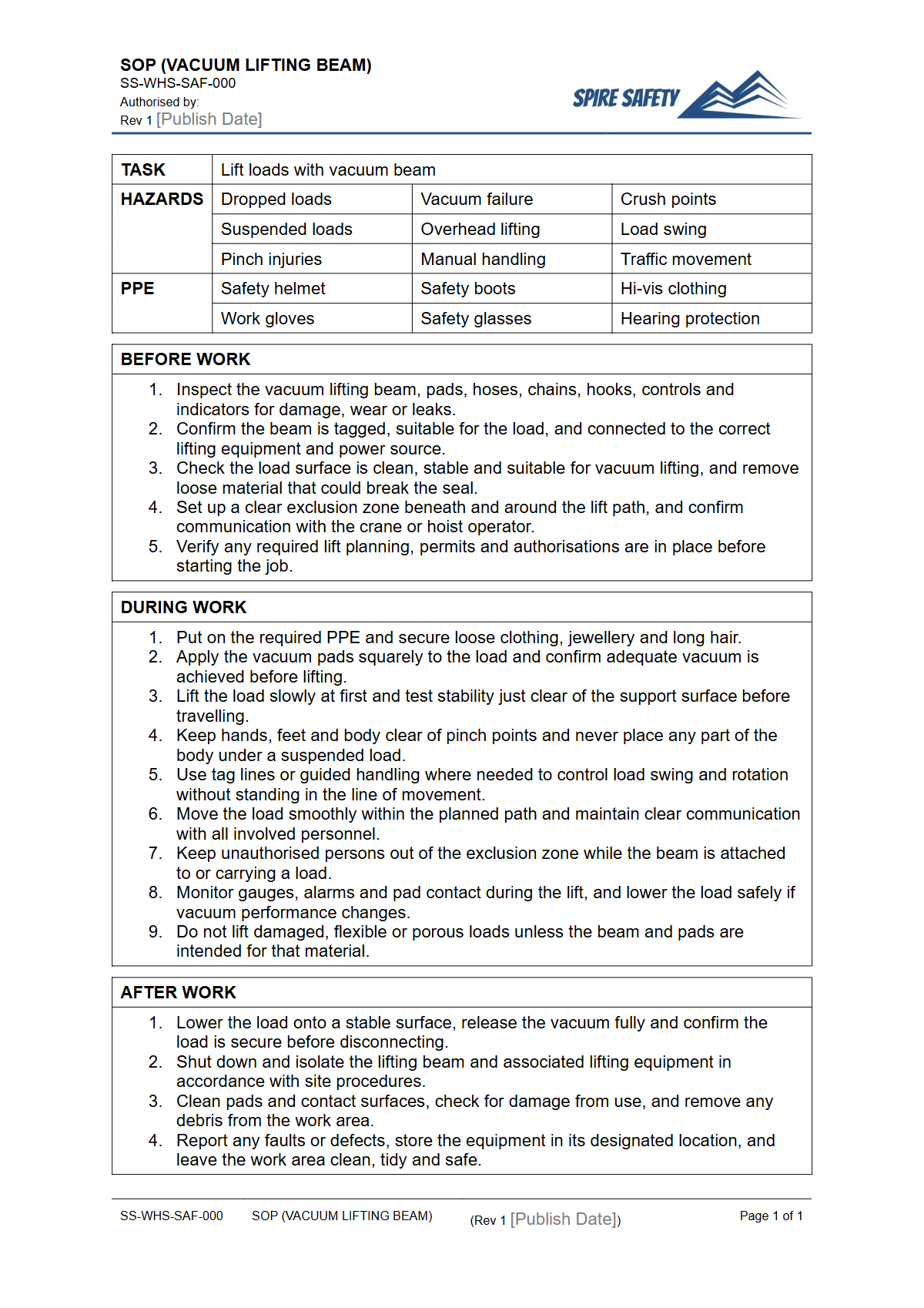
Download our Free Safe Operating Procedure for a Vacuum Lifting Beam to formalise your safety processes. This customisable template helps you control risks.
Free Safe Operating Procedure (Vacuum Lifting Beam) Template
DOCX • 126 KB + PDF
Updated Oct 2026
No signup required
Purpose of the Free Safe Operating Procedure (Vacuum Lifting Beam) Template
This Free Safe Operating Procedure (Vacuum Lifting Beam) Template provides a structured starting point for documenting the safe use of vacuum lifting equipment in your workplace. Vacuum lifters are a form of high-risk plant, and failing to manage their operation can lead to serious incidents, including catastrophic load drops.
Using a standardised SOP helps your organisation fulfil its duty of care by clearly outlining step-by-step instructions, pre-start checks, potential hazards, and required personal protective equipment (PPE).
Formalising your processes with an SOP ensures that every operator follows a consistent, safe method, reducing the risk of human error and equipment misuse. It serves as a critical training tool for new employees and a reference for experienced operators.
Documented procedures are a fundamental component of effective safety management, demonstrating a proactive approach to risk control. This SOP should form part of your broader comprehensive WHS management systems, integrating with risk assessments, training records, and maintenance schedules to create a safer work environment.
Video walkthrough
How to use the Free Safe Operating Procedure (Vacuum Lifting Beam) Template
To effectively use this Free Safe Operating Procedure (Vacuum Lifting Beam) Template, you must adapt it to the specific context of your workplace. The provided DOCX file is fully editable, allowing you to insert details about your particular make and model of vacuum lifter, the types of materials handled (e.g., glass, steel, stone), and your unique site conditions.
Start by downloading the template and consulting with the workers and supervisors who will be using the equipment. Their direct experience is invaluable for identifying practical steps and hazards.
You must conduct a site-specific risk assessment for the vacuum lifting tasks and use the findings to inform the content of your SOP. Pay close attention to sections covering pre-operational checks, emergency procedures (like power failure protocols), and exclusion zones.
A common mistake is to simply adopt a generic document without proper customisation. It is crucial that we customise this template for our specific workplace, equipment, and operational environment to ensure it is effective. Many workplaces use various types of lifting equipment, each requiring its own procedure, such as our FREE Telehandler SOP Template.
Once customised, the SOP should be approved by a competent person, communicated to all relevant personnel, and made easily accessible at the point of use. Regular reviews and updates are necessary to keep the document current, especially after an incident or when new equipment or processes are introduced.
For complex operations, seeking an independent review through a WHS compliance auditing service can provide additional assurance that your controls are robust and effective.
When to use it
A Safe Operating Procedure for a vacuum lifting beam should be used as the primary reference document for all routine operations involving the equipment. It is not just a document for new workers; it is a critical tool for daily use.
It should be consulted during pre-start checks, used as a guide for correct lifting and moving techniques, and referenced when preparing for shutdown. The SOP is also an essential part of your training and competency assessment process, providing a clear benchmark for safe performance.
This procedure should also be reviewed before undertaking any non-routine lifts or handling new types of materials to ensure all potential risks have been considered. While the SOP outlines safe steps, it is a control measure derived from a risk assessment, not a substitute for one.
It should be used alongside other safety documents for related equipment, such as an Air Compressor SOP if the lifter is pneumatic, to ensure a holistic approach to workshop safety.
Who should use it
This Safe Operating Procedure is intended for several key roles within an organisation. Primarily, it is for the operators of the vacuum lifting beam.
They must be trained on the contents of the SOP and follow its instructions meticulously to ensure their own safety and that of others. Supervisors and line managers are also key users, as they are responsible for enforcing the procedure, monitoring compliance, and ensuring operators are competent.
WHS managers, coordinators, and safety advisors will use this template as a foundational document to build upon. They are responsible for ensuring the SOP is correctly customised, integrated into the overall safety system, and regularly reviewed.
They might also use it during safety audits, incident investigations, and management meetings to discuss and improve workplace safety performance. Supervisors must also ensure that procedures for any related downstream tasks, such as those covered in our FREE Oxy Acetylene SOP Template, are available and followed.
For organisations needing assistance in developing and implementing these frameworks, our specialist WHS consulting support can provide expert guidance.
By ensuring all relevant personnel understand and use the SOP, your organisation can build a stronger safety culture. You can explore our complete free WHS resources library for more templates to support your safety management system.
Common mistakes
Common mistakes to avoid
- Neglecting pre-use checks of suction pads, vacuum lines, and the vacuum gauge.
- Attempting to lift materials with porous, dirty, wet, or uneven surfaces that cannot form a proper seal.
- Failing to establish, mark, and enforce a clear exclusion zone directly underneath the suspended load.
- Allowing untrained or unverified personnel to operate the equipment without direct supervision.
Legal references
Legal considerations
The following legal requirements may be relevant to this type of work.
- Work Health and Safety Act (Harmonised) — Provides the primary duties for protecting workers and other people from work health and safety risks.
- Work Health and Safety Regulations (Harmonised) — Sets out requirements supporting the management of workplace hazards and risks.
The following codes may be relevant to this type of work.
- Managing WHS Risks Code of Practice — Provides practical guidance on identifying hazards, assessing risks and applying effective controls.
- Work Health and Safety Consultation, Cooperation and Coordination Code of Practice — Provides practical guidance on consulting workers and coordinating with other duty holders.
- Managing the Work Environment and Facilities Code of Practice — Provides practical guidance on safe work environments, workplace facilities and related controls.
Did you know
Vacuum Loss Risk
Even a minor power fluctuation or a small leak in a hose or suction pad can cause a rapid loss of vacuum, potentially leading to a sudden and complete failure of the lift. This is why strict exclusion zones under a suspended load are non-negotiable.
Surface Integrity is Key
The lifting capacity of a vacuum beam is entirely dependent on the surface of the material being lifted. The surface must be clean, dry, and non-porous; any dust, moisture, or texture can compromise the seal and dramatically reduce lifting performance.
FAQ
Frequently asked questions
01What key information should be included in a vacuum lifting beam SOP?
02Is a Safe Operating Procedure a legal requirement for vacuum lifters in Australia?
03How often should a vacuum lifter SOP be reviewed and updated?
04Can I use a generic vacuum lifter SOP for any model?
Share this resource
Free Safe Operating Procedure (Vacuum Lifting Beam) Template
Browse Categories
How To Use It
- 1Download and open in Word or PDF.
- 2Replace the placeholders with your business details.
- 3Get it reviewed by a WHS specialist before rollout.
Need it customised?
Our WHS consultants can adapt this template to your site, run a gap analysis, or audit what you already have in place.
Book a Free Consultation WHS consulting servicesor call 1300 156 382
Related templates
- Free Safe Operating Procedure (Vacuum Packer) Template
- Free Safe Operating Procedure (Vacuum Pump) Template
- Free Safe Operating Procedure (Valve Actuator Test) Template
- Free Safe Operating Procedure (Valve Grinder) Template
- Free Safe Operating Procedure (Valve Lapping) Template
- Free Safe Operating Procedure (Vapour Degreaser) Template