
Free Safe Operating Procedure (Valve Grinder) Template
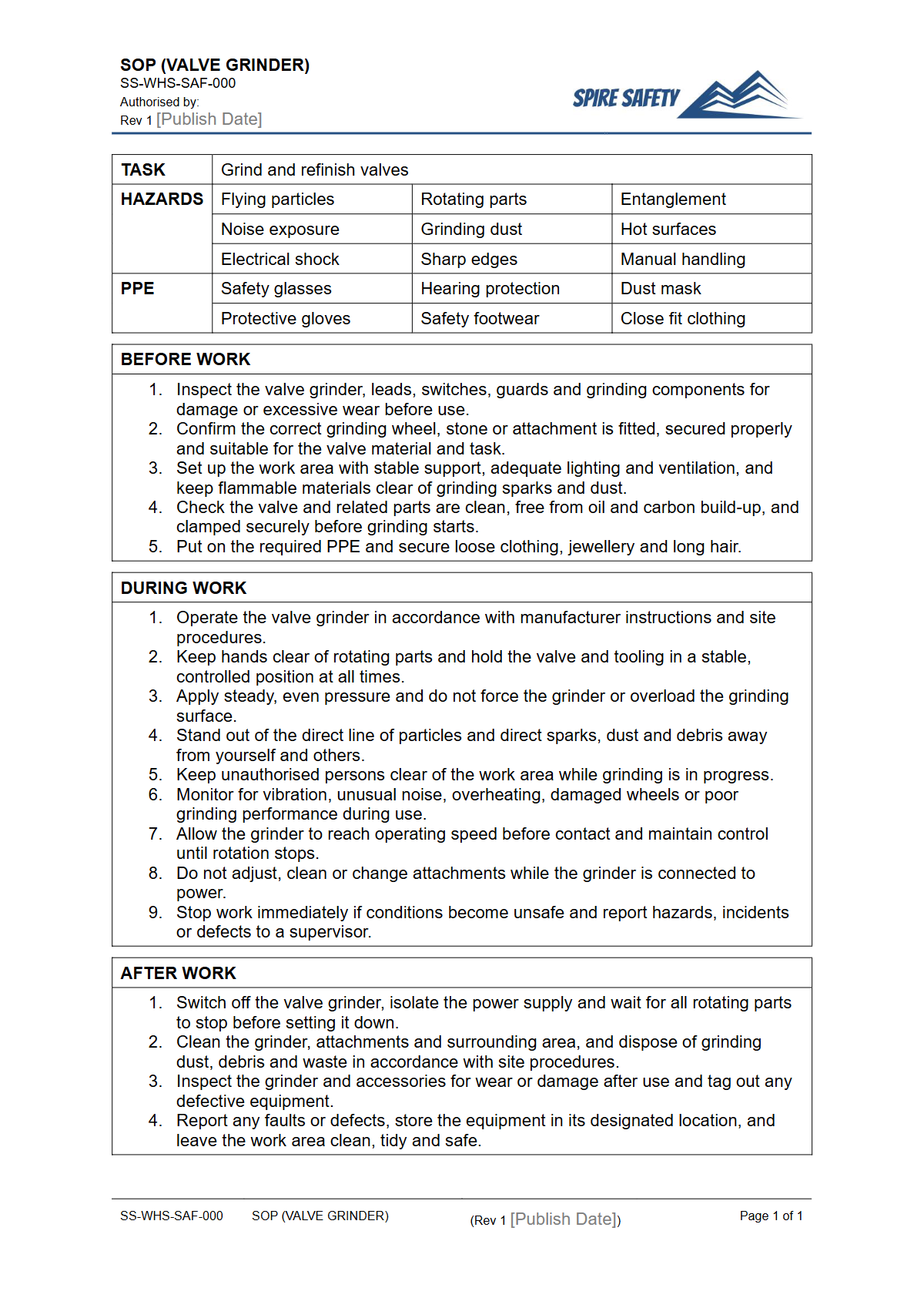
Download our free Safe Operating Procedure (Valve Grinder) Template to formalise safe work practices. This customisable document helps you meet your WHS duties.
Free Safe Operating Procedure (Valve Grinder) Template
DOCX • 126 KB + PDF
Updated Oct 2026
No signup required
Purpose of the Free Safe Operating Procedure (Valve Grinder) Template
Operating a valve grinder involves significant risks, including exposure to high-speed rotating parts, abrasive wheel shatter, airborne dust, and hazardous noise levels. A documented Safe Operating Procedure (SOP) is a critical tool for managing these risks effectively.
Our Free Safe Operating Procedure (Valve Grinder) Template provides a comprehensive, structured starting point for your business to formalise safe work methods. It prompts you to outline key safety requirements, from pre-start checks and personal protective equipment (PPE) to step-by-step operational instructions and emergency responses.
By implementing a clear and accessible SOP, you create a consistent standard for all operators, reducing the likelihood of incidents and injuries. This document serves as an essential part of your overall safety framework, demonstrating a commitment to worker safety and helping to build robust WHS management systems. It ensures that crucial safety information is not just assumed but is formally recorded, taught, and readily available to those performing the task.
Video walkthrough
How to use the Free Safe Operating Procedure (Valve Grinder) Template
This template is available for download in both DOCX and PDF formats. The DOCX file is fully editable, allowing you to tailor the content to the specific valve grinder models, materials, and unique environmental conditions of your workplace.
It is designed to be a foundation, not a final document. Like our free Air Compressor SOP template, this resource must be adapted to reflect your site-specific risk assessment findings.
Customising Your SOP
To make this template effective for your organisation, follow these steps:
- Identify Hazards: Conduct a thorough risk assessment for the valve grinding task in your specific work environment. Consider mechanical, electrical, noise, vibration, and dust hazards.
- Insert Site-Specific Details: Add the make and model of your equipment, the specific types of valves being worked on, and the exact location where the work is performed.
- Define PPE Requirements: List the mandatory PPE, such as safety glasses, face shields, hearing protection, respiratory protection, and protective footwear, as determined by your risk assessment.
- Consult Your Workers: Involve the operators who use the equipment every day. Their practical experience is invaluable for creating a procedure that is both safe and workable. Under WHS law, consultation is a mandatory part of the risk management process.
- Finalise and Train: Once customised, use the SOP as a key training document for new operator inductions and for regular refresher training for existing staff. We strongly recommend you do not just file this document away; it must be a living part of your daily operations.
- Schedule Reviews: The SOP should be reviewed regularly to ensure it remains current. An annual review, or inclusion in your WHS compliance auditing schedule, is good practice.
When to use a Valve Grinder Safe Operating Procedure
A specific SOP for a valve grinder should be developed and implemented before any worker is permitted to operate the equipment. It is an essential control measure for a high-risk task.
This document should be a central part of your training and competency framework, used during new employee inductions, when an existing worker is being trained on the machine for the first time, or for periodic refresher training sessions. It should also be reviewed and referenced after any incident or near-miss involving the equipment to identify and implement improvements. This SOP is just one component of managing workshop safety; you might also need procedures for other equipment, such as our FREE Oxy Acetylene SOP Template.
Who should use this Safe Operating Procedure
This SOP template is designed for use by a range of personnel within an organisation. Primarily, Workshop Managers and Supervisors are responsible for customising, implementing, and enforcing the procedure.
They must ensure that all operators are trained and competent in its contents. WHS Managers and Advisors will use this template as part of the broader safety system to ensure procedural consistency and to meet due diligence requirements.
Most importantly, the final, customised SOP is for the Equipment Operators themselves. It is their guide to performing the job safely and a reference they can consult at any time.
Properly training them on specific tools using documents like this one and our FREE Circular Saw SOP Template is a key supervisory responsibility. For a complete collection of our safety documents, you can browse our free WHS resources library.
Common mistakes
Common mistakes to avoid
- Failing to inspect the grinding stone for cracks, chips, or other damage before mounting and use.
- Operating the grinder without appropriate eye, face, and hearing protection.
- Using the incorrect type, grit, or size of grinding stone for the specific valve or machine.
- Neglecting to secure the valve head or workpiece properly in the chuck or fixture before starting.
Legal references
Legal considerations
The following legal requirements may be relevant to this type of work.
- Work Health and Safety Act (Harmonised) — Provides the primary duties for protecting workers and other people from work health and safety risks.
- Work Health and Safety Regulations (Harmonised) — Sets out requirements supporting the management of workplace hazards and risks.
The following codes may be relevant to this type of work.
- Managing WHS Risks Code of Practice — Provides practical guidance on identifying hazards, assessing risks and applying effective controls.
- Work Health and Safety Consultation, Cooperation and Coordination Code of Practice — Provides practical guidance on consulting workers and coordinating with other duty holders.
- Managing the Work Environment and Facilities Code of Practice — Provides practical guidance on safe work environments, workplace facilities and related controls.
Did you know
Noise Hazard
Valve grinders can easily produce noise levels over 85 dB(A), the Australian exposure standard for an eight-hour period. Without adequate hearing protection, this can lead to permanent, irreversible hearing damage.
Inhalation Risk
Grinding engine valves can release fine particles of metal, carbon deposits, and abrasive material into the air. Effective local exhaust ventilation and respiratory protection are critical to prevent long-term lung disease like silicosis or siderosis.
FAQ
Frequently asked questions
01What must be included in a Safe Operating Procedure for a valve grinder?
02Is a valve grinder SOP a legal requirement in Australia?
03How often should an SOP for a valve grinder be reviewed?
04Can this template be used for other types of grinders?
Share this resource
Free Safe Operating Procedure (Valve Grinder) Template
Browse Categories
How To Use It
- 1Download and open in Word or PDF.
- 2Replace the placeholders with your business details.
- 3Get it reviewed by a WHS specialist before rollout.
Need it customised?
Our WHS consultants can adapt this template to your site, run a gap analysis, or audit what you already have in place.
Book a Free Consultation WHS consulting servicesor call 1300 156 382
Related templates
- Free Safe Operating Procedure (Valve Lapping) Template
- Free Safe Operating Procedure (Vapour Degreaser) Template
- Free Safe Operating Procedure (Vegetable Peeler) Template
- Free Safe Operating Procedure (Vegetable Slicer) Template
- Free Safe Operating Procedure (Vegetation Around Signs) Template
- Free Safe Operating Procedure (Vegetation Hand Cutting) Template