
Free Safe Operating Procedure (Valve Lapping) Template
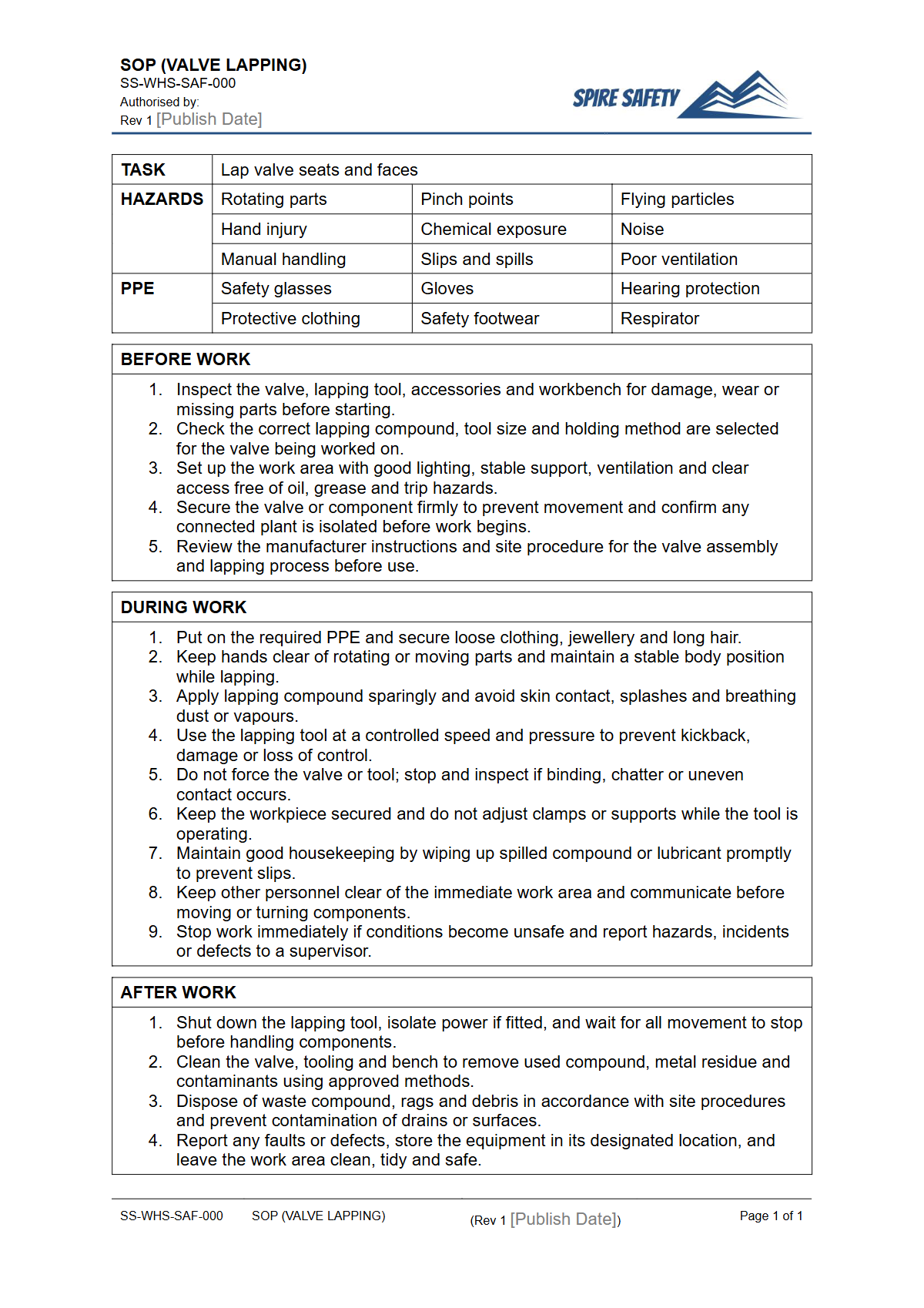
Download our free Safe Operating Procedure (Valve Lapping) Template. This customisable DOCX and PDF helps formalise your valve lapping safety process.
Free Safe Operating Procedure (Valve Lapping) Template
DOCX • 126 KB + PDF
Updated Oct 2026
No signup required
Purpose of the Free Safe Operating Procedure (Valve Lapping) Template
This Free Safe Operating Procedure (Valve Lapping) Template provides a structured framework for documenting the safety requirements for lapping engine or industrial valves. It helps organisations formalise procedures to manage risks associated with rotating machinery, abrasive compounds, ergonomic strain, and airborne particles.
Using a standardised SOP ensures that all workers follow a consistent, pre-approved method, significantly reducing the likelihood of incidents and injuries.
A well-defined SOP is a cornerstone of effective safety management. It acts as a critical administrative control by detailing the safest way to perform a task from start to finish.
This document helps in identifying specific hazards present in the valve lapping process and outlines the control measures required to mitigate them. Implementing robust SOPs is a key part of developing comprehensive WHS management systems that protect workers and support organisational compliance.
Video walkthrough
How to use the Free Safe Operating Procedure (Valve Lapping) Template
This resource is available for download as a DOCX file, allowing for easy editing and customisation to suit your specific workplace needs. Simply download the template and open it in a word processor to begin adapting it.
The procedure should be tailored to include details about the exact machinery, tools, and types of lapping compounds used on your site.
IMPORTANT: This document is a template and must be customised to your specific operational context. We strongly recommend you consult with the workers who regularly perform valve lapping, as their practical experience is invaluable for creating a procedure that is both safe and workable.
Ensure you incorporate details from the manufacturer's instructions and the Safety Data Sheets (SDS) for any chemicals used. This process is similar to creating procedures for other equipment, such as the steps outlined in our free Air Compressor SOP.
When to use this Safe Operating Procedure
A Safe Operating Procedure for valve lapping should be a dynamic document used in various day-to-day scenarios. It is an essential tool for inducting and training new employees or apprentices, ensuring they learn the correct, safe method from the outset.
It should also be used for refresher training for experienced workers to prevent complacency and reinforce safe work habits.
Furthermore, the SOP should be readily available in the work area and reviewed by operators before commencing a valve lapping job. It serves as a checklist and a reminder of the key safety steps.
In the unfortunate event of an incident or near miss, the SOP becomes a critical reference document during the investigation to determine if the procedure was followed and if it requires revision.
Who should use this Safe Operating Procedure
This SOP is primarily for workers, technicians, mechanics, and apprentices who are tasked with performing valve lapping. They must be trained on the procedure and understand every step before undertaking the work independently.
Supervisors and team leaders also have a key role, using the SOP to monitor work practices, supports your compliance efforts, and conduct informal workplace observations.
WHS managers and coordinators will use this procedure as part of the site's overall risk management framework. It provides documented evidence of a safe system of work, which is essential for demonstrating due diligence.
The SOP also serves as a benchmark during safety inspections and is a key document reviewed during WHS compliance auditing to verify that documented procedures align with actual practices on the workshop floor.
Key Hazards in Valve Lapping
The valve lapping process, while seemingly straightforward, presents several key hazards that must be managed. Properly identifying these in your SOP is crucial for effective risk control.
Hazards and Control Measures
- Mechanical Hazards: The rotating components of a lapping machine create entanglement and pinch point risks. Controls include ensuring all machine guards are in place and secure, wearing close-fitting clothing, and tying back long hair.
- Chemical Hazards: Lapping compounds and cleaning solvents can cause skin irritation, dermatitis, or other health effects. Controls include consulting the SDS, wearing appropriate chemical-resistant gloves, and ensuring adequate hand washing facilities are available. The principles for managing hazardous tasks are similar to those in our free Oxy Acetylene SOP template.
- Airborne Contaminants: Fine dust from abrasive compounds or metal particles can be inhaled. Controls involve using local exhaust ventilation where possible and wearing appropriate respiratory protection (e.g., P2 masks) as determined by your risk assessment.
- Ergonomic Hazards: Repetitive motions and awkward postures, especially during manual lapping, can lead to musculoskeletal disorders. Controls include taking regular breaks, using ergonomically designed tools, and rotating tasks amongst workers. Managing risks from powered tools is also covered in resources like our free Circular Saw SOP.
By customising this template to address these and any other site-specific hazards, you create a robust tool for improving workshop safety. You can find more templates and checklists to support your safety systems in our complete free WHS resources library.
Common mistakes
Common mistakes to avoid
- Using the wrong grit lapping compound for the valve material.
- Failing to wear appropriate eye protection against splashes or debris.
- Inadequate cleaning of the valve and seat after lapping, leaving abrasive residue.
- Neglecting to check the manufacturer's instructions for the specific lapping machine.
Legal references
Legal considerations
The following legal requirements may be relevant to this type of work.
- Work Health and Safety Act (Harmonised) — Provides the primary duties for protecting workers and other people from work health and safety risks.
- Work Health and Safety Regulations (Harmonised) — Sets out requirements supporting the management of workplace hazards and risks.
The following codes may be relevant to this type of work.
- Managing WHS Risks Code of Practice — Provides practical guidance on identifying hazards, assessing risks and applying effective controls.
- Work Health and Safety Consultation, Cooperation and Coordination Code of Practice — Provides practical guidance on consulting workers and coordinating with other duty holders.
- Managing the Work Environment and Facilities Code of Practice — Provides practical guidance on safe work environments, workplace facilities and related controls.
Did you know
Lapping Compounds
Valve lapping compounds are abrasive pastes that come in various grits, from coarse to fine. The Safety Data Sheet (SDS) for the specific compound used should always be consulted as part of the risk assessment.
Beyond Engines
While commonly associated with automotive engines, valve lapping is a critical maintenance process for many industrial valves used in chemical processing, power generation, and oil and gas industries.
FAQ
Frequently asked questions
01What should be included in a valve lapping SOP?
02Is a Safe Operating Procedure a legal requirement in Australia?
03How often should a valve lapping SOP be reviewed?
04Who is responsible for writing a Safe Operating Procedure?
Share this resource
Free Safe Operating Procedure (Valve Lapping) Template
Browse Categories
How To Use It
- 1Download and open in Word or PDF.
- 2Replace the placeholders with your business details.
- 3Get it reviewed by a WHS specialist before rollout.
Need it customised?
Our WHS consultants can adapt this template to your site, run a gap analysis, or audit what you already have in place.
Book a Free Consultation WHS consulting servicesor call 1300 156 382
Related templates
- Free Safe Operating Procedure (Vapour Degreaser) Template
- Free Safe Operating Procedure (Vegetable Peeler) Template
- Free Safe Operating Procedure (Vegetable Slicer) Template
- Free Safe Operating Procedure (Vegetation Around Signs) Template
- Free Safe Operating Procedure (Vegetation Hand Cutting) Template
- Free Safe Operating Procedure (Vegetation Removal) Template