
Free Safe Operating Procedure (Vegetable Slicer) Template
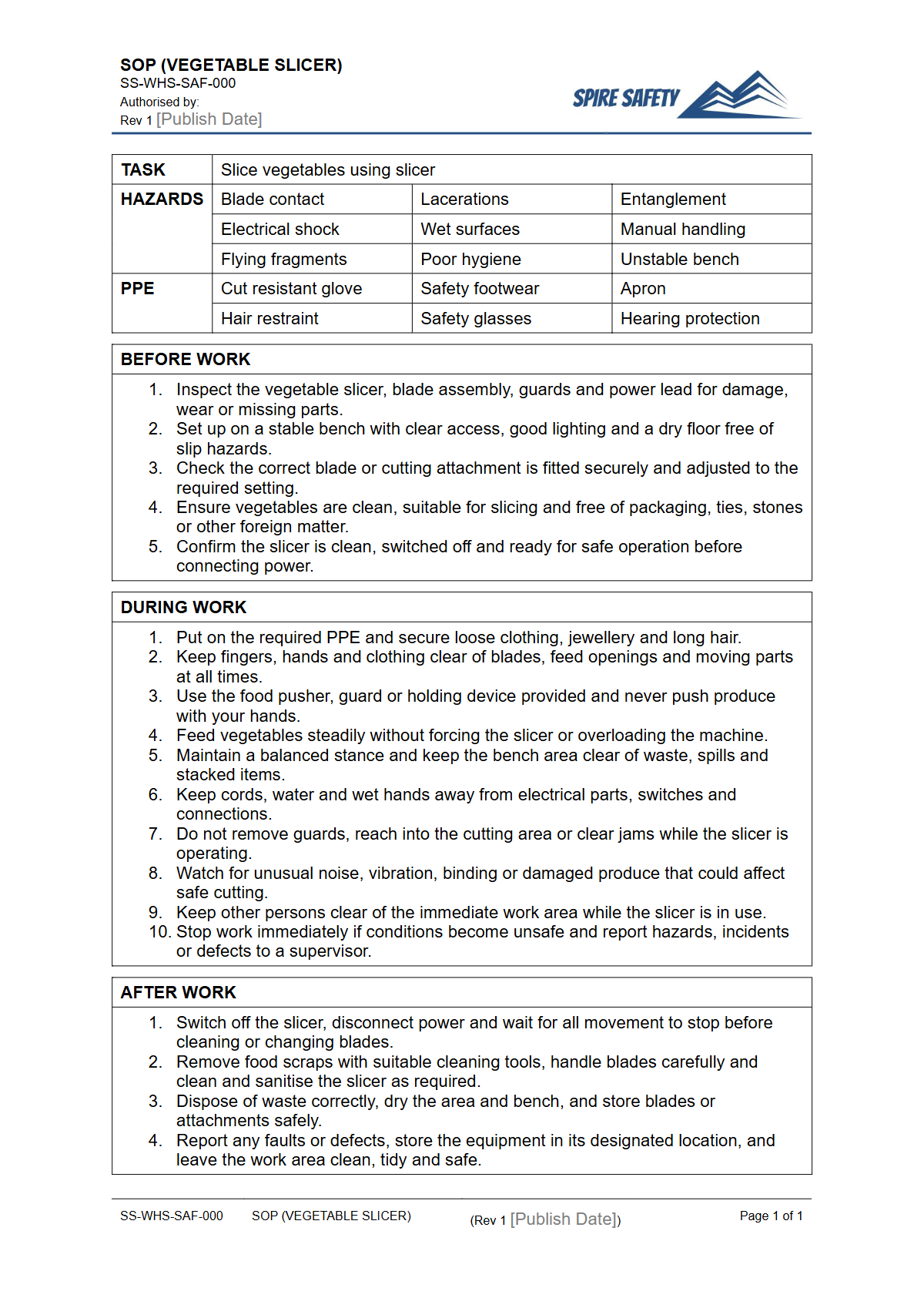
Download our free Safe Operating Procedure for vegetable slicers. This template helps you document safe work methods and manage kitchen hazards effectively.
Free Safe Operating Procedure (Vegetable Slicer) Template
DOCX • 126 KB + PDF
Updated Oct 2026
No signup required
Purpose of the Free Safe Operating Procedure (Vegetable Slicer) Template
Commercial vegetable slicers, particularly models with fast-moving blades, present significant risks in any kitchen environment. This free Safe Operating Procedure (Vegetable Slicer) Template provides a structured framework to document the required steps for operating this equipment safely.
Its primary purpose is to help Persons Conducting a Business or Undertaking (PCBUs) manage risks and fulfil their duty of care. Key hazards associated with vegetable slicers include severe cuts, lacerations, amputation from blade contact, entanglement of clothing or jewellery, and electrical hazards if damaged or used incorrectly.
By implementing a clear, written procedure, you establish a consistent benchmark for safe operation, cleaning, and maintenance. This document serves as a vital tool for worker training, induction, and ongoing supervision.
A documented SOP demonstrates a commitment to systematic safety, which is a cornerstone of effective WHS management systems. It ensures that every worker, regardless of experience, understands the approved method for using the machinery, the associated hazards, and the critical control measures required to prevent injury.
Video walkthrough
How to use the Free Safe Operating Procedure (Vegetable Slicer) Template
This template is provided in both DOCX and PDF formats for your convenience. The DOCX file is fully editable, allowing for comprehensive customisation to suit your specific workplace needs.
The process should involve consultation with the workers who will be using the equipment, as their direct experience is invaluable for identifying practical risks and effective controls.
To implement this SOP effectively:
- Download the Template: Start by downloading the DOCX version.
- Conduct a Risk Assessment: Before customising the document, perform a specific risk assessment on the vegetable slicer(s) used in your workplace. Consider the model, its condition, the location of use, and the tasks it is used for.
- Customise the Content: Populate the template with details specific to your equipment and operational context. This includes listing the required Personal Protective Equipment (PPE) like cut-resistant gloves and safety glasses, detailing pre-operational checks, outlining step-by-step operating instructions, and specifying cleaning and maintenance procedures, including lockout-tagout (LOTO) steps. The process is similar to creating a Safe Operating Procedure for a Deep Fryer, where equipment-specific details are critical.
- Consult and Train: Review the draft SOP with all relevant workers. Once finalised, use it as the basis for formal training sessions to ensure everyone understands and can apply the procedure correctly.
- Review and Update: The SOP should be a living document, reviewed regularly and updated whenever there is a change in equipment, procedures, or following any incident.
Important: This document is a template and not a complete safety solution. To ensure it is effective and suitable for your organisation, you must customise it to reflect the specific equipment, processes, and risks present in your workplace.
We cannot provide any guarantee of its suitability without this customisation. For complex environments, seeking professional WHS consulting services can help ensure all risks are adequately addressed.
When to use a Safe Operating Procedure
A Safe Operating Procedure for a vegetable slicer should be used as a primary reference document in several key situations. It must be integrated into the induction and training for any new employee tasked with operating the machine.
It also serves as the basis for refresher training to prevent complacency among experienced staff. The SOP should be readily accessible near the equipment for quick reference during operation.
Furthermore, this procedure is a critical tool during incident investigations. If a near miss or injury occurs, the SOP can be reviewed to determine if the procedure was followed and whether it needs to be updated to prevent a recurrence.
It should also be reviewed and updated whenever a new model of slicer is introduced or if the existing equipment is modified. In larger food processing facilities, this might be part of a suite of documents, including procedures like a Conveyer System SOP, to manage integrated production lines.
Who should use it
This SOP is intended for use by a range of personnel within a food service or processing environment. The primary users are the workers who directly operate the vegetable slicer, including chefs, kitchen hands, and food preparation staff.
They must be trained on the SOP's contents and follow it diligently.
Supervisors and managers are responsible for implementing the SOP, delivering training, and ensuring compliance on the floor. They use the document to guide their supervision and to conduct informal checks or formal observations.
WHS managers and business owners (PCBUs) use the SOP to fulfil their legal obligations, demonstrating that a safe system of work has been established for high-risk plant. Developing robust procedures for all high-risk tools, whether it's a vegetable slicer or a SOP for a circular saw, is a fundamental aspect of workplace safety management. For more templates and guidance, explore our extensive free WHS resources library.
Common mistakes
Common mistakes to avoid
- Using the slicer without the food pusher or safety guard in place.
- Attempting to clear blockages or clean the blade while the machine is still powered on.
- Failing to wear appropriate cut-resistant gloves during operation and especially during cleaning.
- Inadequate training for new or casual staff on the specific model of slicer used in the workplace.
Legal references
Legal considerations
The following legal requirements may be relevant to this type of work.
- Work Health and Safety Act (Harmonised) — Provides the primary duties for protecting workers and other people from work health and safety risks.
- Work Health and Safety Regulations (Harmonised) — Sets out requirements supporting the management of workplace hazards and risks.
The following codes may be relevant to this type of work.
- Managing WHS Risks Code of Practice — Provides practical guidance on identifying hazards, assessing risks and applying effective controls.
- Work Health and Safety Consultation, Cooperation and Coordination Code of Practice — Provides practical guidance on consulting workers and coordinating with other duty holders.
- Managing the Work Environment and Facilities Code of Practice — Provides practical guidance on safe work environments, workplace facilities and related controls.
Did you know
Blade Guard Importance
The most common cause of injury from vegetable slicers is operators bypassing or removing the safety guard, often to speed up cleaning or processing. These guards are a critical engineering control designed to prevent contact with the blade.
Lockout/Tagout Procedures
For cleaning and maintenance, slicers must be completely de-energised and locked out to prevent accidental start-up. This critical step, known as lockout/tagout (LOTO), is often missed in busy kitchens but is essential for preventing severe injuries.
FAQ
Frequently asked questions
01What must be included in a Safe Operating Procedure for a vegetable slicer?
02How often should a vegetable slicer SOP be reviewed?
03Are commercial vegetable slicers considered high-risk equipment?
04Who is responsible for training staff on the vegetable slicer SOP?
Share this resource
Free Safe Operating Procedure (Vegetable Slicer) Template
Browse Categories
How To Use It
- 1Download and open in Word or PDF.
- 2Replace the placeholders with your business details.
- 3Get it reviewed by a WHS specialist before rollout.
Need it customised?
Our WHS consultants can adapt this template to your site, run a gap analysis, or audit what you already have in place.
Book a Free Consultation WHS consulting servicesor call 1300 156 382
Related templates
- Free Safe Operating Procedure (Vegetation Around Signs) Template
- Free Safe Operating Procedure (Vegetation Hand Cutting) Template
- Free Safe Operating Procedure (Vegetation Removal) Template
- Free Safe Operating Procedure (Vehicle Access Control) Template
- Free Safe Operating Procedure (Vehicle Battery Change) Template
- Free Safe Operating Procedure (Vehicle Detailing) Template