
Free Safe Operating Procedure (Vehicle Detailing) Template
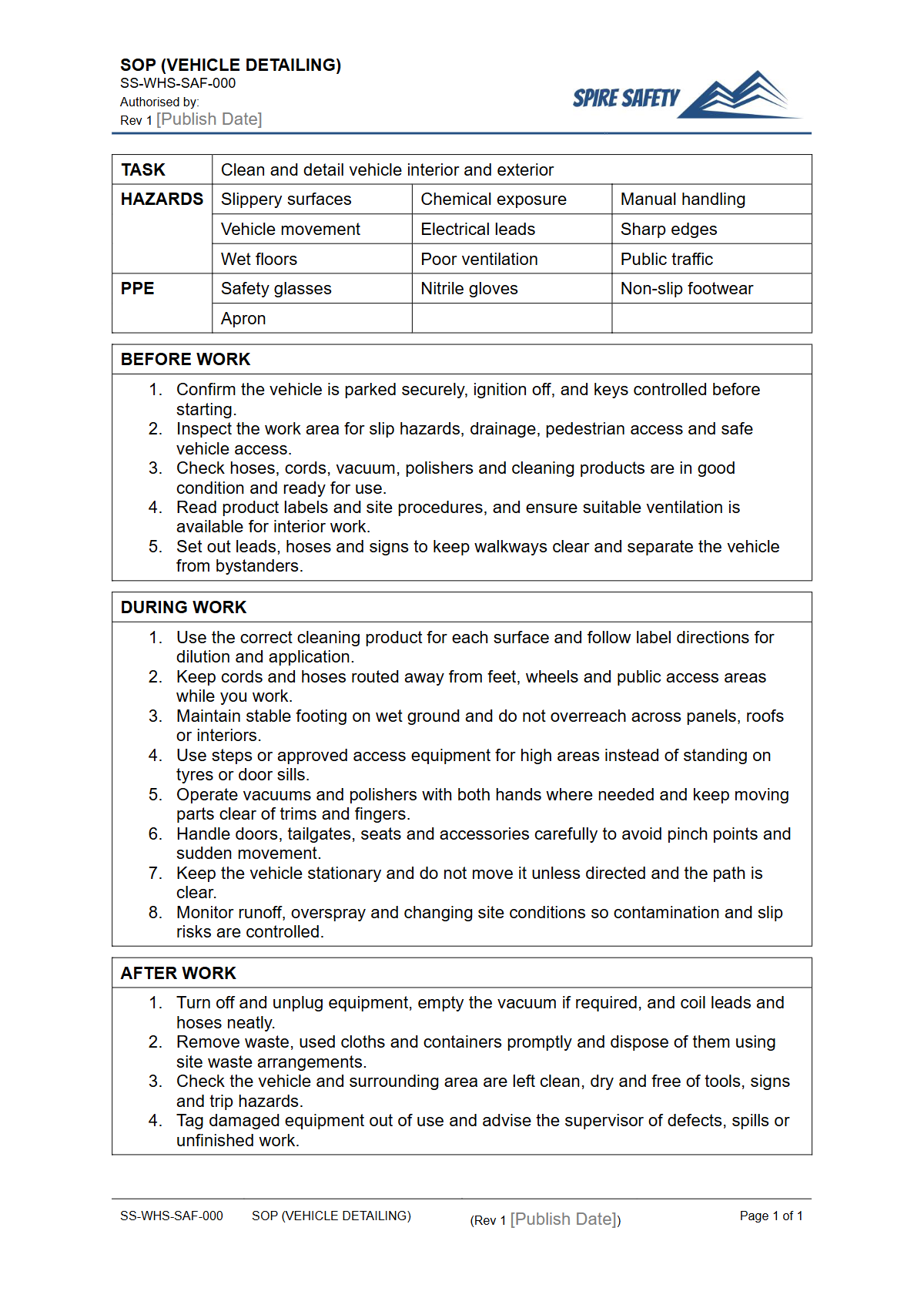
Download our free Safe Operating Procedure (SOP) for vehicle detailing to manage risks and formalise safe work practices. Get your customisable template today.
Free Safe Operating Procedure (Vehicle Detailing) Template
DOCX • 126 KB + PDF
Updated Oct 2026
No signup required
Purpose of the Free Safe Operating Procedure (Vehicle Detailing) Template
Vehicle detailing involves a range of hazards that can pose significant risks to workers if not properly managed. This free Safe Operating Procedure (Vehicle Detailing) Template provides a structured framework for identifying these hazards and implementing robust control measures.
A documented SOP is a critical tool for any business looking to formalise its commitment to safety, ensuring every task is performed consistently and safely, every time.
Key hazards addressed in a vehicle detailing context include:
- Chemical Exposure: Contact with detergents, solvents, acids, waxes, and coatings can cause skin irritation, respiratory issues, or long-term health effects.
- Manual Tasks: Repetitive motions from polishing, awkward postures while cleaning interiors, and lifting heavy equipment can lead to musculoskeletal injuries.
- Electrical Hazards: Use of powered equipment like buffers, polishers, and vacuums near water creates a risk of electric shock.
- Slips, Trips, and Falls: Wet floors are an inherent part of the job, increasing the risk of falls.
- Plant and Equipment: Incorrect use of high-pressure washers, air compressors, or other machinery can cause serious injury. For larger operations, this may even include automated washing lines, which require their own documentation like a conveyer system SOP.
By implementing this SOP, your organisation can systematically reduce the likelihood of incidents, demonstrate due diligence, and foster a proactive safety culture.
Video walkthrough
How to use the Free Safe Operating Procedure (Vehicle Detailing) Template
This document is a template, not a finished procedure. To make it effective, you must customise it to reflect the specific circumstances of your workplace.
Your process should involve downloading the DOCX file and editing it to detail your unique equipment, chemicals, work environment, and staff responsibilities.
Follow these steps to implement the SOP successfully:
- Customise: Add your company name and logo. Go through each section and replace the placeholder text with details specific to your site. List the exact brand names of chemicals used and reference their Safety Data Sheets (SDS).
- Consult: Discuss the draft procedure with your workers and any health and safety representatives. Their hands-on experience is invaluable for identifying practical risks and effective controls. This is a key requirement under Australian WHS law.
- Finalise and Train: Once finalised, formally train all relevant employees on the SOP. Ensure they understand the steps, the hazards, and the control measures required, including the correct use of Personal Protective Equipment (PPE). Keep records of this training.
- Review: Schedule regular reviews of the SOP (e.g., annually) or whenever there is a change in equipment, chemicals, processes, or after an incident or near miss.
An SOP is a fundamental part of a safety framework. For a more holistic approach to workplace safety, consider how this procedure integrates into broader WHS management systems that cover all aspects of your operation.
If your workshop also performs tasks like panel beating or mechanical repairs, you will need to develop procedures for those specific high-risk activities. As an example, tasks involving hot work would require a specific document such as an Oxy Acetylene SOP to manage fire and fume risks.
When to use a Vehicle Detailing Safe Operating Procedure
An SOP for vehicle detailing should be a living document, used actively within your daily operations rather than just sitting on a shelf. It is primarily used as a practical tool to ensure work is done safely.
Specific times to use the SOP include:
- Worker Training and Induction: It forms the basis of training for new employees and refresher training for existing staff.
- Pre-Task Planning: Workers should refer to the SOP before starting a detailing job to refresh their understanding of the required steps and safety controls.
- Supervision and Monitoring: Supervisors can use the SOP as a benchmark to monitor work practices and ensure procedures are being followed correctly.
- Incident Investigation: If an incident or near miss occurs, the SOP should be reviewed to determine if the procedure was followed and if it needs to be updated to prevent a recurrence.
Regularly reviewing the effectiveness of your implemented procedures is a sign of a mature safety system. A formal WHS compliance auditing process can help identify gaps and opportunities for improvement across all your safety documents.
Who should use this Safe Operating Procedure
This Safe Operating Procedure is intended for use by everyone involved in the vehicle detailing process within a business. A successful safety culture requires participation at all levels of the organisation.
Key users include:
- Persons Conducting a Business or Undertaking (PCBUs): Business owners and directors use the SOP to fulfil their primary duty of care to provide and maintain a safe system of work.
- Managers and Supervisors: They are responsible for implementing the SOP, ensuring workers are trained, and monitoring compliance on a day-to-day basis.
- Workers: The detailers and technicians performing the work must follow the procedure to ensure their own safety and the safety of others. They also have a responsibility to contribute to its review and improvement.
- WHS Representatives: They use the document as a reference point when consulting on safety matters and representing the interests of their work group.
The procedure should also guide the development of SOPs for specific equipment used in the detailing process. For instance, many workshops require a dedicated air compressor SOP to manage the risks of pressurised air and equipment failure.
For more templates, checklists, and safety guides, explore our complete free WHS resources library.
Common mistakes
Common mistakes to avoid
- Using a generic template without customising it for your specific chemicals, equipment, and worksite.
- Failing to provide or enforce the use of correct Personal Protective Equipment (PPE) for chemical handling.
- Neglecting to properly train all workers on the finalised SOP and document the training.
- Not reviewing and updating the procedure after a near miss, incident, or change in process.
Legal references
Legal considerations
The following legal requirements may be relevant to this type of work.
- Work Health and Safety Act (Harmonised) — Provides the primary duties for protecting workers and other people from work health and safety risks.
- Work Health and Safety Regulations (Harmonised) — Sets out requirements supporting the management of workplace hazards and risks.
The following codes may be relevant to this type of work.
- Managing WHS Risks Code of Practice — Provides practical guidance on identifying hazards, assessing risks and applying effective controls.
- Work Health and Safety Consultation, Cooperation and Coordination Code of Practice — Provides practical guidance on consulting workers and coordinating with other duty holders.
- Managing the Work Environment and Facilities Code of Practice — Provides practical guidance on safe work environments, workplace facilities and related controls.
Did you know
Ergonomic Risk
According to Safe Work Australia, technicians in the vehicle repair and service industry have a high rate of musculoskeletal disorders. Awkward postures and repetitive tasks common in detailing are significant contributing factors.
Chemical Sensitivity
Some automotive cleaning products contain volatile organic compounds (VOCs) that can cause respiratory irritation and other health issues. Proper ventilation and PPE are critical controls when working with these substances.
FAQ
Frequently asked questions
01What hazards should be included in a vehicle detailing SOP?
02Is a Safe Operating Procedure a legal requirement for car detailing in Australia?
03How often should I review my vehicle detailing SOP?
04What's the difference between an SOP and a SWMS for vehicle detailing?
Share this resource
Free Safe Operating Procedure (Vehicle Detailing) Template
Browse Categories
How To Use It
- 1Download and open in Word or PDF.
- 2Replace the placeholders with your business details.
- 3Get it reviewed by a WHS specialist before rollout.
Need it customised?
Our WHS consultants can adapt this template to your site, run a gap analysis, or audit what you already have in place.
Book a Free Consultation WHS consulting servicesor call 1300 156 382
Related templates
- Free Safe Operating Procedure (Vehicle Interior Cleaning) Template
- Free Safe Operating Procedure (Vehicle Jacking) Template
- Free Safe Operating Procedure (Vehicle Loading Check) Template
- Free Safe Operating Procedure (Vehicle Loading Ramp) Template
- Free Safe Operating Procedure (Vehicle Recovery Winch) Template
- Free Safe Operating Procedure (Vehicle Service Handover) Template