
Free Safe Operating Procedure (Vehicle Interior Cleaning) Template
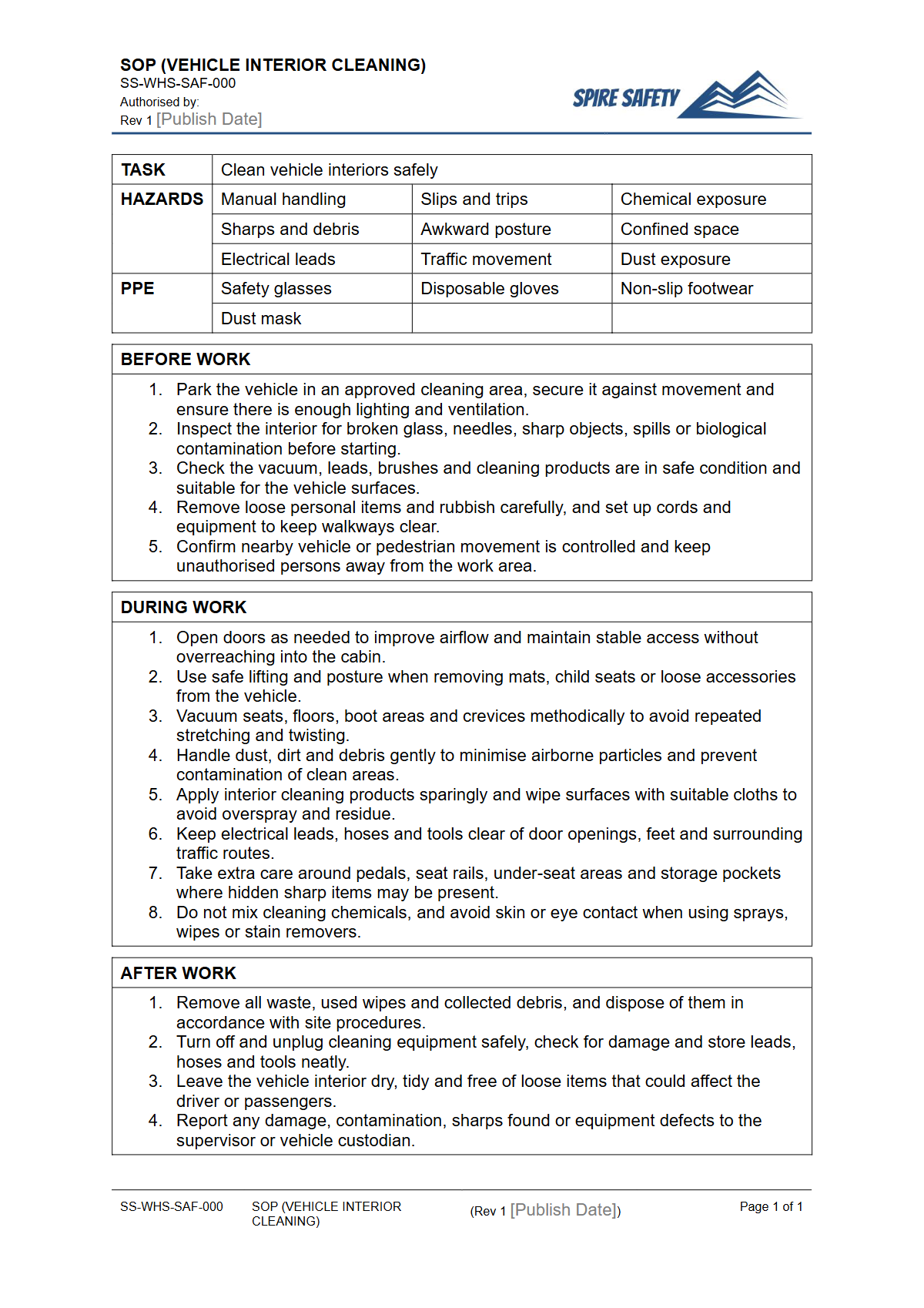
Formalise your safety process for cleaning vehicle interiors with our structured template. Download our free Safe Operating Procedure to get started.
Free Safe Operating Procedure (Vehicle Interior Cleaning) Template
DOCX • 126 KB + PDF
Updated Oct 2026
No signup required
Purpose of the Free Safe Operating Procedure (Vehicle Interior Cleaning) Template
This Free Safe Operating Procedure (Vehicle Interior Cleaning) Template provides a structured starting point for businesses to document a safe system of work for cleaning the inside of cars, trucks, buses, and other vehicles. Performing this task safely involves managing multiple risks, including exposure to hazardous chemicals, ergonomic strains from working in cramped spaces, and electrical hazards from cleaning equipment.
Using a formal SOP helps ensure workers follow a consistent, safe process every time, reducing the likelihood of injuries and incidents. It serves as a critical tool for training, supervision, and demonstrating a commitment to workplace safety.
A documented SOP is a fundamental component of a robust safety framework. By clearly defining steps, required PPE, and emergency responses, it helps a Person Conducting a Business or Undertaking (PCBU) meet their primary duty of care.
Integrating procedures like this one into your daily operations is a key part of building effective WHS management systems that protect your team and support your operational goals.
Video walkthrough
How to use the Free Safe Operating Procedure (Vehicle Interior Cleaning) Template
Our Free Safe Operating Procedure (Vehicle Interior Cleaning) Template is available in an editable DOCX format for easy customisation, as well as a printable PDF. To use it effectively, you must adapt it to the specific context of your workplace.
This involves conducting a risk assessment to identify the unique hazards associated with your tasks, equipment, chemicals, and work environment. Your procedure should list the specific cleaning products used, the makes and models of equipment, and the controls you have in place.
Important: This document is a template, not a finished procedure. We cannot know the specific hazards of your workplace.
You must add site-specific details to ensure it is relevant and effective for your business and consult with your workers during this process. If you need assistance with hazard identification or developing customised safety documents, engaging professional WHS consulting services can provide expert guidance.
When to use this Safe Operating Procedure
This Safe Operating Procedure should be used as a primary reference document before any vehicle interior cleaning task is undertaken. It is an essential resource for worker induction and training, ensuring new and existing employees understand the approved method for completing the job safely.
It should also be readily available in the work area for quick reference. The SOP is a living document that should be reviewed regularly, especially after an incident, when new equipment or chemicals are introduced, or when work processes change.
This ongoing review process is often a key area of focus during a WHS compliance auditing program.
Who should use it
This template is designed for any person or business involved in the commercial cleaning of vehicle interiors. This includes, but is not limited to:
- Automotive detailing businesses
- Car wash and cleaning services
- Fleet maintenance workshops
- Car rental agencies
- Public transport operators (bus, coach, and taxi companies)
- Heavy vehicle and transport logistics companies
- Plant and equipment hire companies
It should be used by managers and supervisors to establish and enforce safety standards, and by workers as a guide for performing their duties safely.
Key Hazards in Vehicle Interior Cleaning
Your customised SOP must address the specific hazards in your workplace. Common examples include:
Chemical Hazards
Many interior cleaners, stain removers, sanitisers, and deodorisers contain hazardous chemicals that can cause skin irritation, respiratory issues, or other health effects. Always have the Safety Data Sheet (SDS) for each product available and ensure workers are trained on its contents.
Documenting procedures for handling chemicals is a critical safety control, similar to how an Oxy Acetylene SOP details controls for managing gas and fire risks.
Ergonomic and Manual Handling Hazards
Cleaning inside a vehicle often requires working in awkward, stooped, or twisted postures for extended periods. This, combined with repetitive movements like vacuuming and scrubbing, can lead to musculoskeletal disorders (MSDs).
Your SOP should promote job rotation, stretching, and the use of tools that improve posture.
Electrical Hazards
Powered equipment such as vacuums, steam cleaners, and air compressors introduce the risk of electric shock, particularly in potentially damp environments. The SOP must include steps for pre-use equipment inspection, proper cord management, and avoiding contact with water. The principles are similar to those in other equipment-based procedures, such as our Free Air Compressor SOP Template.
Biological Hazards
Workers may be exposed to mould, bacteria, viruses, and bodily fluids left inside vehicles. The SOP should specify the required level of PPE (e.g., gloves, masks) and outline procedures for decontamination and safe disposal of contaminated waste.
By customising this template to address these and other site-specific risks, you can create a comprehensive SOP that effectively protects your workers. Explore our complete free WHS resources library for more templates to support your safety management system.
Common mistakes
Common mistakes to avoid
- Using unapproved cleaning chemicals brought from home, which may not have a Safety Data Sheet (SDS) available.
- Failing to ensure adequate ventilation by opening vehicle doors and windows, leading to a build-up of chemical fumes.
- Not wearing appropriate personal protective equipment (PPE), particularly gloves and safety glasses, when handling chemicals.
- Neglecting to inspect electrical equipment like vacuums and steam cleaners for damage before use.
Legal references
Legal considerations
The following legal requirements may be relevant to this type of work.
- Work Health and Safety Act (Harmonised) — Provides the primary duties for protecting workers and other people from work health and safety risks.
- Work Health and Safety Regulations (Harmonised) — Sets out requirements supporting the management of workplace hazards and risks.
The following codes may be relevant to this type of work.
- Managing WHS Risks Code of Practice — Provides practical guidance on identifying hazards, assessing risks and applying effective controls.
- Work Health and Safety Consultation, Cooperation and Coordination Code of Practice — Provides practical guidance on consulting workers and coordinating with other duty holders.
- Managing the Work Environment and Facilities Code of Practice — Provides practical guidance on safe work environments, workplace facilities and related controls.
Did you know
Hidden VOCs
Many car air fresheners and interior cleaning products release Volatile Organic Compounds (VOCs). In enclosed vehicle cabins, these can accumulate to levels that are significantly higher than outdoor air, posing a potential respiratory risk for workers.
Ergonomic Strain
Work-related musculoskeletal disorders are a leading cause of serious workers' compensation claims in Australia. Tasks involving sustained awkward postures, like cleaning vehicle interiors, are a known contributor to these types of injuries.
FAQ
Frequently asked questions
01What hazards should be included in a vehicle cleaning SOP?
02Is a Safe Operating Procedure legally required for vehicle cleaning?
03How often should we review our vehicle interior cleaning SOP?
04What is the difference between an SOP and a SWMS?
Share this resource
Free Safe Operating Procedure (Vehicle Interior Cleaning) Template
Browse Categories
How To Use It
- 1Download and open in Word or PDF.
- 2Replace the placeholders with your business details.
- 3Get it reviewed by a WHS specialist before rollout.
Need it customised?
Our WHS consultants can adapt this template to your site, run a gap analysis, or audit what you already have in place.
Book a Free Consultation WHS consulting servicesor call 1300 156 382
Related templates
- Free Safe Operating Procedure (Vehicle Jacking) Template
- Free Safe Operating Procedure (Vehicle Loading Check) Template
- Free Safe Operating Procedure (Vehicle Loading Ramp) Template
- Free Safe Operating Procedure (Vehicle Recovery Winch) Template
- Free Safe Operating Procedure (Vehicle Service Handover) Template
- Free Safe Operating Procedure (Vehicle Unloading Check) Template