
Free Safe Operating Procedure (Vehicle Unloading Check) Template
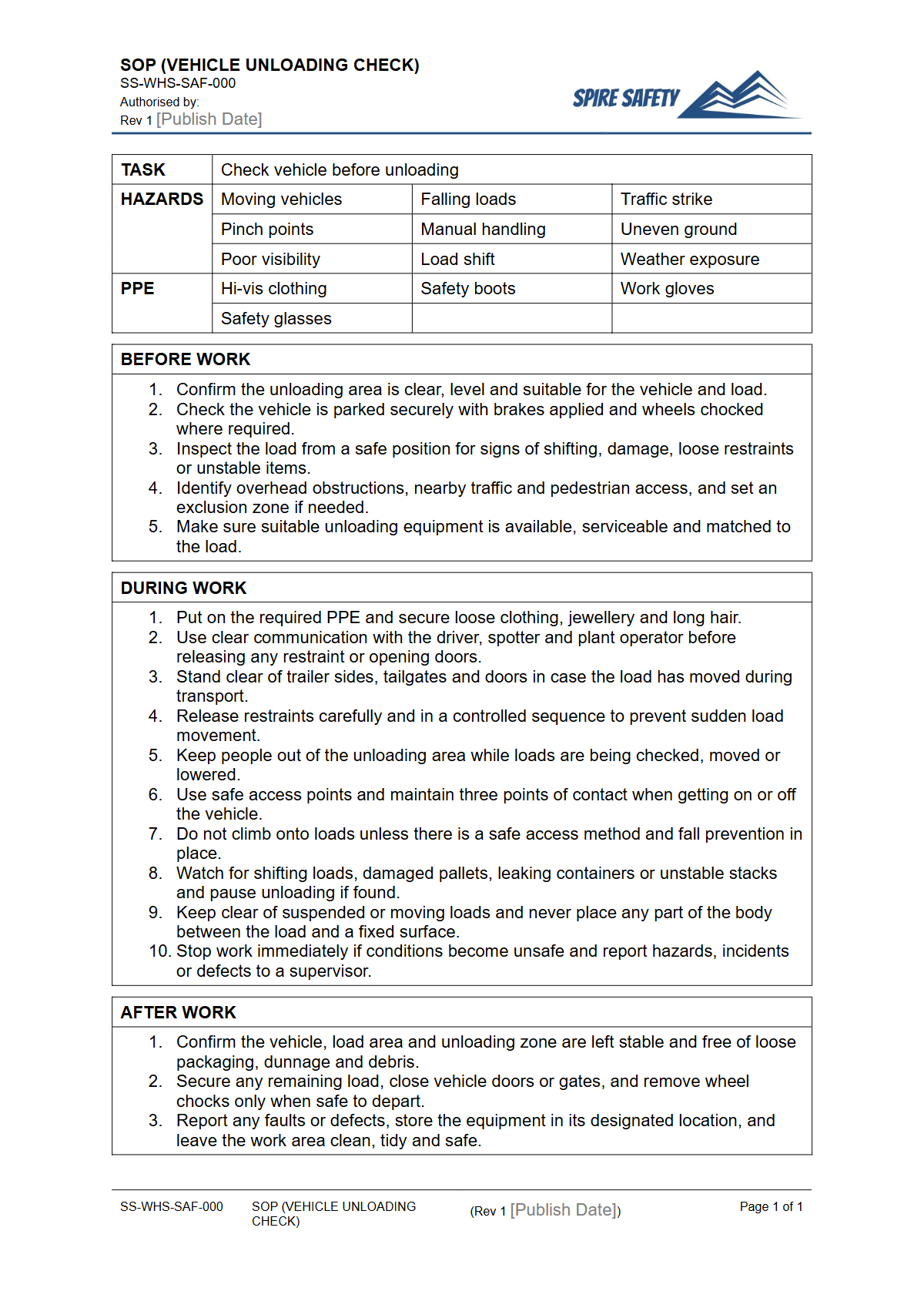
Control risks during vehicle unloading with a clear, step-by-step process. Download our free Safe Operating Procedure (Vehicle Unloading Check) template.
Free Safe Operating Procedure (Vehicle Unloading Check) Template
DOCX • 126 KB + PDF
Updated Oct 2026
No signup required
Purpose of the Free Safe Operating Procedure (Vehicle Unloading Check) Template
Unloading vehicles presents significant risks, including collisions between mobile plant and pedestrians, musculoskeletal injuries from manual handling, and property damage from falling loads. Implementing a documented procedure is a critical step in managing these hazards.
Our Free Safe Operating Procedure (Vehicle Unloading Check) Template provides a structured starting point for your business to formalise its approach to receiving goods safely and efficiently.
This Safe Operating Procedure (SOP) template helps your organisation define a consistent, step-by-step process for all workers to follow. By documenting the task, you create a valuable tool for worker training, induction, and supervision.
It also serves as evidence of your commitment to managing risks, a key duty for any PCBU (Person Conducting a Business or Undertaking) under Australian WHS legislation. An effective SOP is a fundamental building block for effective WHS management systems, ensuring safety controls are communicated clearly and applied consistently across your operations.
Video walkthrough
How to use the Free Safe Operating Procedure (Vehicle Unloading Check) Template
Download the template in your preferred format (DOCX for easy editing or PDF) and adapt it to your specific operational context. This document outlines a generic process that must be tailored to the realities of your workplace.
IMPORTANT: This is a template only. Spire Safety has provided a structured starting point aligned with Australian WHS practice, but you must customise it.
Your final SOP must reflect the specific vehicles, loads, equipment, site layout, and risks unique to your workplace. A generic document is not sufficient for compliance.
To customise the template effectively:
- Conduct a risk assessment for your specific unloading tasks and environment.
- Consult with your workers and supervisors who perform and oversee the unloading tasks. Their direct experience is invaluable for identifying practical risks and controls.
- Define clear roles and responsibilities for drivers, unloaders, supervisors, and traffic controllers.
- Specify the exact Personal Protective Equipment (PPE) required, such as high-visibility clothing, safety footwear, and gloves.
- Detail procedures for the specific plant used, such as forklifts or cranes. Your process may need to reference other documents, like our FREE Telehandler SOP Template, for equipment-specific instructions.
If you are uncertain about how to conduct the necessary risk assessments or tailor the document to your legal obligations, it is wise to seek expert WHS consulting to ensure your procedures are robust and effective.
Key Elements of a Vehicle Unloading Procedure
A comprehensive SOP for vehicle unloading should address every stage of the process. Use the template to document your organisation's specific controls for these key areas:
Pre-Arrival and Site Entry
Detail how drivers are inducted to site rules before or upon arrival. This includes designated routes, speed limits, communication protocols, and PPE requirements.
Ensure there is a clear process for checking the driver in and directing them safely to the unloading bay or area.
Unloading Zone Preparation
Describe how the unloading area is secured. This must include establishing and communicating clear exclusion zones to separate pedestrians and other vehicles from the immediate work area.
The procedure should also cover checking that the ground surface is stable, level, and clear of obstructions.
Load Check and Unloading
Outline the steps for visually inspecting the load for any signs of movement or instability that may have occurred during transit. Specify the approved method for unloading, whether by forklift, crane, or manual handling. If goods are transferred directly to processing equipment, you may also need a free Conveyer System SOP.
Training and Supervision
A documented procedure is only useful if it is understood and followed. Your SOP should be a central part of your training program for all relevant personnel.
Supervisors must be empowered to monitor adherence to the procedure, correct unsafe behaviour, and stop work if conditions become hazardous. Regular reviews and observations, sometimes as part of a formal WHS compliance auditing program, can verify that the SOP is being implemented effectively on the ground.
Reviewing Your Safe Operating Procedure
Safety management is a continuous process. Your Vehicle Unloading SOP should be a living document, reviewed regularly to ensure it remains current and effective. A review should be triggered:
- After any incident or near miss involving vehicle unloading.
- When new types of vehicles, loads, or unloading equipment are introduced.
- If the layout of the workplace changes.
- On a scheduled basis, typically every one to two years, as part of a routine document review cycle.
By maintaining and improving your safety documents, you foster a proactive safety culture. For more tools to support your safety management system, explore our complete free WHS resources library.
Common mistakes
Common mistakes to avoid
- Assuming delivery drivers are aware of your site's specific safety rules and traffic management plan.
- Failing to establish and clearly communicate a physical exclusion zone around the vehicle and unloading equipment.
- Using incorrect equipment for the load, such as a forklift with the wrong attachment or capacity.
- Neglecting to inspect the load for shifting or instability before starting to unload.
Legal references
Legal considerations
The following legal requirements may be relevant to this type of work.
- Work Health and Safety Act (Harmonised) — Provides the primary duties for protecting workers and other people from work health and safety risks.
- Work Health and Safety Regulations (Harmonised) — Sets out requirements supporting the management of workplace hazards and risks.
The following codes may be relevant to this type of work.
- Managing WHS Risks Code of Practice — Provides practical guidance on identifying hazards, assessing risks and applying effective controls.
- Work Health and Safety Consultation, Cooperation and Coordination Code of Practice — Provides practical guidance on consulting workers and coordinating with other duty holders.
- Managing the Work Environment and Facilities Code of Practice — Provides practical guidance on safe work environments, workplace facilities and related controls.
Did you know
A High-Risk Industry
According to Safe Work Australia, the transport, postal, and warehousing industry consistently has one of the highest rates of serious injury claims, with vehicle incidents being a major cause.
Exclusion Zones are Key
Establishing and enforcing exclusion zones—areas where pedestrians and unauthorised vehicles are not permitted—is one of the most effective controls for preventing collisions in loading and unloading areas.
FAQ
Frequently asked questions
01What is the difference between an SOP and a SWMS?
02Is a vehicle unloading check legally required in Australia?
03Who is responsible for safety during vehicle unloading?
04How often should we review our Vehicle Unloading SOP?
Share this resource
Free Safe Operating Procedure (Vehicle Unloading Check) Template
Browse Categories
How To Use It
- 1Download and open in Word or PDF.
- 2Replace the placeholders with your business details.
- 3Get it reviewed by a WHS specialist before rollout.
Need it customised?
Our WHS consultants can adapt this template to your site, run a gap analysis, or audit what you already have in place.
Book a Free Consultation WHS consulting servicesor call 1300 156 382
Related templates
- Free Safe Operating Procedure (Vehicle Washing) Template
- Free Safe Operating Procedure (Veneer Lathe) Template
- Free Safe Operating Procedure (Vent Bag Installation) Template
- Free Safe Operating Procedure (Ventilation Blower) Template
- Free Safe Operating Procedure (Venue Seating Setup) Template
- Free Safe Operating Procedure (Vertical Lifeline) Template