
Free Safe Operating Procedure (Vent Bag Installation) Template
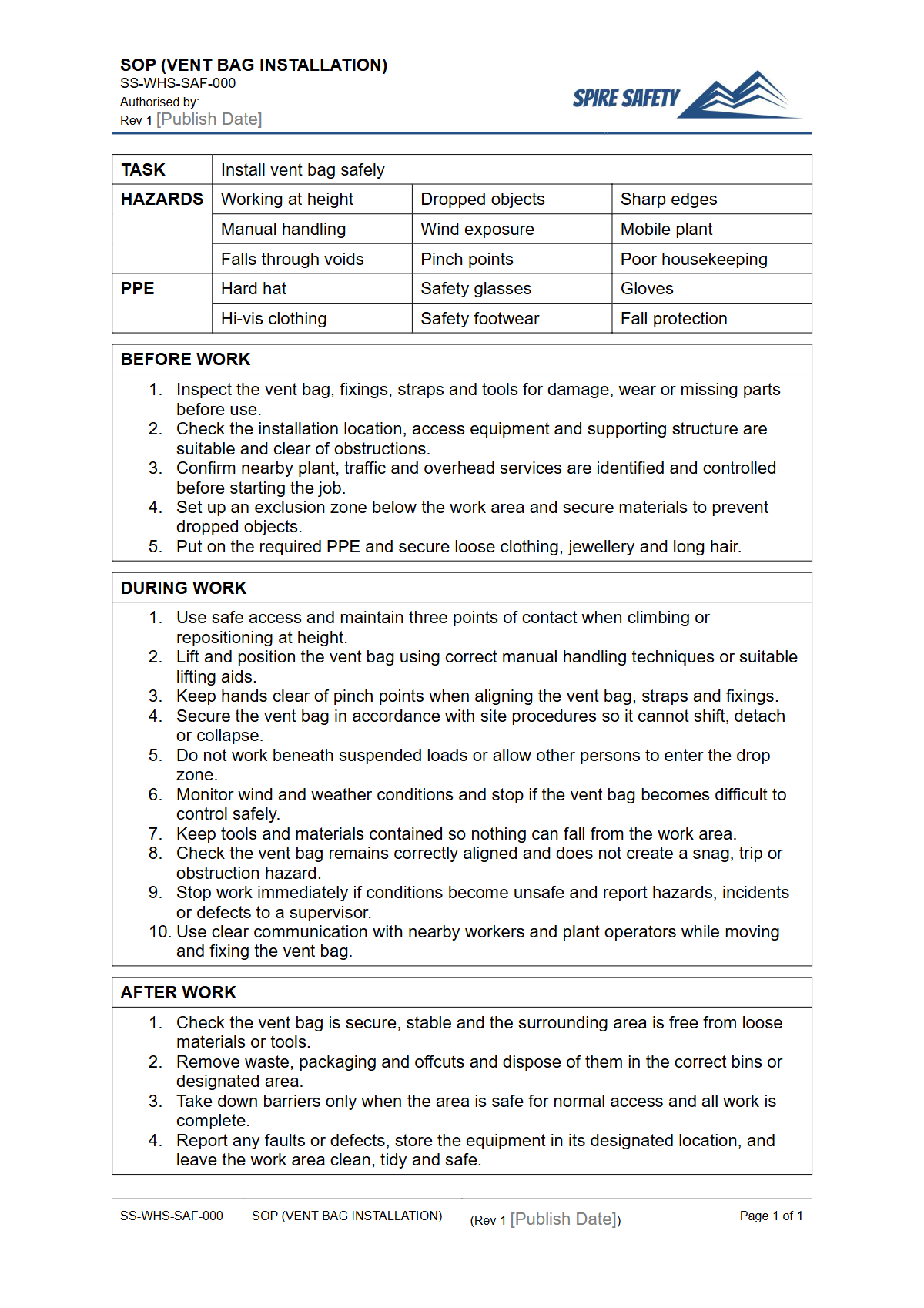
Clearly outline the safety steps for vent bag installation with our comprehensive template. Download this free Safe Operating Procedure to get started.
Free Safe Operating Procedure (Vent Bag Installation) Template
DOCX • 126 KB + PDF
Updated Oct 2026
No signup required
Purpose of the Free Safe Operating Procedure (Vent Bag Installation) Template
Installing ventilation bags, particularly in mining, tunnelling, or large-scale construction, is a task with significant risks if not managed correctly. This Free Safe Operating Procedure (Vent Bag Installation) Template provides a structured framework for documenting the required safety controls.
It guides your team through the process step-by-step, from pre-start checks and site preparation to the final installation and inspection. Using a formal SOP helps standardise your process, ensuring that every worker understands the hazards and the measures needed to control them, such as poor air quality, manual handling injuries, and entanglement risks.
A well-defined SOP is a critical component of a compliant and effective safety framework. It serves as a training tool for new workers and a reference for experienced personnel, promoting a consistent and safety-focused approach to the task. Integrating this procedure into your operations demonstrates a commitment to proactively managing workplace risks and forms a key part of a robust WHS management system.
Hazards Addressed in the Vent Bag Installation SOP
This template prompts you to consider and control common hazards associated with vent bag installation, including:
- Atmospheric Hazards: Exposure to dust, fumes, or oxygen-deficient atmospheres before ventilation is established.
- Manual Handling: Strains and sprains from lifting, carrying, and positioning heavy or awkward vent bag sections.
- Slips, Trips, and Falls: Working on uneven ground, around equipment, or at heights.
- Entanglement & Struck-by: Risks from moving vehicles, machinery, or the ventilation fan itself.
- Noise: Exposure to high noise levels from fans and other site equipment.
- Stored Energy: Uncontrolled release of air pressure or electrical hazards associated with the ventilation fan.
Video walkthrough
How to use the Free Safe Operating Procedure (Vent Bag Installation) Template
This template is provided in both DOCX and PDF formats for your convenience. The DOCX file is fully editable, allowing you to tailor the content to the specific equipment, environment, and regulations of your worksite.
To use it effectively, download the document and work with your team—including operators and supervisors—to fill in the details unique to your operation. This includes specifying the types of vent bags used, the tools required, site-specific hazards, and your organisation's emergency procedures.
Important: This is a template only. For it to be useful, we stress that you must customise it to reflect the actual conditions and risks of your workplace. A generic procedure that doesn't align with your specific tasks is not an effective control measure.
A task like this often involves ancillary equipment, and you may also need our free Air Compressor SOP to cover associated plant.
When to use a Vent Bag Installation SOP
A Safe Operating Procedure for vent bag installation should be used every time the task is performed. It is especially critical in the following situations:
- Initial Installation: When setting up a new ventilation system in an underground mine, tunnel, or large enclosed structure.
- Extensions and Modifications: Whenever the ventilation circuit is extended or altered as work progresses into new areas.
- Maintenance and Repair: When sections of the vent bag line are being replaced, repaired, or inspected.
- Training and Induction: As a core document for training new workers or refreshing the knowledge of existing employees on the correct, safe procedure.
- Incident Investigation: As a benchmark to review whether established procedures were followed after a safety incident or near miss.
Documenting procedures for key tasks helps ensure operational discipline. For tasks involving heavy plant, it's wise to have specific SOPs ready, such as our free Telehandler SOP Template for materials handling.
Who should use this Safe Operating Procedure
This SOP is intended for use by various personnel within an organisation to ensure the task is planned, supervised, and executed safely. Key users include:
- Workers/Operators: The individuals directly responsible for carrying out the installation. They must follow the procedure to ensure their own safety and the safety of their colleagues.
- Supervisors and Team Leaders: Responsible for ensuring that workers are trained on the SOP, have the necessary resources, and are following the procedure correctly. They use it to conduct pre-start briefings and monitor the work.
- WHS/HSE Advisors: Health and safety personnel use the SOP as part of risk assessments, safety audits, and training program development. They are often responsible for developing, reviewing, and updating the procedure.
Ultimately, the SOP is a tool for the entire team to create a shared understanding of how to perform the job safely. Regular reviews and WHS compliance auditing can verify that the SOP is being implemented effectively. To cover the use of other common equipment on site, you may also require a Safe Operating Procedure for conveyer systems.
Common mistakes
Common mistakes to avoid
- Using damaged, torn, or leaking vent bags, which compromises airflow and ventilation efficiency.
- Failing to adequately secure bag sections and suspension points, leading to collapse or detachment.
- Neglecting to conduct pre-start checks of the ventilation fan, power source, and surrounding area.
- Incorrectly joining bag sections, creating restrictions, twists, or leaks that impede airflow.
Legal references
Legal considerations
The following legal requirements may be relevant to this type of work.
- Work Health and Safety Act (Harmonised) — Provides the primary duties for protecting workers and other people from work health and safety risks.
- Work Health and Safety Regulations (Harmonised) — Sets out requirements supporting the management of workplace hazards and risks.
The following codes may be relevant to this type of work.
- Managing WHS Risks Code of Practice — Provides practical guidance on identifying hazards, assessing risks and applying effective controls.
- Work Health and Safety Consultation, Cooperation and Coordination Code of Practice — Provides practical guidance on consulting workers and coordinating with other duty holders.
- Managing the Work Environment and Facilities Code of Practice — Provides practical guidance on safe work environments, workplace facilities and related controls.
Did you know
Ventilation is Key
In underground mining and tunnelling, vent bags are critical for delivering fresh air and removing hazardous gases like methane and carbon monoxide, making their correct installation a life-saving task.
Material Matters
Vent bags are typically made from durable, tear-resistant, and flame-retardant PVC or vinyl-coated polyester fabric to withstand the harsh conditions found in underground and construction environments.
FAQ
Frequently asked questions
01What is a Safe Operating Procedure for vent bag installation?
02Why is a specific SOP needed for installing vent bags?
03Who is responsible for creating and implementing a Vent Bag Installation SOP?
04How often should a Vent Bag Installation SOP be reviewed?
Share this resource
Free Safe Operating Procedure (Vent Bag Installation) Template
Browse Categories
How To Use It
- 1Download and open in Word or PDF.
- 2Replace the placeholders with your business details.
- 3Get it reviewed by a WHS specialist before rollout.
Need it customised?
Our WHS consultants can adapt this template to your site, run a gap analysis, or audit what you already have in place.
Book a Free Consultation WHS consulting servicesor call 1300 156 382
Related templates
- Free Safe Operating Procedure (Ventilation Blower) Template
- Free Safe Operating Procedure (Venue Seating Setup) Template
- Free Safe Operating Procedure (Vertical Lifeline) Template
- Free Safe Operating Procedure (Vet Animal Bedding) Template
- Free Safe Operating Procedure (Vet Animal Transfer) Template
- Free Safe Operating Procedure (Vet Cage Cleaning) Template