
Free Safe Operating Procedure (Vet Animal Bedding) Template
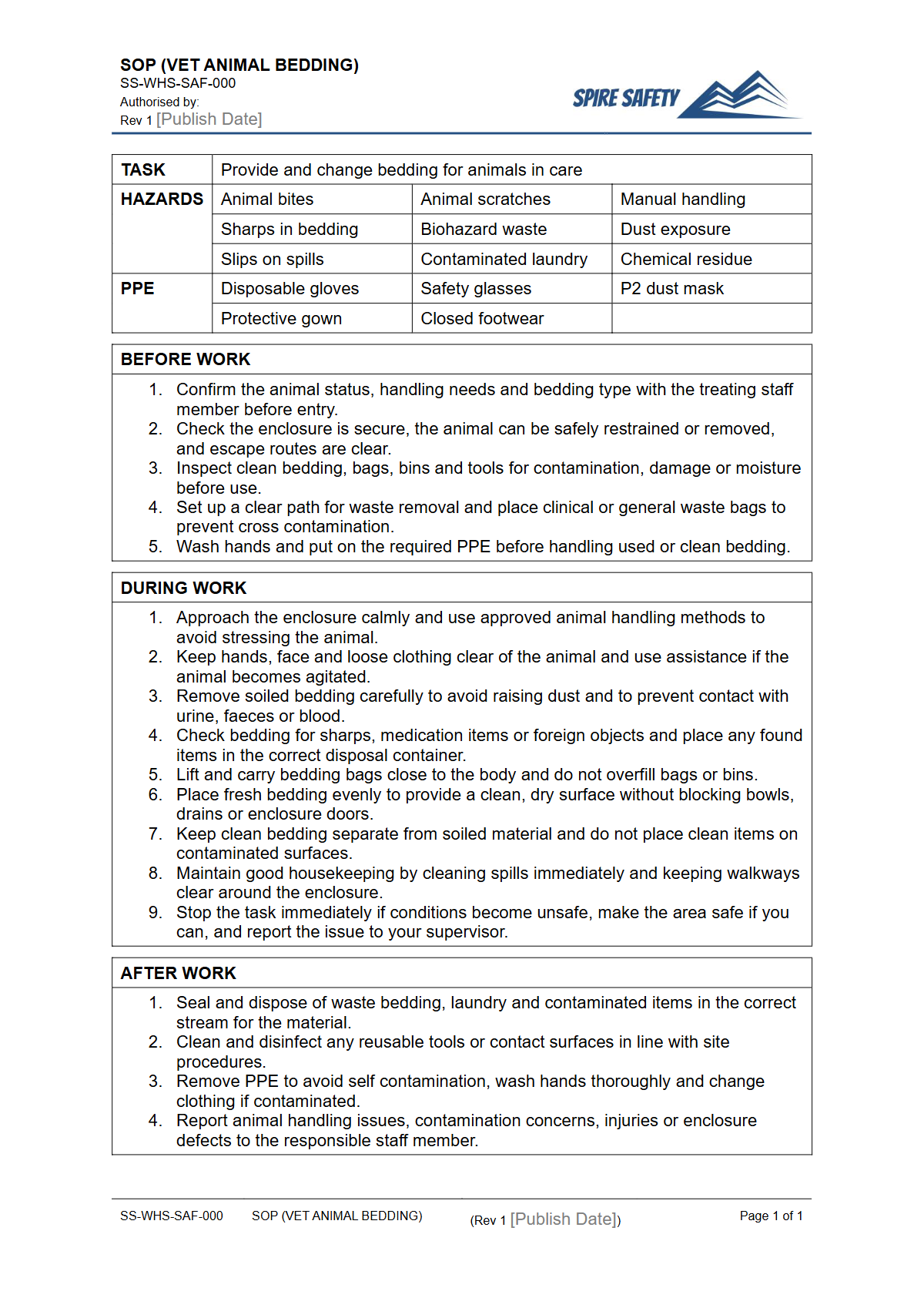
Download our free Safe Operating Procedure (Vet Animal Bedding) Template to guide your team on safe handling. This template helps you document key risks.
Free Safe Operating Procedure (Vet Animal Bedding) Template
DOCX • 126 KB + PDF
Updated Oct 2026
No signup required
Purpose of the Free Safe Operating Procedure (Vet Animal Bedding) Template
Veterinary clinics, animal shelters, and research facilities require clear, documented processes for routine tasks to ensure worker safety. This free Safe Operating Procedure (Vet Animal Bedding) Template provides a structured starting point for managing the risks associated with changing and handling animal bedding.
The primary purpose is to minimise exposure to hazards such as biological agents, dust, chemicals, and ergonomic strains.
Using a standardised SOP helps ensure every worker performs the task consistently and safely, reducing the likelihood of injury or illness. Key risks addressed include manual handling of heavy bedding bags, exposure to zoonotic diseases from animal waste, respiratory irritation from dust, and chemical exposure from cleaning agents.
Documenting these steps is a fundamental part of robust WHS management systems and demonstrates a commitment to workplace safety.
Video walkthrough
How to use the Free Safe Operating Procedure (Vet Animal Bedding) Template
This Safe Operating Procedure (Vet Animal Bedding) Template is designed as a foundational document. It is not a complete, ready-to-use procedure.
You must adapt it to the specific context of your workplace, including the types of animals housed, the bedding materials used (e.g., wood shavings, straw, paper), and the cleaning chemicals approved for use.
Important: We strongly recommend you conduct a site-specific risk assessment and consult with your workers before finalising the document. Customise the steps, PPE requirements, and emergency procedures to reflect your unique operational environment.
In larger facilities, soiled bedding may be moved via automated systems, which would necessitate a dedicated Conveyer System SOP to manage associated mechanical hazards.
Once customised, the SOP should be used as a training tool for new employees and for refresher training for existing staff. Regular reviews, often as part of scheduled WHS compliance auditing, ensure the procedure remains relevant and effective.
When to use it
A Safe Operating Procedure for vet animal bedding should be in place and communicated to all relevant personnel before they are first assigned the task. It is a critical document for induction and ongoing training.
The SOP should be actively referenced and reviewed in several situations:
- During initial worker training and onboarding.
- As a basis for periodic refresher training sessions.
- When a new type of bedding material or cleaning agent is introduced.
- Following a workplace incident or near-miss related to the task.
- As part of an annual review of all workplace safety procedures.
If a review identifies significant gaps or changes in your processes, you may benefit from external advice to ensure best practice. Seeking professional WHS consulting can provide valuable insight into complex risk management challenges.
Who should use it
This SOP is intended for all individuals involved in the lifecycle of animal bedding within a veterinary or animal care setting. This includes:
- Veterinary Nurses and Technicians: Who regularly change bedding in cages and enclosures.
- Animal Attendants and Kennel Hands: Whose primary duties often involve cleaning and husbandry.
- Clinic or Facility Managers: Responsible for implementing safety procedures, providing training, and ensuring compliance.
- WHS/OHS Officers and Representatives: Who oversee the development, implementation, and review of safety documentation.
By ensuring everyone understands and follows the same procedure, organisations can create a safer and more predictable work environment. You can find more templates to support your safety system in our free WHS resources library.
Common mistakes
Common mistakes to avoid
- Forgetting to customise the template for the specific bedding types and chemicals used in the workplace.
- Providing inadequate or incorrect PPE, or failing to train staff on its proper use and maintenance.
- Using poor manual handling techniques when lifting heavy bags of new bedding or disposing of soiled waste.
- Neglecting to consult with workers who perform the task when developing or updating the procedure.
Legal references
Legal considerations
The following legal requirements may be relevant to this type of work.
- Work Health and Safety Act (Harmonised) — Provides the primary duties for protecting workers and other people from work health and safety risks.
- Work Health and Safety Regulations (Harmonised) — Sets out requirements supporting the management of workplace hazards and risks.
The following codes may be relevant to this type of work.
- Managing WHS Risks Code of Practice — Provides practical guidance on identifying hazards, assessing risks and applying effective controls.
- Work Health and Safety Consultation, Cooperation and Coordination Code of Practice — Provides practical guidance on consulting workers and coordinating with other duty holders.
- Managing the Work Environment and Facilities Code of Practice — Provides practical guidance on safe work environments, workplace facilities and related controls.
Did you know
Zoonotic Disease Risk
Soiled animal bedding can be a transmission vector for zoonotic diseases—illnesses that can pass from animals to humans. Proper handling procedures are a key infection control measure in any animal care facility.
Bedding Dust
Dust from certain types of animal bedding, like some wood shavings, can be a respiratory sensitiser. Repeated, unprotected exposure can potentially lead to occupational asthma or other respiratory conditions.
FAQ
Frequently asked questions
01What are the main hazards when changing vet animal bedding?
02Does this SOP template cover all types of animal bedding?
03How often should an SOP for animal bedding be reviewed?
04Is PPE required for changing animal bedding?
Share this resource
Free Safe Operating Procedure (Vet Animal Bedding) Template
Browse Categories
How To Use It
- 1Download and open in Word or PDF.
- 2Replace the placeholders with your business details.
- 3Get it reviewed by a WHS specialist before rollout.
Need it customised?
Our WHS consultants can adapt this template to your site, run a gap analysis, or audit what you already have in place.
Book a Free Consultation WHS consulting servicesor call 1300 156 382
Related templates
- Free Safe Operating Procedure (Vet Animal Transfer) Template
- Free Safe Operating Procedure (Vet Cage Cleaning) Template
- Free Safe Operating Procedure (Vet Cage Waste Cleanup) Template
- Free Safe Operating Procedure (Vet Kennel Cleaning) Template
- Free Safe Operating Procedure (Vet Laundry Handling) Template
- Free Safe Operating Procedure (Vet Room Cleaning) Template