
Free Safe Operating Procedure (Vet Kennel Cleaning) Template
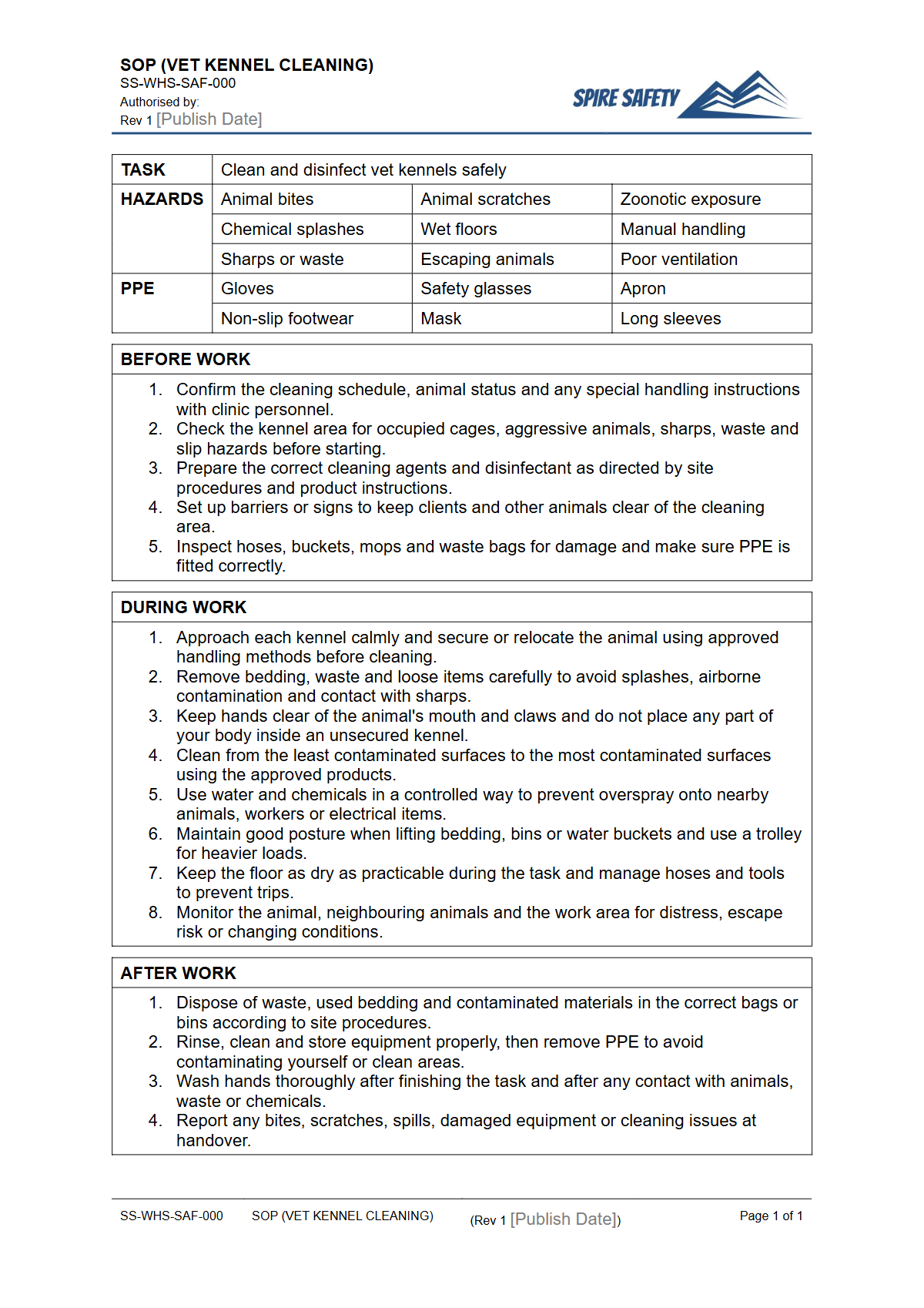
Download our free Safe Operating Procedure for vet kennel cleaning. This template provides a structured starting point for developing your clinic's safety protocols.
Free Safe Operating Procedure (Vet Kennel Cleaning) Template
DOCX • 126 KB + PDF
Updated Oct 2026
No signup required
Purpose of the Free Safe Operating Procedure (Vet Kennel Cleaning) Template
Veterinary clinics face unique workplace hazards, and cleaning kennels is a task that combines many of them: manual handling, exposure to biological agents, and the use of hazardous chemicals. This Free Safe Operating Procedure (Vet Kennel Cleaning) Template provides a structured framework for documenting the safest, most effective way to perform this essential task.
Its purpose is to help persons conducting a business or undertaking (PCBUs) manage risks and meet their primary duty of care under Australian WHS laws.
By clearly outlining required steps, personal protective equipment (PPE), and emergency procedures, an SOP helps standardise work methods, reduce the risk of injury or illness, and ensure a consistent level of hygiene and safety. A well-developed SOP is a critical component of a comprehensive WHS management system, demonstrating a commitment to proactive risk management for your staff and the animals in their care.
Video walkthrough
How to use the Free Safe Operating Procedure (Vet Kennel Cleaning) Template
This template is a starting point designed for customisation. Download the DOCX or PDF and adapt it to the specific context of your veterinary practice.
Effective customisation involves consulting with the workers who actually perform the cleaning tasks—their direct experience is invaluable for identifying practical hazards and effective controls.
Note: This document is a template and must be customised to your specific workplace. We are not responsible for the implementation or suitability of this procedure in your workplace.
Consultation with your team and site-specific risk assessments are essential.
When customising, you must detail the specific disinfectants and cleaning agents used, their Safety Data Sheets (SDS), correct dilution ratios, and required contact times. You should also integrate procedures for any specific equipment used in the cleaning process.
If your clinic uses machinery like pressure washers, you must also develop equipment-specific procedures, similar to our Free Air Compressor SOP, to cover its unique risks.
Key Hazards to Address
When adapting this Safe Operating Procedure, ensure your risk assessment and documented steps account for these common hazards:
- Biological Hazards: Exposure to zoonotic diseases (illnesses transmissible from animals to humans) such as ringworm, giardia, or leptospirosis through contact with animal waste, saliva, or dander.
- Hazardous Chemicals: Skin contact, inhalation, or eye exposure to concentrated disinfectants, detergents, and other cleaning agents. Incorrect mixing can create toxic gases or reduce efficacy. The principles of chemical safety here are similar to those in other sanitisation-heavy environments, as detailed in resources like a Safe Operating Procedure for a Deep Fryer.
- Manual Handling: Musculoskeletal injuries from lifting heavy animals, moving cages, carrying buckets of water, and adopting awkward postures while scrubbing or reaching.
- Slips, Trips, and Falls: Wet floors are an ever-present hazard during and after cleaning operations. Hoses, buckets, and other equipment can also create trip hazards.
When to use a Safe Operating Procedure
A Safe Operating Procedure for vet kennel cleaning should be used consistently as a core operational document. It is essential for training new vet nurses and kennel hands, ensuring they learn the correct, safe method from day one.
It also serves as a benchmark for refresher training for existing staff and for performance monitoring.
Furthermore, the SOP is a critical reference tool during incident investigations. If an injury or near-miss occurs, the procedure can be reviewed to determine if it was followed and whether it needs to be updated to prevent a recurrence.
Periodic reviews are vital for maintaining relevance, a process that can be strengthened through professional WHS compliance auditing to ensure your systems remain effective.
Who should use it
This SOP is intended for all personnel involved in the cleaning and maintenance of animal enclosures in a veterinary setting. This includes:
- Veterinary Nurses
- Kennel Hands and Animal Attendants
- Clinic Managers and Supervisors
- Work Health and Safety (WHS) Officers
Managers and supervisors are responsible for ensuring the SOP is implemented, understood, and followed by all relevant staff. They must also provide the necessary training, supervision, and PPE.
For complex clinic environments, seeking guidance from WHS consulting professionals can help ensure your procedures are robust and practical.
By using this template and exploring our wider free WHS resources library, you can build a stronger foundation for safety management in your practice.
Common mistakes
Common mistakes to avoid
- Using a generic SOP without customising it for specific chemicals, equipment, and layouts of the clinic.
- Failing to adequately train staff on the finalised procedure and confirm their understanding.
- Neglecting to provide or enforce the use of the specified Personal Protective Equipment (PPE).
- Using incorrect dilution ratios for disinfectants, which can either be ineffective or create a chemical hazard.
Legal references
Legal considerations
The following legal requirements may be relevant to this type of work.
- Work Health and Safety Act (Harmonised) — Provides the primary duties for protecting workers and other people from work health and safety risks.
- Work Health and Safety Regulations (Harmonised) — Sets out requirements supporting the management of workplace hazards and risks.
The following codes may be relevant to this type of work.
- Managing WHS Risks Code of Practice — Provides practical guidance on identifying hazards, assessing risks and applying effective controls.
- Work Health and Safety Consultation, Cooperation and Coordination Code of Practice — Provides practical guidance on consulting workers and coordinating with other duty holders.
- Managing the Work Environment and Facilities Code of Practice — Provides practical guidance on safe work environments, workplace facilities and related controls.
Did you know
Zoonotic Risk
The Australian Veterinary Association notes that over 70 diseases can be transmitted from animals to humans. Effective cleaning and disinfection protocols are a primary barrier against zoonotic transmission in clinical settings.
Chemical Exposure
Studies have shown that veterinary technicians can have a higher risk of occupational asthma and respiratory issues, partly linked to repeated exposure to cleaning chemicals and disinfectants without adequate ventilation or PPE.
FAQ
Frequently asked questions
01What key information should be in a Safe Operating Procedure for vet kennel cleaning?
02How often should our veterinary clinic review its cleaning SOPs?
03Is using this SOP template enough to be WHS-aligned?
04What is the difference between a Safe Operating Procedure (SOP) and a Safe Work Method Statement (SWMS)?
Share this resource
Free Safe Operating Procedure (Vet Kennel Cleaning) Template
Browse Categories
How To Use It
- 1Download and open in Word or PDF.
- 2Replace the placeholders with your business details.
- 3Get it reviewed by a WHS specialist before rollout.
Need it customised?
Our WHS consultants can adapt this template to your site, run a gap analysis, or audit what you already have in place.
Book a Free Consultation WHS consulting servicesor call 1300 156 382
Related templates
- Free Safe Operating Procedure (Vet Laundry Handling) Template
- Free Safe Operating Procedure (Vet Room Cleaning) Template
- Free Safe Operating Procedure (Vet Waiting Room Clean) Template
- Free Safe Operating Procedure (Vet Waste Handling) Template
- Free Safe Operating Procedure (Vibrating Screed) Template
- Free Safe Operating Procedure (Vibrating Screen) Template