
Free Safe Operating Procedure (Vibrating Screen) Template
Download our free Safe Operating Procedure for vibrating screens. This customisable template helps you outline operational steps and control WHS risks.
Free Safe Operating Procedure (Vibrating Screen) Template
DOCX • 126 KB + PDF
Updated Oct 2026
No signup required
Purpose of the Free Safe Operating Procedure (Vibrating Screen) Template
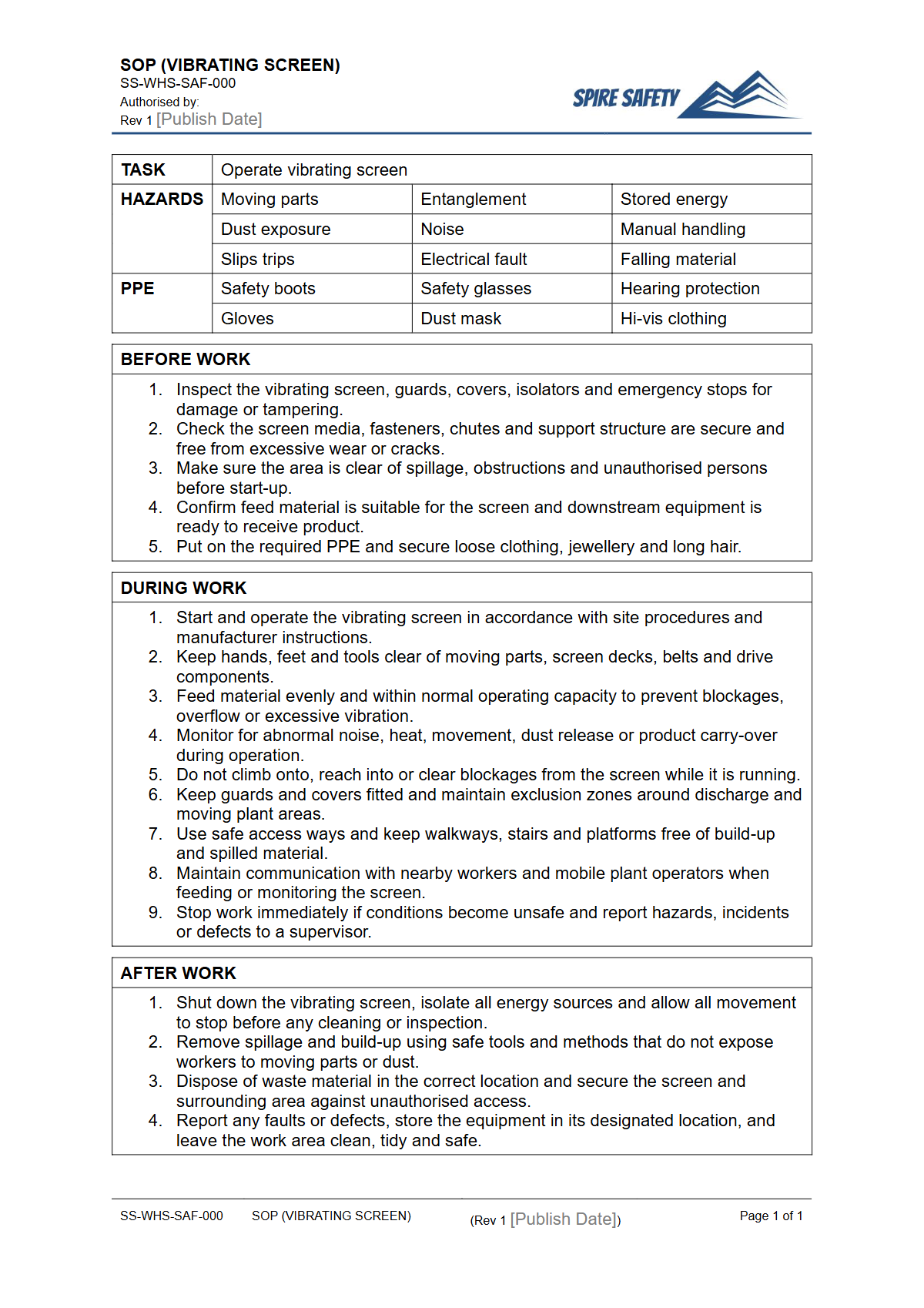
This Free Safe Operating Procedure (Vibrating Screen) Template provides a structured framework for documenting the steps required to operate vibrating screens safely. Vibrating screens, common in mining, quarrying, and recycling industries, present significant hazards including mechanical entanglement, noise, vibration, airborne dust, and risks associated with cleaning and maintenance.
A documented SOP is a critical tool for managing these risks, ensuring that all personnel follow a consistent, approved method for each task. It serves as a key component of your overall safety framework, helping to meet your duty of care under Australian WHS legislation.
Implementing robust SOPs is fundamental to building effective WHS management systems. This template helps formalise your processes, providing clear instructions to operators and maintenance staff. By clearly outlining pre-start checks, operational steps, shutdown procedures, and emergency responses, it helps reduce the likelihood of incidents and injuries.
It also serves as an essential training resource for new employees and a reference for experienced workers, promoting a consistent safety culture across the organisation.
Video walkthrough
How to use the Free Safe Operating Procedure (Vibrating Screen) Template
This template is provided in both DOCX and PDF formats for your convenience. The DOCX version is fully editable, allowing you to tailor the content to your specific operational context.
It is designed as a comprehensive starting point, aligned with the principles of the model WHS framework. However, you must adapt it to reflect the unique aspects of your workplace, including the specific make and model of your vibrating screen, the materials being processed, and your established control measures.
To effectively use this resource, follow these steps:
- Download: Choose the DOCX file to begin customisation.
- Consult: Work with operators, supervisors, and maintenance personnel who use the equipment daily. Their direct knowledge is invaluable for creating a practical and effective procedure.
- Customise: Modify the document to include details specific to your site. This includes adding your company branding, specifying the exact locations of emergency stops, detailing the types of PPE required, and referencing adjacent equipment like that covered in a conveyer system SOP.
- Review and Approve: Once customised, the SOP should be reviewed and formally approved by a competent person within your organisation, such as a manager or WHS representative.
- Train and Implement: Ensure all relevant workers are trained on the new SOP before it is implemented. Keep records of this training.
Important: This document is a template only. We are not WHS consultants providing advice.
You must adapt this Safe Operating Procedure to the specific equipment, tasks, and hazards found in your workplace. Its effectiveness is entirely dependent on your thorough and accurate customisation.
When to use it
A Safe Operating Procedure for a vibrating screen should be used as the primary reference document for all tasks involving the machine. It is not a document to be filed away; it should be readily accessible to workers at or near the point of use.
Its application is crucial during several key phases of operation.
Specific situations include:
- Pre-operational Checks: Before starting the machine for a shift, operators must follow the SOP to inspect for damage, check guarding, and ensure the work area is clear.
- Normal Operation: The SOP guides the operator on how to start, monitor, and shut down the screen under routine conditions.
- Cleaning and Maintenance: It outlines the lock-out tag-out (LOTO) procedures required before any maintenance, inspection, or cleaning tasks are performed to prevent accidental start-up. Tasks like clearing blockages or cleaning may involve other tools, which also require documented procedures, such as a free Air Compressor SOP if using compressed air.
- Emergency Situations: The SOP provides clear instructions on how to respond to common emergencies, such as a machine blockage, fire, or medical incident.
Who should use it
This SOP is intended for all personnel who interact with or work in the vicinity of vibrating screens. A clear understanding and consistent application of the procedure across different roles is essential for maintaining a safe work environment.
Key users include:
- Plant Operators: The primary users of the SOP, who rely on it for daily guidance on safe operation, pre-start checks, and shutdown processes.
- Maintenance Personnel: Fitters and technicians must follow the SOP, particularly the sections on isolation, LOTO, and safe maintenance practices, before commencing any work on the machine.
- Supervisors and Managers: Responsible for ensuring operators are trained on the SOP and that its procedures are being followed correctly. They also use it as a tool for incident investigations and performance reviews. Regular reviews of SOPs and other safety documents can be integrated into a broader WHS compliance auditing program.
- WHS Representatives and Committees: This group uses the SOP to assist in risk assessments, workplace inspections, and consultative processes regarding plant safety. For complex sites with multiple types of heavy equipment, such as those requiring a free Scraper SOP template, expert guidance may be needed to ensure all procedures integrate seamlessly.
Developing and implementing these procedures can be complex. If you require assistance tailoring templates or developing a complete safety management system, consider engaging professional WHS consulting services.
You can find this and many other helpful documents in our complete free WHS resources library, designed to support Australian businesses in their safety efforts.
Common mistakes
Common mistakes to avoid
- Using a generic 'off-the-shelf' SOP without customising it for the specific machine and site conditions.
- Failing to implement a strict lock-out tag-out (LOTO) procedure before any cleaning, maintenance, or clearing of blockages.
- Neglecting pre-start checks, leading to operation of the machine with faulty guards or other defects.
- Poor dust suppression, leading to workers being exposed to hazardous airborne contaminants like crystalline silica.
Legal references
Legal considerations
The following legal requirements may be relevant to this type of work.
- Work Health and Safety Act (Harmonised) — Provides the primary duties for protecting workers and other people from work health and safety risks.
- Work Health and Safety Regulations (Harmonised) — Sets out requirements supporting the management of workplace hazards and risks.
The following codes may be relevant to this type of work.
- Managing WHS Risks Code of Practice — Provides practical guidance on identifying hazards, assessing risks and applying effective controls.
- Work Health and Safety Consultation, Cooperation and Coordination Code of Practice — Provides practical guidance on consulting workers and coordinating with other duty holders.
- Managing the Work Environment and Facilities Code of Practice — Provides practical guidance on safe work environments, workplace facilities and related controls.
Did you know
Invisible Vibration Risk
Whole-Body Vibration (WBV) from standing on platforms near vibrating screens can cause musculoskeletal disorders over time. The risk isn't just from direct contact but also from the vibrations transmitted through the structure.
Noise Hazard
A typical vibrating screen can operate at levels well over 100 decibels (dB), far exceeding the 85 dB exposure standard where hearing protection becomes mandatory. Without proper controls and PPE, permanent hearing loss can occur rapidly.
FAQ
Frequently asked questions
01What are the main hazards of a vibrating screen?
02How often should a Safe Operating Procedure for a vibrating screen be reviewed?
03Is a Safe Operating Procedure a legal requirement in Australia?
04What should be included in training for operating a vibrating screen?
Share this resource
Free Safe Operating Procedure (Vibrating Screen) Template
Browse Categories
How To Use It
- 1Download and open in Word or PDF.
- 2Replace the placeholders with your business details.
- 3Get it reviewed by a WHS specialist before rollout.
Need it customised?
Our WHS consultants can adapt this template to your site, run a gap analysis, or audit what you already have in place.
Book a Free Consultation WHS consulting servicesor call 1300 156 382
Related templates
- Free Safe Operating Procedure (Vibration Logger) Template
- Free Safe Operating Procedure (Vibration Meter) Template
- Free Safe Operating Procedure (Vibratory Feeder) Template
- Free Safe Operating Procedure (Vibro Hammer) Template
- Free Safe Operating Procedure (Vine Training) Template
- Free Safe Operating Procedure (Vineyard Pruning) Template