
Free Safe Operating Procedure (Vibration Meter) Template
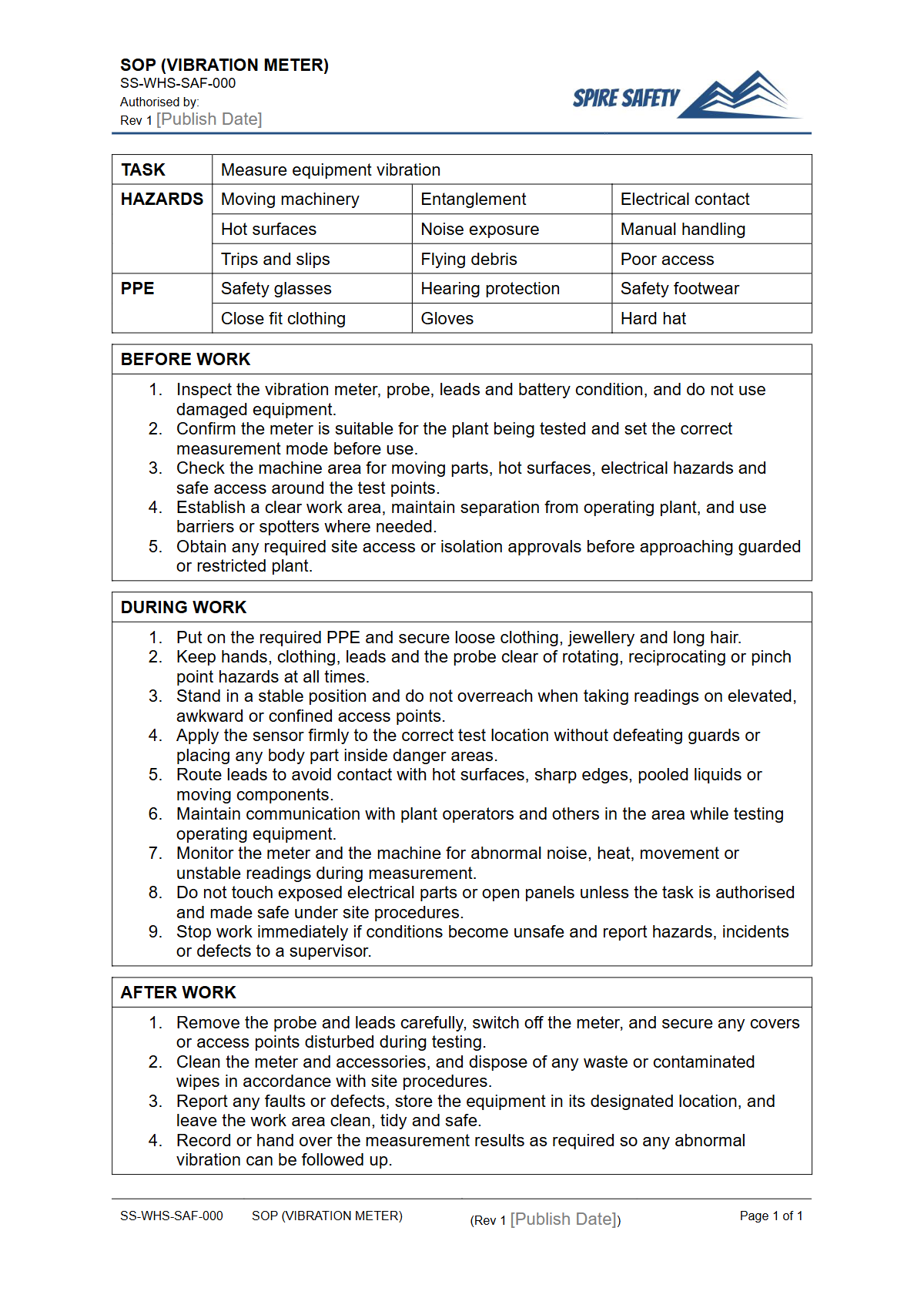
Document the safe use of vibration meters to monitor workplace exposure risks. Download our Free Safe Operating Procedure (Vibration Meter) Template today.
Free Safe Operating Procedure (Vibration Meter) Template
DOCX • 126 KB + PDF
Updated Oct 2026
No signup required
Purpose of the Free Safe Operating Procedure (Vibration Meter) Template
Measuring exposure to hand-arm vibration (HAV) and whole-body vibration (WBV) is a critical component of managing workplace health and safety risks. This Free Safe Operating Procedure (Vibration Meter) Template provides a structured framework for documenting the correct and safe use of vibration measurement equipment.
Using a standardised procedure helps ensure that data collection is consistent, accurate, and repeatable, which is essential for conducting reliable risk assessments and verifying the effectiveness of control measures. This SOP is designed to guide workers through the pre-operational checks, safe operation, and post-operational steps for using a vibration meter, aligning with Australian WHS best practices.
A well-defined SOP minimises the risk of operator error, which could lead to inaccurate readings and flawed conclusions about vibration exposure levels. It formalises the process, covering key aspects like equipment calibration, correct sensor placement, measurement duration, and data recording.
Implementing a formal procedure also demonstrates an organisation's commitment to proactively managing hazards associated with vibrating plant and tools. This can be a vital part of a comprehensive WHS management system, helping to protect workers from conditions like 'vibration white finger' and musculoskeletal disorders.
Video walkthrough
How to use the Free Safe Operating Procedure (Vibration Meter) Template
This document serves as a comprehensive starting point for your organisation. After downloading the DOCX or PDF file, you should customise it to reflect your specific operational context.
Start by adding your company name, logo, and other relevant details in the designated fields. The most critical step is to adapt the procedural steps to match the specific make and model of the vibration meter you use, as well as the types of tools, plant, and environments being assessed.
Important: This is a template and must be customised to our specific workplace. We must review the content and edit it to detail the exact equipment we use (brand, model), the tasks performed, and the unique hazards and control measures relevant to our site.
This customisation is a key part of fulfilling our WHS duties. For example, when measuring vibration from specific equipment, you may also need a dedicated SOP for that tool, such as our FREE Circular Saw SOP (Safe Operating Procedure) Template to ensure the task itself is performed safely during measurement.
When to use a Vibration Meter SOP
A Safe Operating Procedure for a vibration meter should be implemented and followed whenever vibration measurements are required. This typically occurs in several key scenarios:
- Initial Risk Assessments: When identifying and assessing hazards associated with new tools, machinery, or work processes that are known to produce significant vibration.
- Verification of Controls: After implementing control measures (e.g., introducing low-vibration tools, anti-vibration gloves, or damped seating), a meter is used to verify their effectiveness in reducing exposure.
- Health Monitoring: As part of an ongoing health surveillance program, especially in industries where workers are regularly exposed to high levels of HAV or WBV.
- Incident Investigation: Following reports of symptoms or near misses related to vibration exposure, to quantify the risk and inform corrective actions.
- Compliance Checks: During routine safety checks or formal WHS compliance auditing to ensure exposure levels remain below the national exposure standards.
Using a vibration meter is essential for gathering objective data. Relying solely on manufacturer data can be misleading, as real-world vibration levels are heavily influenced by factors like operator technique, tool maintenance, and the material being worked on. For heavy machinery, you might need SOPs for both the machine and the measurement process, like those for high-vibration plant found in our FREE Trencher SOP (Safe Operating Procedure) Template.
Who should use this Safe Operating Procedure
This SOP is intended for personnel who are responsible for conducting workplace monitoring and risk assessments. This includes, but is not limited to:
- WHS Advisors and Officers: Professionals tasked with managing the organisation's safety programs and ensuring compliance with WHS legislation.
- Occupational Hygienists: Specialists who measure and assess workplace hazards, including physical hazards like vibration.
- Site Supervisors and Managers: Individuals responsible for the direct oversight of workers and the implementation of safety procedures on the ground.
- Competent Workers: Any employee who has received specific training and been deemed competent to operate the vibration meter according to manufacturer instructions and established procedures.
It is crucial that anyone using a vibration meter is competent to do so. This involves more than just knowing how to turn the device on; it requires an understanding of the principles of vibration, correct sensor attachment, setting appropriate measurement parameters, and interpreting the results.
Without this competency, the data collected can be meaningless or, worse, dangerously misleading. The use of specialist equipment like this is often covered in task-specific procedures, similar to our Free Air Compressor SOP (Safe Operating Procedure) Template, where correct operation is key to safety. To find other relevant templates and checklists, you can explore our full free WHS resources library.
Common mistakes
Common mistakes to avoid
- Using an uncalibrated meter or failing to perform pre-use field checks.
- Incorrectly positioning the sensor on the tool handle or operator's body.
- Measuring for a non-representative time period that doesn't capture typical exposure.
- Failing to document environmental factors and task variables that could affect readings.
Legal references
Legal considerations
The following legal requirements may be relevant to this type of work.
- Work Health and Safety Act (Harmonised) — Provides the primary duties for protecting workers and other people from work health and safety risks.
- Work Health and Safety Regulations (Harmonised) — Sets out requirements supporting the management of workplace hazards and risks.
The following codes may be relevant to this type of work.
- Managing WHS Risks Code of Practice — Provides practical guidance on identifying hazards, assessing risks and applying effective controls.
- Work Health and Safety Consultation, Cooperation and Coordination Code of Practice — Provides practical guidance on consulting workers and coordinating with other duty holders.
- Managing the Work Environment and Facilities Code of Practice — Provides practical guidance on safe work environments, workplace facilities and related controls.
Did you know
Two Types of Vibration
Workplace vibration is categorised into Hand-Arm Vibration (HAV), transmitted from power tools to a worker's hands, and Whole-Body Vibration (WBV), transmitted through the seat or feet from vehicles and industrial machinery.
Vibration White Finger
Hand-Arm Vibration Syndrome (HAVS) is often called 'vibration white finger'. It's a permanent condition that damages nerves and blood vessels, causing numbness, tingling, and loss of dexterity in the hands and fingers.
FAQ
Frequently asked questions
01What is a vibration meter used for in WHS?
02Is special training required to use a vibration meter?
03How often should a vibration meter be calibrated?
04Does this SOP template cover all types of vibration meters?
Share this resource
Free Safe Operating Procedure (Vibration Meter) Template
Browse Categories
How To Use It
- 1Download and open in Word or PDF.
- 2Replace the placeholders with your business details.
- 3Get it reviewed by a WHS specialist before rollout.
Need it customised?
Our WHS consultants can adapt this template to your site, run a gap analysis, or audit what you already have in place.
Book a Free Consultation WHS consulting servicesor call 1300 156 382
Related templates
- Free Safe Operating Procedure (Vibratory Feeder) Template
- Free Safe Operating Procedure (Vibro Hammer) Template
- Free Safe Operating Procedure (Vine Training) Template
- Free Safe Operating Procedure (Vineyard Pruning) Template
- Free Safe Operating Procedure (Vinyl Cutter) Template
- Free Safe Operating Procedure (Visitor Wheelchair Use) Template