
Free Safe Operating Procedure (Visitor Wheelchair Use) Template
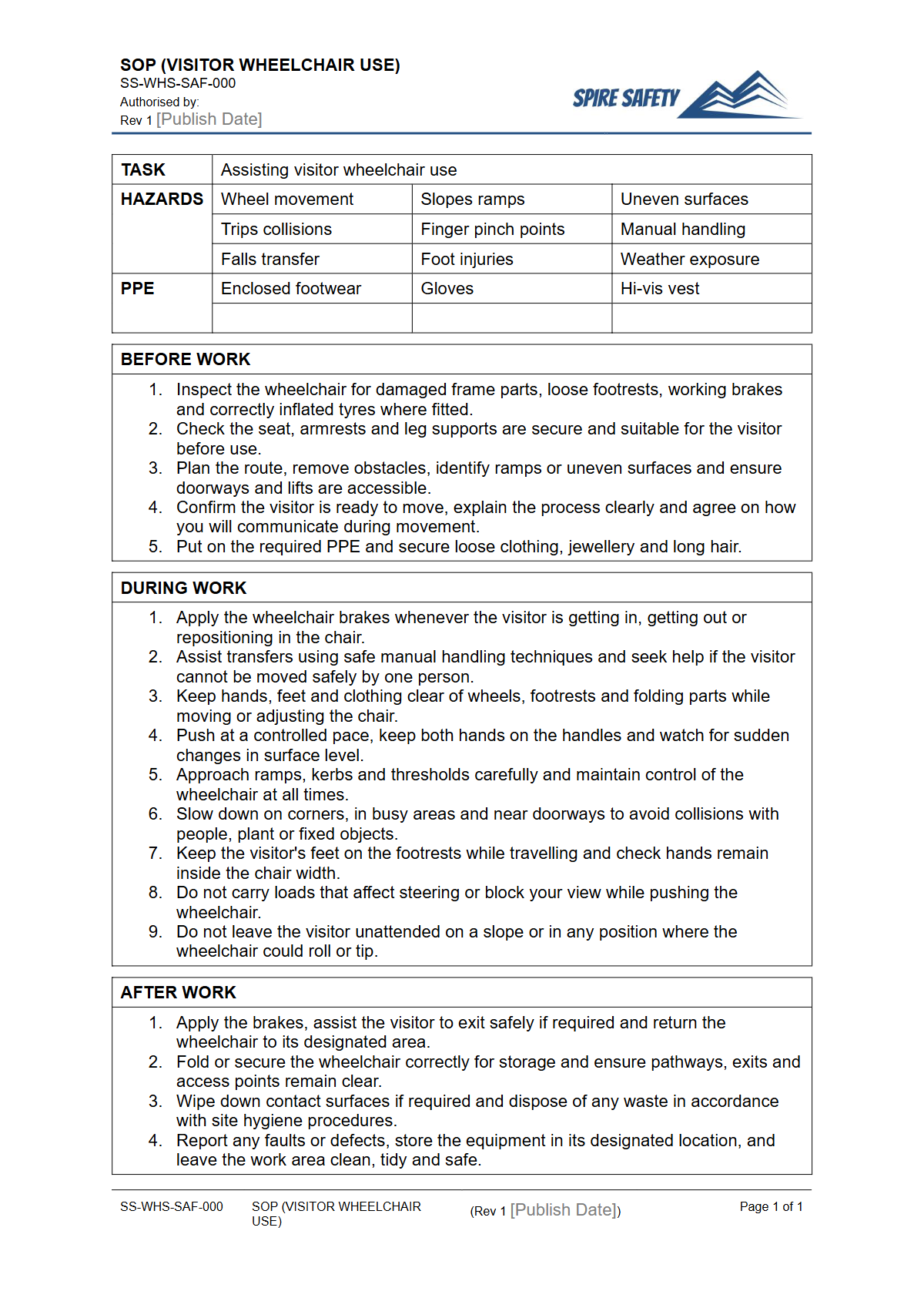
Ensure safe and dignified access for all visitors with our free visitor wheelchair use SOP template.
Free Safe Operating Procedure (Visitor Wheelchair Use) Template
DOCX • 126 KB + PDF
Updated Oct 2026
No signup required
Purpose of the Free Safe Operating Procedure (Visitor Wheelchair Use) Template
Ensuring the safety, dignity, and accessibility of all visitors is a core part of an organisation's duty of care. This Free Safe Operating Procedure (Visitor Wheelchair Use) Template provides a structured starting point for businesses to document the process for safely assisting visitors who use wheelchairs, whether their own or one provided by the facility.
A formalised procedure helps to minimise risks such as manual handling injuries to staff, falls, or property damage. It also provides clear, consistent instructions to employees, ensuring that assistance is offered respectfully and effectively, and demonstrates a proactive approach to meeting accessibility obligations.
Using a standardised SOP ensures that every interaction is guided by best practice, reducing confusion for staff and enhancing the visitor's experience. This document outlines the key steps and considerations, from initial communication with the visitor to navigating the physical environment.
Proper procedure is crucial for a wide range of equipment and tasks; just as you would use a free Air Compressor SOP to manage workshop risks, this template helps manage risks associated with visitor mobility.
Video walkthrough
How to use the Free Safe Operating Procedure (Visitor Wheelchair Use) Template
This document is a template and must be customised to suit the specific needs and environment of your workplace. It is not a complete, ready-to-use document.
A generic procedure cannot account for the unique layout, staffing, and specific hazards of your site. Integrating this procedure into your broader WHS management systems ensures it becomes part of your organisation's standard practice and is subject to regular review and improvement.
To implement this SOP:
- Download and Review: Download the DOCX or PDF and familiarise yourself with the sections provided.
- Customise: Adapt the content to your workplace. Add site-specific details, such as designated accessible routes, locations of ramps and lifts, potential hazards (e.g., steep gradients, uneven surfaces), and emergency contact numbers.
- Consult: Discuss the draft procedure with your staff, particularly those in visitor-facing roles. Their practical input is invaluable for creating a workable and effective SOP. Involving them is a key part of the WHS consultation process.
- Train: Once finalised, formally train all relevant employees on the procedure. This must include practical demonstrations on safe manual handling techniques and use of any on-site wheelchairs.
- Approve and Distribute: Have the final SOP approved by management and make it readily accessible to all relevant personnel.
Remember, we have designed this as a guide to help you build your own site-specific procedure. Your final document should reflect the real-world conditions and tasks your workers will face.
For complex accessibility requirements or a comprehensive review of your visitor management policies, our WHS consulting services can provide expert guidance.
When to use this Safe Operating Procedure
This Safe Operating Procedure should be referenced and applied in several key situations. Its primary use is as a practical guide for staff whenever a visitor requires assistance with a wheelchair.
This includes guiding them along a path, pushing the wheelchair, or helping them navigate obstacles like doors or ramps. It should also be a core training document for onboarding new staff in reception, security, or customer service roles.
Furthermore, the principles within this SOP are critical when planning for and executing emergency evacuations, forming the basis of procedures for assisting individuals with impaired mobility to a safe assembly point. The need for clear procedures applies across all business functions; just as kitchen staff must follow a specific procedure for deep fryer operation, visitor-facing teams need clear guidance for accessibility tasks.
Who should use it
This SOP is designed for any person who may be required to interact with or assist visitors who use wheelchairs. This includes a wide range of roles:
- Front-of-house staff and receptionists
- Security personnel
- Event staff and ushers
- Facilities management personnel
- First aid officers and emergency wardens
- Any employee designated to provide visitor assistance
Additionally, WHS managers, human resources personnel, and department heads should use this template to develop, approve, and implement the policy as part of their overall safety and accessibility framework. While the risks differ from those outlined in a detailed Telehandler SOP, the underlying principle of structured, safe work is the same: providing clear instructions to mitigate risk for a specific task.
Maintaining a Safe Environment for Wheelchair Users
A Safe Operating Procedure is an administrative control, but it is most effective when supported by a safe physical environment. Organisations should proactively manage their premises to eliminate or minimise accessibility barriers.
This includes conducting regular inspections of accessible routes to ensure they are free from obstruction, maintaining ramps and lifts in good working order, and ensuring accessible facilities like toilets are clean and functional. Regular safety reviews, potentially as part of a formal WHS compliance audit, will help identify any gaps in your physical environment or procedural controls.
By combining a well-designed environment with a robust SOP, you create a genuinely safe and welcoming space for everyone. To find more templates to support your safety system, browse our complete free WHS resources library.
Common mistakes
Common mistakes to avoid
- Assuming the visitor wants or needs help without asking first.
- Failing to train staff in safe manual handling techniques for pushing wheelchairs.
- Not inspecting provided wheelchairs for faults like faulty brakes or flat tyres.
- Forgetting to include accessible routes and assistance procedures in emergency plans.
Legal references
Legal considerations
The following legal requirements may be relevant to this type of work.
- Work Health and Safety Act (Harmonised) — Provides the primary duties for protecting workers and other people from work health and safety risks.
- Work Health and Safety Regulations (Harmonised) — Sets out requirements supporting the management of workplace hazards and risks.
The following codes may be relevant to this type of work.
- Managing WHS Risks Code of Practice — Provides practical guidance on identifying hazards, assessing risks and applying effective controls.
- Work Health and Safety Consultation, Cooperation and Coordination Code of Practice — Provides practical guidance on consulting workers and coordinating with other duty holders.
- Managing the Work Environment and Facilities Code of Practice — Provides practical guidance on safe work environments, workplace facilities and related controls.
Did you know
Manual Task Risk
Pushing a wheelchair, especially up ramps or over uneven ground, is a manual task under WHS regulations. Incorrect technique can lead to musculoskeletal injuries for the person assisting, such as back or shoulder strains.
Accessibility by Design
The best way to ensure safety is through universal design principles, creating environments that are inherently accessible to everyone without the need for special assistance. This reduces reliance on procedures and minimises risk for both visitors and staff.
FAQ
Frequently asked questions
01Is providing a wheelchair for visitors a legal requirement in Australia?
02What training should staff receive for assisting wheelchair users?
03How does this SOP relate to an emergency evacuation plan?
04Can our organisation modify this visitor wheelchair use SOP template?
Share this resource
Free Safe Operating Procedure (Visitor Wheelchair Use) Template
Browse Categories
How To Use It
- 1Download and open in Word or PDF.
- 2Replace the placeholders with your business details.
- 3Get it reviewed by a WHS specialist before rollout.
Need it customised?
Our WHS consultants can adapt this template to your site, run a gap analysis, or audit what you already have in place.
Book a Free Consultation WHS consulting servicesor call 1300 156 382
Related templates
- Free Safe Operating Procedure (Voltage Detector) Template
- Free Safe Operating Procedure (Waffle Maker) Template
- Free Safe Operating Procedure (Walk Through Scanner) Template
- Free Safe Operating Procedure (Walk-In Freezer) Template
- Free Safe Operating Procedure (Walker Cleaning) Template
- Free Safe Operating Procedure (Walking Aid Inspection) Template