
Free Safe Operating Procedure (Walker Cleaning) Template
Formalise your cleaning process for mobility aids with our free Safe Operating Procedure (Walker Cleaning) Template. Download your DOCX and PDF today.
Free Safe Operating Procedure (Walker Cleaning) Template
DOCX • 126 KB + PDF
Updated Oct 2026
No signup required
Purpose of the Free Safe Operating Procedure (Walker Cleaning) Template
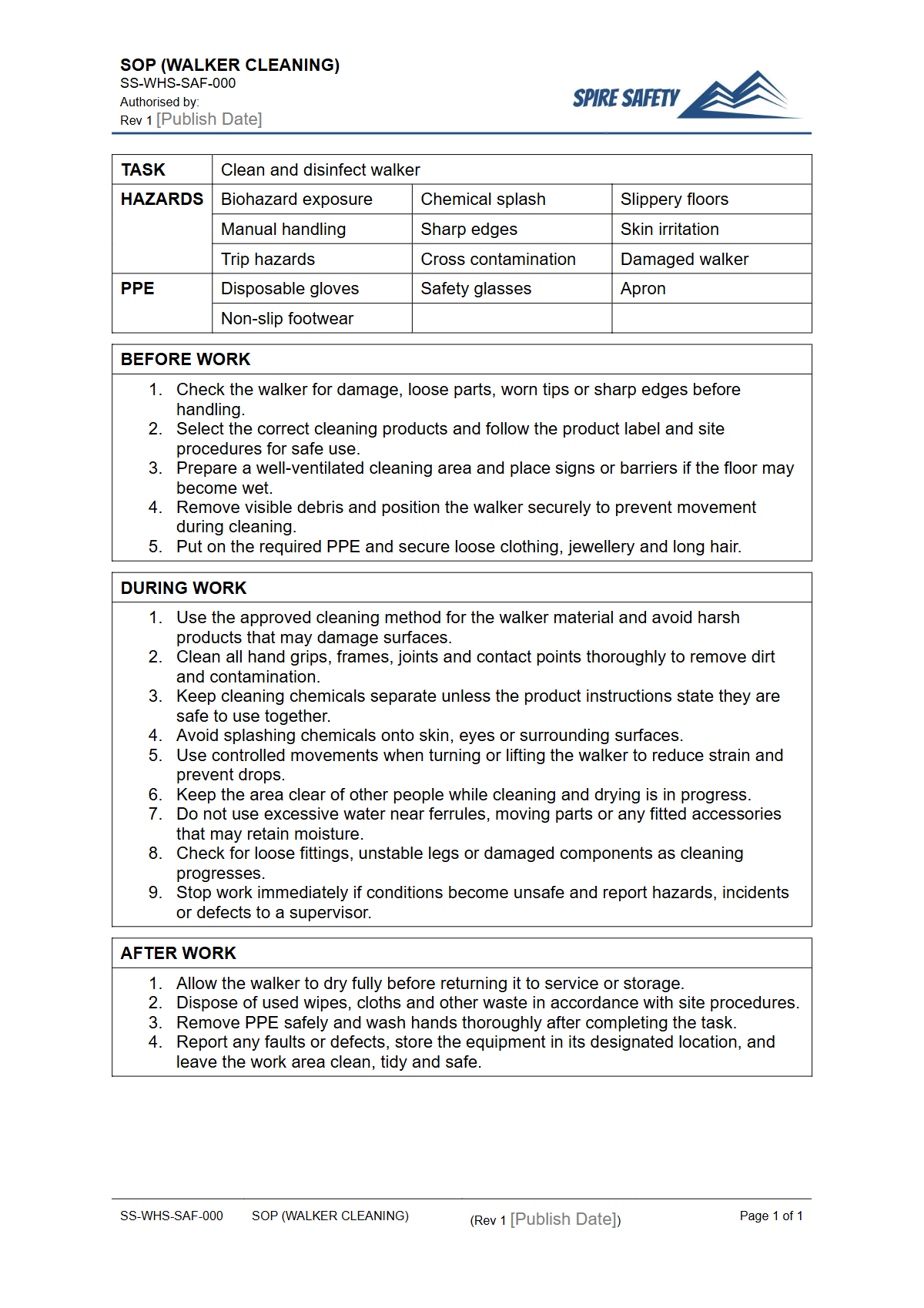
This Free Safe Operating Procedure (Walker Cleaning) Template provides a structured framework for documenting the safe and hygienic cleaning of mobility walkers. Commonly used in aged care facilities, hospitals, and rehabilitation centres, walkers require regular cleaning to prevent the spread of infection and ensure they remain safe for use.
A documented SOP ensures that this task is performed consistently and correctly, addressing risks such as exposure to cleaning chemicals, manual handling, and cross-contamination. By implementing a clear procedure, your organisation can uphold high standards of hygiene, protect the health of both residents and workers, and demonstrate a commitment to systematic safety management.
Using a standardised template helps ensure all critical steps are included, from pre-cleaning inspection to final wipe-down and storage. It serves as an essential training tool for new staff and a reliable reference for experienced workers.
Just as a commercial kitchen requires a Safe Operating Procedure for deep fryer use to manage specific hazards, healthcare and aged care environments need formal processes for critical hygiene tasks to control infection risks effectively.
Video walkthrough
How to use the Free Safe Operating Procedure (Walker Cleaning) Template
This template is designed to be a comprehensive starting point. After downloading the DOCX or PDF file, you must customise it to reflect the specific context of your workplace.
Effective customisation involves consulting with the workers who perform the cleaning tasks to ensure the procedure is practical and accurately reflects the work as done. This collaborative approach helps improve safety outcomes and encourages worker buy-in.
Key areas for customisation include:
- Chemicals: List the specific cleaning and disinfectant products used, including their correct dilution ratios.
- PPE: Detail the mandatory Personal Protective Equipment (PPE) required, such as gloves and safety glasses, based on the Safety Data Sheets (SDS) for your chosen chemicals.
- Step-by-Step Procedure: Modify the cleaning steps to match your facility’s workflow, equipment, and designated cleaning areas.
- Emergency Procedures: Outline actions to take in case of a chemical splash, spill, or adverse reaction.
- Responsibilities: Clearly assign roles for who performs the task, who supervises, and who is responsible for maintaining the equipment and supplies.
Important: This document is a template only. We provide it as a starting point for you to build a procedure that is specific to your site, equipment, and operational needs.
You must adapt it to your unique workplace risks and control measures.
When to use it
A walker cleaning SOP should be applied consistently as part of your facility's infection control and maintenance program. It is essential for routine, scheduled cleaning to maintain general hygiene.
The frequency should be defined within the procedure, for example, daily, weekly, or after each resident use, depending on your risk assessment. It is also critical to use the SOP for cleaning between different users to prevent cross-contamination.
The procedure should be strictly followed after any known contamination event, such as a spill of bodily fluids or during an infectious disease outbreak within the facility. Furthermore, integrating the SOP into the process for admitting or discharging residents ensures that all mobility equipment is properly sanitised before being issued to a new user.
Having a robust procedure is a fundamental part of your overall WHS management systems, providing clear instruction for a high-frequency, risk-associated task.
Who should use it
This SOP is intended for any worker whose duties involve the cleaning and maintenance of mobility walkers. This typically includes healthcare assistants, personal care workers, aged care staff, hospital orderlies, and environmental services or cleaning staff.
Supervisors and facility managers should also be familiar with the procedure to ensure it is being followed correctly and to provide adequate training and resources.
The document is also a valuable resource for WHS managers and infection control coordinators responsible for developing and reviewing safety protocols. Regular reviews of the SOP's effectiveness can be incorporated into your workplace safety processes, such as during WHS compliance auditing, to identify opportunities for improvement.
If you require assistance developing or implementing procedures tailored to your organisation, consider engaging expert WHS consulting services. You can also explore our complete free WHS resources library for more templates and guides.
Common mistakes
Common mistakes to avoid
- Using incorrect chemical dilutions, which can render disinfectants ineffective or damage the walker's materials.
- Failing to allow for the manufacturer-specified 'contact time' for disinfectants to work before wiping dry.
- Not wearing the correct Personal Protective Equipment (PPE), leading to skin irritation or chemical splashes to the eyes.
- Overlooking a physical inspection of the walker for wear and tear (e.g., worn grips, faulty wheels) during the cleaning process.
Legal references
Legal considerations
The following legal requirements may be relevant to this type of work.
- Work Health and Safety Act (Harmonised) — Provides the primary duties for protecting workers and other people from work health and safety risks.
- Work Health and Safety Regulations (Harmonised) — Sets out requirements supporting the management of workplace hazards and risks.
The following codes may be relevant to this type of work.
- Managing WHS Risks Code of Practice — Provides practical guidance on identifying hazards, assessing risks and applying effective controls.
- Work Health and Safety Consultation, Cooperation and Coordination Code of Practice — Provides practical guidance on consulting workers and coordinating with other duty holders.
- Managing the Work Environment and Facilities Code of Practice — Provides practical guidance on safe work environments, workplace facilities and related controls.
Did you know
Infection Control Hotspots
Studies have shown that high-touch surfaces on mobility aids like walkers are significant vectors for transmitting pathogens. Hand grips are a primary area of concern, making documented cleaning procedures a critical infection control measure in any healthcare setting.
Disinfectant Contact Time
For a disinfectant to be effective, it must remain on a surface for a specific duration known as 'contact time'. Simply spraying and immediately wiping a surface may not kill pathogens; your SOP should specify the required contact time as per the chemical manufacturer's instructions.
FAQ
Frequently asked questions
01What should be included in a walker cleaning SOP?
02Why is a specific SOP for cleaning walkers necessary in aged care?
03How often should walkers be cleaned?
04Are cleaning chemicals considered hazardous substances?
Share this resource
Free Safe Operating Procedure (Walker Cleaning) Template
Browse Categories
How To Use It
- 1Download and open in Word or PDF.
- 2Replace the placeholders with your business details.
- 3Get it reviewed by a WHS specialist before rollout.
Need it customised?
Our WHS consultants can adapt this template to your site, run a gap analysis, or audit what you already have in place.
Book a Free Consultation WHS consulting servicesor call 1300 156 382
Related templates
- Free Safe Operating Procedure (Walking Aid Inspection) Template
- Free Safe Operating Procedure (Walkway Leaf Clearing) Template
- Free Safe Operating Procedure (Wall Chaser) Template
- Free Safe Operating Procedure (Wall Sander) Template
- Free Safe Operating Procedure (Wall Scanner) Template
- Free Safe Operating Procedure (Wall Washing) Template