
Free Safe Operating Procedure (Wall Scanner) Template
Download our free Safe Operating Procedure (Wall Scanner) Template to guide workers through the safe use of wall scanners. Get your DOCX and PDF now.
Free Safe Operating Procedure (Wall Scanner) Template
DOCX • 126 KB + PDF
Updated Oct 2026
No signup required
Purpose of the Free Safe Operating Procedure (Wall Scanner) Template
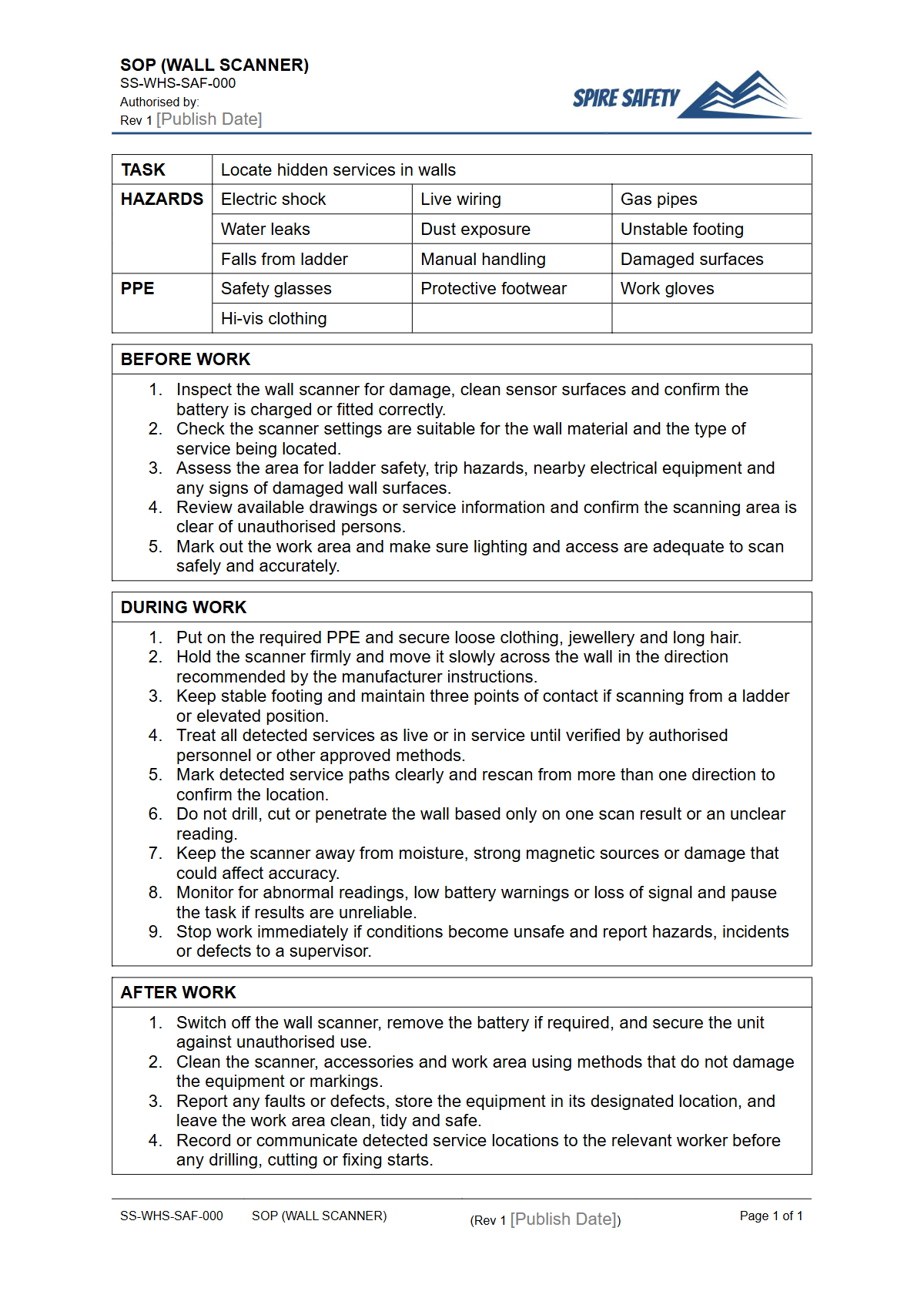
A wall scanner is an essential tool for safely identifying hidden objects like pipes, studs, and live electrical wiring before drilling or cutting into a surface. This free Safe Operating Procedure (Wall Scanner) Template provides a structured framework for documenting the required steps to use this equipment safely and effectively.
Using a standardised procedure helps minimise the risk of property damage, utility strikes, electric shock, and personal injury. It establishes a clear, repeatable process for all workers, ensuring that pre-start checks, operational steps, and shutdown tasks are performed consistently every time.
This document serves as a fundamental part of your risk management process. By outlining potential hazards and corresponding control measures, it helps persons conducting a business or undertaking (PCBUs) meet their primary duty of care.
It provides a practical tool for training, competency assessment, and on-the-job reference, promoting a proactive safety culture where risks associated with penetrating walls are systematically managed. For other common construction tasks, our free trencher SOP template offers similar guidance for excavation work.
Video walkthrough
How to use the Free Safe Operating Procedure (Wall Scanner) Template
This template is available for download as a DOCX file for easy editing and customisation, as well as a print-ready PDF. To use it, simply download the file and open it in your preferred word processor.
Go through each section and adapt the content to reflect the specific models of wall scanners used in your workplace, the types of materials you typically encounter, and your site-specific safety protocols. It is crucial to replace the placeholder text with detailed, practical information relevant to your operations.
Important: This document is a template and must be customised to your workplace. We have developed it as a starting point, and it is your responsibility to ensure it is adapted to the specific wall scanner models you use, your unique site conditions, and your organisation's existing safety management system.
A generic procedure is not sufficient to ensure safety or compliance.
When is a Wall Scanner SOP needed?
A Safe Operating Procedure for a wall scanner should be used before any activity that involves penetrating a wall, floor, or ceiling. This includes common tasks like drilling holes for anchors, cutting openings for windows or service access, or sawing through plasterboard and other materials.
It is essential during renovation, demolition, and construction projects, as well as for routine installation work performed by electricians, plumbers, and HVAC technicians. Implementing this SOP ensures that a systematic check is performed, preventing costly and dangerous mistakes. Similar procedural discipline is vital when using other power tools, as detailed in our free circular saw SOP template.
Who should use this Procedure?
This SOP is intended for all personnel who operate wall scanners as part of their duties. This includes tradespeople such as carpenters, electricians, and plumbers, as well as general construction workers, maintenance staff, and project supervisors.
Site managers and WHS officers should use the document to ensure consistent safety standards are communicated and implemented across the worksite. It also forms a critical part of the induction and training process for new workers or those unfamiliar with the specific scanning equipment being used.
Competency to use the equipment should be verified before work commences.
Key Elements of a Wall Scanner Safe Operating Procedure
A comprehensive wall scanner SOP should cover several critical areas to be effective. The template prompts you to detail these, including:
- Pre-Operational Checks: Instructions on inspecting the device for damage, checking battery levels, and performing any required calibration according to manufacturer specifications.
- Hazard Identification: A list of potential hazards, such as live AC wiring, metal pipes, rebar, and the risk of inaccurate readings.
- Control Measures: Specific actions to mitigate risks, like wearing appropriate PPE, using a slow and methodical scanning pattern (e.g., horizontally and vertically), and protocols for uncertain findings.
- Step-by-Step Instructions: A clear, sequential guide to operating the scanner, from turning it on and selecting the correct mode to interpreting the display and marking findings on the wall.
- Post-Operational Tasks: Procedures for cleaning the device, proper storage, and reporting any faults or damage.
For operations involving pressurised equipment on site, our free air compressor SOP template provides a similar level of detailed guidance.
Integrating SOPs into Your Broader Safety System
Safe Operating Procedures are most effective when they are integrated into a holistic safety framework. This SOP should not be a standalone document but a living part of your overall WHS management system. This involves using it for worker training, including it in project planning and risk assessments, and making it readily accessible at the point of work.
Regular reviews and updates are essential to ensure the procedure remains current with new equipment, changing regulations, and lessons learned from incidents or near misses.
Periodic reviews ensure that your documented procedures accurately reflect your on-the-ground practices. A thorough WHS compliance audit can help identify gaps between your documented systems and worker behaviour, providing valuable insights for continuous improvement.
If you need help refining your safety documents, explore our complete free WHS resources library for more templates and guides.
Common mistakes
Common mistakes to avoid
- Scanning too quickly across the surface, which can lead to missed objects.
- Forgetting to calibrate the device before each use as per the manufacturer's instructions.
- Relying on a single pass instead of scanning in multiple directions (e.g., horizontally and vertically) to confirm object locations.
- Assuming the scanner can detect all material types equally well and failing to account for its limitations.
Legal references
Legal considerations
The following legal requirements may be relevant to this type of work.
- Work Health and Safety Act (Harmonised) — Provides the primary duties for protecting workers and other people from work health and safety risks.
- Work Health and Safety Regulations (Harmonised) — Sets out requirements supporting the management of workplace hazards and risks.
The following codes may be relevant to this type of work.
- Managing WHS Risks Code of Practice — Provides practical guidance on identifying hazards, assessing risks and applying effective controls.
- Work Health and Safety Consultation, Cooperation and Coordination Code of Practice — Provides practical guidance on consulting workers and coordinating with other duty holders.
- Managing the Work Environment and Facilities Code of Practice — Provides practical guidance on safe work environments, workplace facilities and related controls.
Did you know
Multiple Technologies
Wall scanners utilise different technologies, including magnetic, capacitive, and radar sensors. Each has unique strengths for detecting various materials, which is why multi-mode scanners often provide more reliable and comprehensive results.
Common Causes of Error
Inaccurate readings are often caused by factors like wall thickness, high material density, moisture content, or even static electricity. This is why scanning slowly in multiple directions is a critical safety step to help verify results.
FAQ
Frequently asked questions
01What is the main purpose of a wall scanner?
02Can a wall scanner detect all types of materials accurately?
03How often should our Safe Operating Procedure for wall scanners be reviewed?
04Does this SOP template cover specific calibration procedures?
Share this resource
Free Safe Operating Procedure (Wall Scanner) Template
Browse Categories
How To Use It
- 1Download and open in Word or PDF.
- 2Replace the placeholders with your business details.
- 3Get it reviewed by a WHS specialist before rollout.
Need it customised?
Our WHS consultants can adapt this template to your site, run a gap analysis, or audit what you already have in place.
Book a Free Consultation WHS consulting servicesor call 1300 156 382
Related templates
- Free Safe Operating Procedure (Wall Washing) Template
- Free Safe Operating Procedure (Ward Waste Collection) Template
- Free Safe Operating Procedure (Warping Machine) Template
- Free Safe Operating Procedure (Wash Bay Sump Clean) Template
- Free Safe Operating Procedure (Wash Plant) Template
- Free Safe Operating Procedure (Washroom Deep Cleaning) Template