
Free Safe Operating Procedure (Ward Waste Collection) Template
Manage ward waste collection risks with our free Safe Operating Procedure template. Download the customisable DOCX and PDF to standardise your process.
Free Safe Operating Procedure (Ward Waste Collection) Template
DOCX • 126 KB + PDF
Updated Oct 2026
No signup required
Purpose of the Free Safe Operating Procedure (Ward Waste Collection) Template
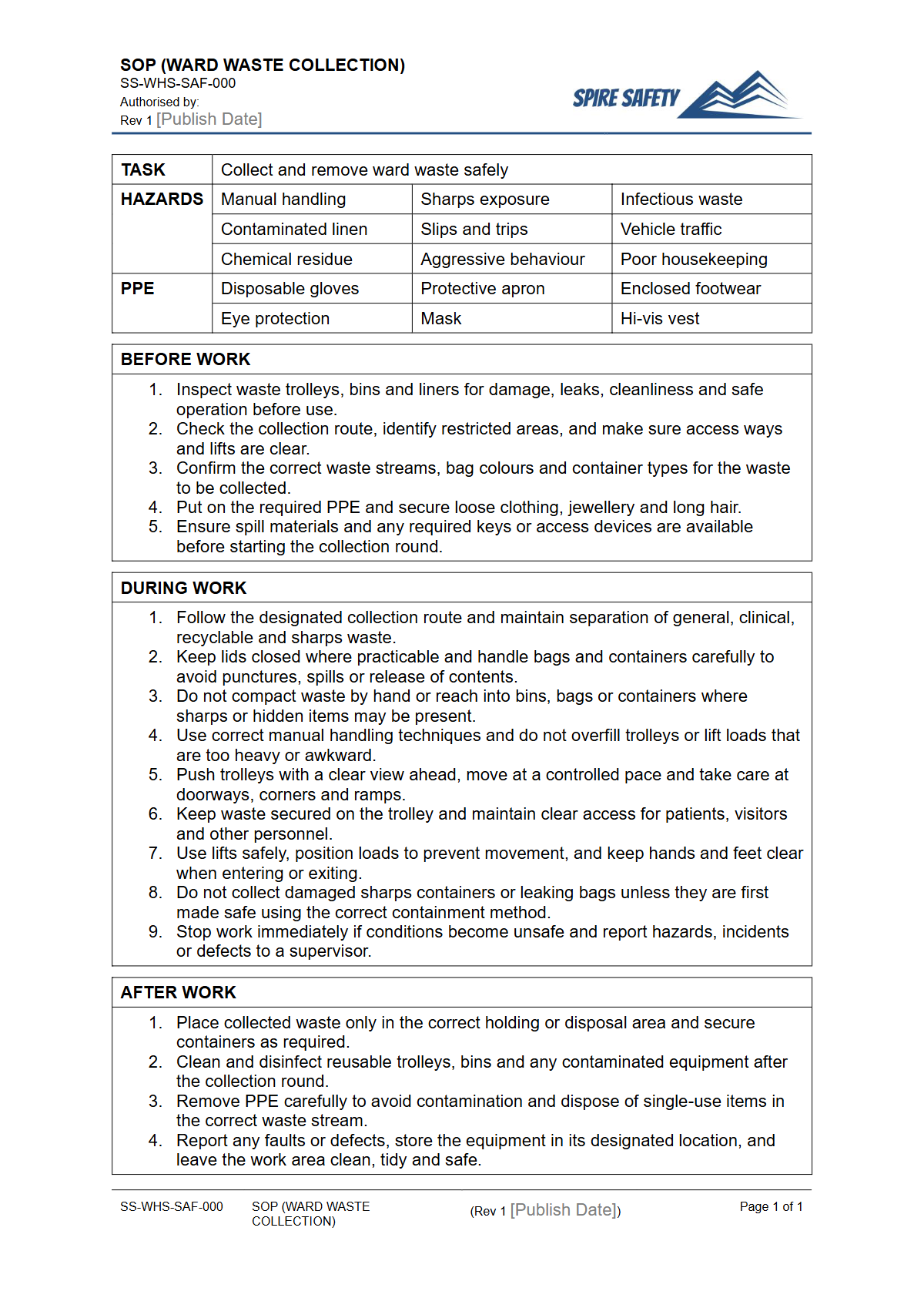
This Safe Operating Procedure (SOP) provides a structured framework for safely collecting and handling general, clinical, and related waste from wards in healthcare, aged care, and similar environments. Using this free Safe Operating Procedure (Ward Waste Collection) template helps your organisation establish and communicate a consistent, safe method for a high-frequency task, addressing significant hazards such as manual tasks, biological exposure, and sharps injuries.
It serves as a key tool for managing risks, training workers, and demonstrating a systematic approach to health and safety.
Implementing a formal procedure helps meet your duties under WHS legislation by controlling identified risks. This document is designed as a practical starting point, aligned with the principles of the model WHS framework, to help you formalise your safety processes.
A well-defined SOP is a foundational element of a robust safety system, ensuring all workers understand the expected standards for safe work behaviour and task execution. Properly implemented, it can reduce incident rates and improve overall safety culture.
Video walkthrough
How to use the Free Safe Operating Procedure (Ward Waste Collection) Template
This template is available for download in both DOCX and PDF formats. We recommend using the DOCX version to tailor the content to the specific requirements of your facility.
A generic procedure is not effective; safety documents must reflect the actual environment and equipment in use. Integrating this SOP effectively is a key part of developing comprehensive WHS management systems that protect your workers and your organisation.
Important: This is a template only. You must customise it by consulting with your workers and incorporating site-specific details.
This includes specifying the types of waste bins and trolleys used, personal protective equipment (PPE) requirements, designated waste storage areas, ward layouts, and your facility’s specific emergency procedures. If you need assistance with customisation or implementation, consider engaging WHS consulting services.
When to use this Safe Operating Procedure
A Safe Operating Procedure for ward waste collection should be used consistently as a core operational document. It is essential during the induction and training of new cleaning staff, healthcare assistants, and nurses who perform this task.
It should also be used for regular refresher training to reinforce safe habits and communicate any changes to the procedure. Furthermore, the SOP serves as a benchmark for workplace inspections and observations.
In the unfortunate event of an incident or near miss related to waste collection, this document provides a reference point for the investigation to determine if the established procedure was followed.
Who should use this document?
This SOP is intended for all personnel involved in the ward waste collection process. This includes:
- Cleaners and environmental services staff
- Patient care assistants and orderlies
- Nurses and clinical staff
- Work Health and Safety (WHS) managers and representatives
- Supervisors and department managers responsible for overseeing staff
Managers and supervisors should use this document to ensure training is adequate and work is performed according to the agreed-upon safe method. For organisations seeking to align with international standards, embedding such procedures supports the framework required for ISO 45001 consulting and certification, which emphasises process-based risk management.
Review and Improvement
Safe Operating Procedures are not static documents. This template should be reviewed regularly—typically annually, or whenever there is a change in equipment, processes, or relevant legislation.
It must also be reviewed after any incident involving waste collection. Scheduling periodic reviews, possibly as part of a broader program of WHS compliance auditing, ensures your safety documentation remains current and effective.
Don't forget to explore our complete free WHS resources library for other templates and guides to support your safety management system.
Common mistakes
Common mistakes to avoid
- Overfilling waste bags, making them too heavy to lift safely and risking tears.
- Failing to correctly segregate different waste streams at the point of generation.
- Using incorrect manual handling techniques, such as bending the back instead of the knees.
- Not wearing or changing required Personal Protective Equipment (PPE) between tasks or wards.
Legal references
Legal considerations
The following legal requirements may be relevant to this type of work.
- Work Health and Safety Act (Harmonised) — Provides the primary duties for protecting workers and other people from work health and safety risks.
- Work Health and Safety Regulations (Harmonised) — Sets out requirements supporting the management of workplace hazards and risks.
The following codes may be relevant to this type of work.
- Managing WHS Risks Code of Practice — Provides practical guidance on identifying hazards, assessing risks and applying effective controls.
- Work Health and Safety Consultation, Cooperation and Coordination Code of Practice — Provides practical guidance on consulting workers and coordinating with other duty holders.
- Managing the Work Environment and Facilities Code of Practice — Provides practical guidance on safe work environments, workplace facilities and related controls.
Did you know
Waste Weight
According to a study by the Australian Commission on Safety and Quality in Health Care, the Australian healthcare system generates a significant volume of waste, with some estimates putting it at over 10 kg per occupied bed per day.
Manual Task Risk
Safe Work Australia data consistently shows that hazardous manual tasks are the leading cause of serious workers' compensation claims in the country. Waste collection is a key source of this risk in healthcare settings.
FAQ
Frequently asked questions
01What kind of PPE is needed for ward waste collection?
02How often should staff be trained on this SOP?
03Can I use this template for both clinical and general waste?
04What is the most common injury from ward waste collection?
Share this resource
Free Safe Operating Procedure (Ward Waste Collection) Template
Browse Categories
How To Use It
- 1Download and open in Word or PDF.
- 2Replace the placeholders with your business details.
- 3Get it reviewed by a WHS specialist before rollout.
Need it customised?
Our WHS consultants can adapt this template to your site, run a gap analysis, or audit what you already have in place.
Book a Free Consultation WHS consulting servicesor call 1300 156 382
Related templates
- Free Safe Operating Procedure (Warping Machine) Template
- Free Safe Operating Procedure (Wash Bay Sump Clean) Template
- Free Safe Operating Procedure (Wash Plant) Template
- Free Safe Operating Procedure (Washroom Deep Cleaning) Template
- Free Safe Operating Procedure (Waste Audit Sorting) Template
- Free Safe Operating Procedure (Waste Bay Cleanup) Template