
Free Safe Operating Procedure (Warping Machine) Template
Clearly outline the safety steps for operating a warping machine with our customisable template. Download your free Safe Operating Procedure to get started.
Free Safe Operating Procedure (Warping Machine) Template
DOCX • 126 KB + PDF
Updated Oct 2026
No signup required
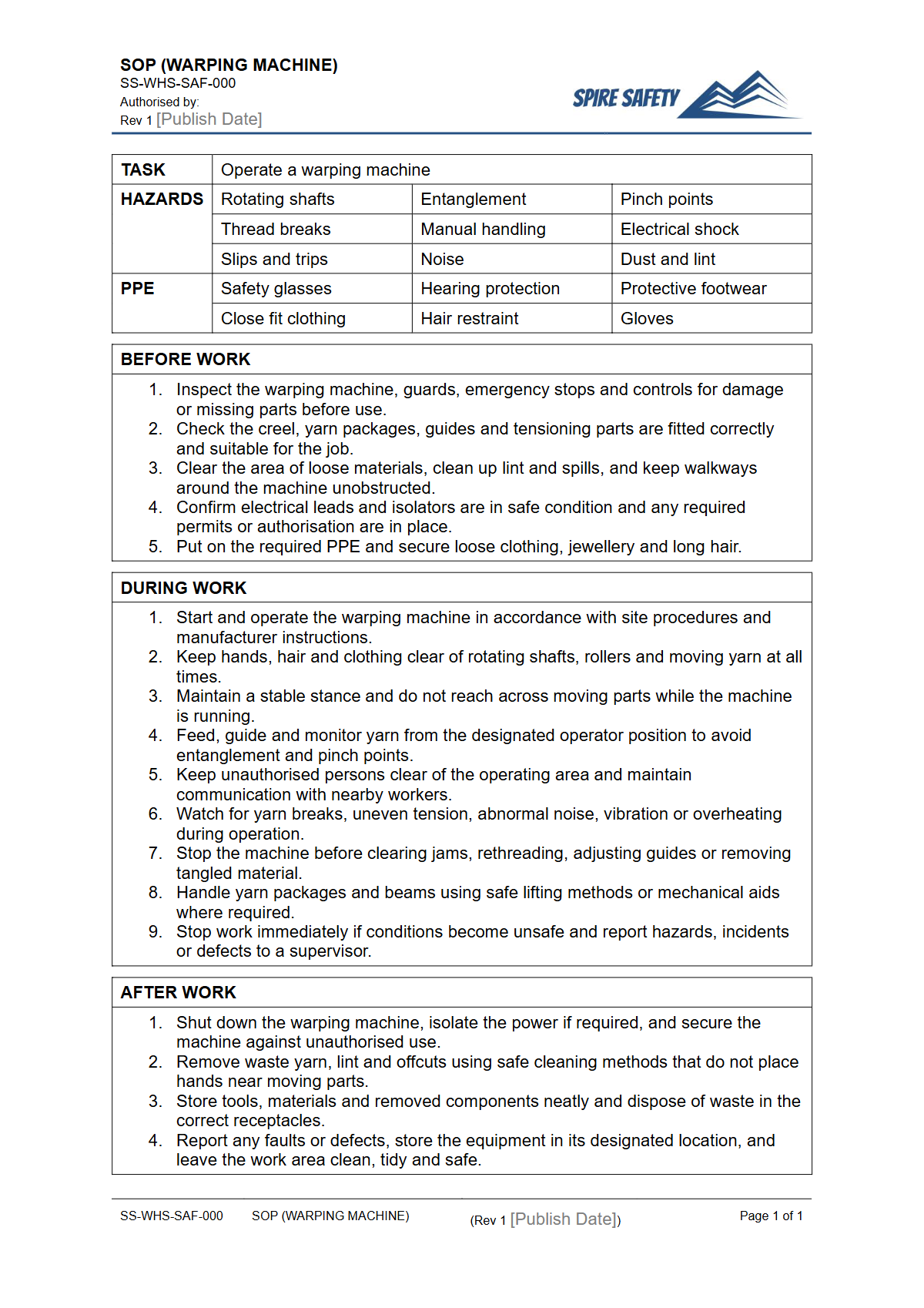
Purpose of the Free Safe Operating Procedure (Warping Machine) Template
Operating a warping machine involves significant risks, primarily from high-speed rotating components, heavy lifting, and potential entanglement. This Free Safe Operating Procedure (Warping Machine) Template provides a structured framework for documenting the required safety controls and work steps.
It is designed to help your organisation manage hazards associated with warping processes, ensuring that operators understand the correct, safe method for machine setup, operation, thread-up, doffing, and routine maintenance.
A well-defined SOP is a fundamental component of workplace safety. It serves as a key training tool for new operators and a reference for experienced staff, promoting consistent and safe work practices. Implementing this procedure helps your business demonstrate its commitment to risk management and is an essential part of developing a comprehensive WHS management system.
Key Hazards Addressed:
- Entanglement in rotating beams, drums, or drive shafts.
- Manual handling injuries from lifting heavy warp beams or packages.
- Musculoskeletal disorders from repetitive motions or awkward postures during thread-up.
- Slips, trips, and falls around the machine.
- Mechanical failures or unexpected start-up during maintenance.
Video walkthrough
How to use the Free Safe Operating Procedure (Warping Machine) Template
This template is available for download as a DOCX file for easy editing and a PDF for straightforward distribution. To use it effectively, you must adapt its contents to the specific make and model of the warping machine in your workplace, your operational context, and the materials being used.
A generic procedure is not sufficient; customisation is essential for controlling your specific risks.
Important Note: We have provided this template as a starting point. You must review, edit, and add site-specific details to reflect your unique operational environment, risk assessment findings, and legal obligations.
Consult with machine operators, supervisors, and WHS personnel during the customisation process to ensure the final SOP is practical and effective.
Many textile and manufacturing facilities use a range of plant and equipment, each requiring its own documented safety procedure. For instance, if your warping machine operations rely on pneumatic systems for tensioning or cleaning, you should also establish an Air Compressor Safe Operating Procedure to manage associated risks.
When to use a Warping Machine SOP
A Safe Operating Procedure for a warping machine should be used as a central part of your daily safety management. It is a live document that should be referenced consistently, not just filed away. Key times to use the SOP include:
- Operator Training: For inducting new employees or training existing workers on a new or modified warping machine.
- Pre-operational Checks: As a checklist to ensure machine guards, emergency stops, and other safety features are functional before starting work.
- Task Guidance: As a step-by-step guide for operators to follow during setup, operation, and doffing.
- Incident Investigation: To review whether established procedures were followed in the event of an accident or near miss.
- Refresher Training: For periodic retraining sessions to reinforce safe work behaviours and communicate any updates to the procedure.
The effectiveness of your SOP should be periodically verified as part of your workplace safety reviews. Incorporating checks on SOP adherence and suitability into your regular WHS compliance audits helps ensure the procedure remains relevant and effective at controlling hazards.
Who should use this Safe Operating Procedure
The development and use of a Warping Machine SOP involves several roles within an organisation. A collaborative approach ensures the procedure is comprehensive, accurate, and practical for everyday use.
- WHS Managers/Officers: To ensure the SOP aligns with the organisation's overall WHS management system and meets regulatory expectations.
- Supervisors and Team Leaders: To train operators, enforce the procedure, and provide feedback on its practicality in the workplace.
- Machine Operators: To follow the step-by-step instructions for safe operation and to provide valuable input on potential improvements or unaddressed hazards.
- Maintenance Personnel: To follow specific lockout/tagout and isolation procedures outlined in the SOP before commencing any service or repair work.
The principles outlined in this document for managing plant safety are transferable to other complex equipment. If your facility also operates machinery with significant mechanical and process hazards, consider adapting a similar structured approach, such as our safe operating procedure for an injection molding machine.
By clearly defining roles and responsibilities, you can foster a strong safety culture where everyone understands their part in preventing workplace incidents. For more templates covering a wide range of equipment and tasks, explore our complete free WHS resources library.
Common mistakes
Common mistakes to avoid
- Using the template without customising it for the specific machine model and workplace risks.
- Failing to involve experienced operators in the drafting and review process, resulting in an impractical SOP.
- Neglecting to implement and enforce correct lockout/tagout procedures during cleaning, jam clearing, or maintenance.
- Treating the SOP as a one-time document instead of a live tool for ongoing training and risk management.
Legal references
Legal considerations
The following legal requirements may be relevant to this type of work.
- Work Health and Safety Act (Harmonised) — Provides the primary duties for protecting workers and other people from work health and safety risks.
- Work Health and Safety Regulations (Harmonised) — Sets out requirements supporting the management of workplace hazards and risks.
The following codes may be relevant to this type of work.
- Managing WHS Risks Code of Practice — Provides practical guidance on identifying hazards, assessing risks and applying effective controls.
- Work Health and Safety Consultation, Cooperation and Coordination Code of Practice — Provides practical guidance on consulting workers and coordinating with other duty holders.
- Managing the Work Environment and Facilities Code of Practice — Provides practical guidance on safe work environments, workplace facilities and related controls.
Did you know
Entanglement Risk
Contact with moving machinery, particularly entanglement, is a leading cause of serious injury in manufacturing. Incidents involving rotating shafts or pulleys can happen in a fraction of a second, often before a person has time to react.
FAQ
Frequently asked questions
01What are the primary hazards associated with a warping machine?
02How often should a Warping Machine SOP be reviewed?
03Is a Safe Operating Procedure (SOP) the same as a Safe Work Method Statement (SWMS)?
04Who is responsible for training workers on this SOP?
Share this resource
Free Safe Operating Procedure (Warping Machine) Template
Browse Categories
How To Use It
- 1Download and open in Word or PDF.
- 2Replace the placeholders with your business details.
- 3Get it reviewed by a WHS specialist before rollout.
Need it customised?
Our WHS consultants can adapt this template to your site, run a gap analysis, or audit what you already have in place.
Book a Free Consultation WHS consulting servicesor call 1300 156 382
Related templates
- Free Safe Operating Procedure (Wash Bay Sump Clean) Template
- Free Safe Operating Procedure (Wash Plant) Template
- Free Safe Operating Procedure (Washroom Deep Cleaning) Template
- Free Safe Operating Procedure (Waste Audit Sorting) Template
- Free Safe Operating Procedure (Waste Bay Cleanup) Template
- Free Safe Operating Procedure (Waste Bin Inspection) Template