
Free Safe Operating Procedure (Waste Audit Sorting) Template
Formalise your waste management processes with our structured template. Download this free Safe Operating Procedure to define safety controls for waste audit sorting.
Free Safe Operating Procedure (Waste Audit Sorting) Template
DOCX • 126 KB + PDF
Updated Oct 2026
No signup required
Purpose of the Free Safe Operating Procedure (Waste Audit Sorting) Template
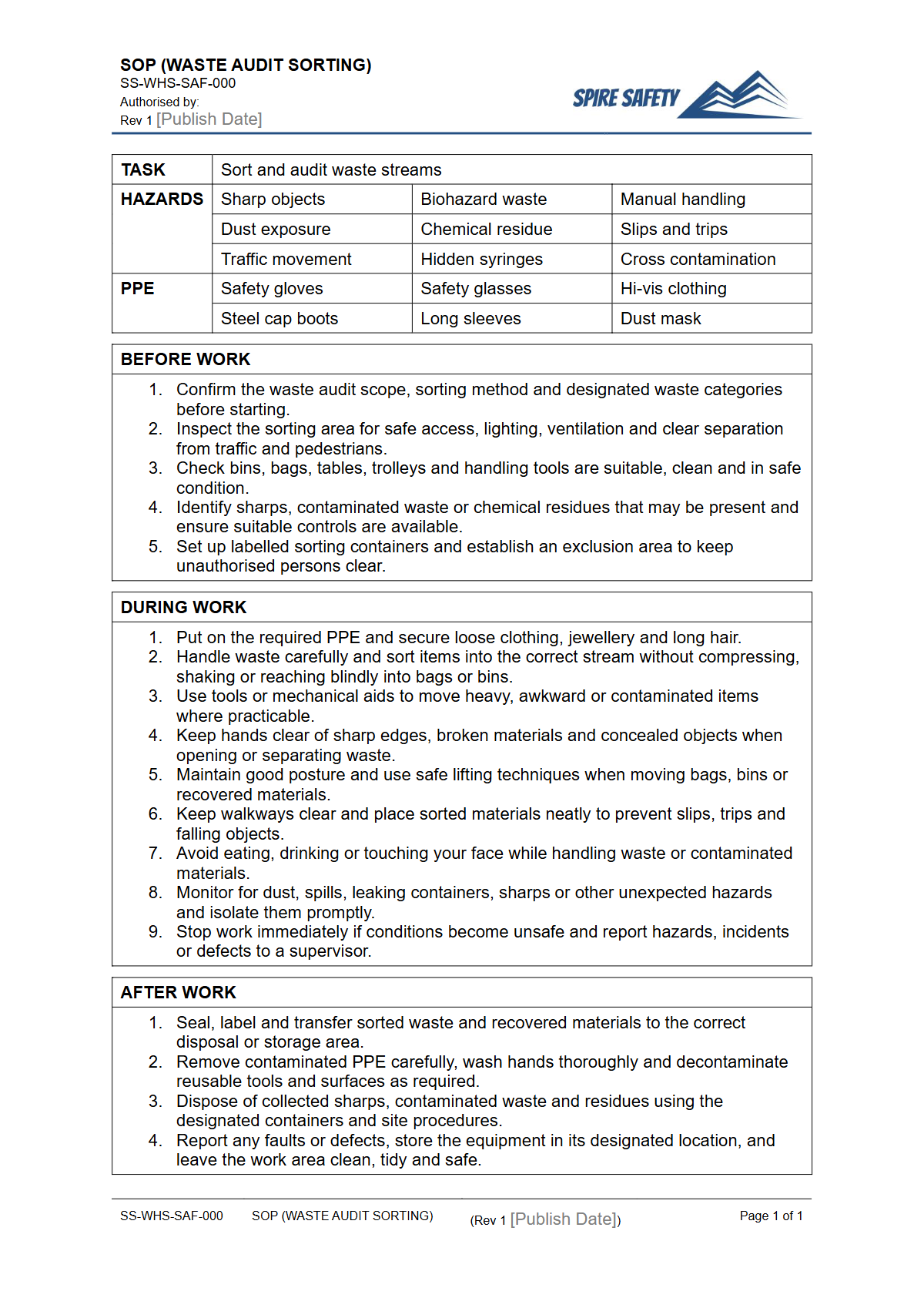
Waste audit sorting, while essential for environmental management and resource recovery, presents a range of health and safety hazards. This Free Safe Operating Procedure (Waste Audit Sorting) Template provides a structured framework to help your organisation document the risks and control measures associated with this task.
By defining a clear, step-by-step process, you can minimise risks such as manual handling injuries, exposure to hazardous substances, and contact with sharps or biological contaminants. A documented SOP is a critical component of effective safety management, ensuring all workers follow the same safe work method every time.
Implementing a robust SOP for waste sorting is a key element in demonstrating due diligence and forms an integral part of broader WHS management systems. This template helps you establish clear instructions for pre-operational checks, the sorting process itself, and post-task clean-up, creating a safer and more organised work environment.
Video walkthrough
How to use the Free Safe Operating Procedure (Waste Audit Sorting) Template
This template is available in both DOCX and PDF formats for your convenience. The DOCX version is fully editable, allowing you to tailor the content to the specific requirements of your workplace.
It's designed as a solid starting point, based on the model WHS framework and common industry practices for waste handling. A systematic approach to safety documentation also supports preparation for formal WHS compliance auditing.
Important: This is a template, not a finished document. To be effective, you must customise it to reflect your specific operational context.
We have provided a comprehensive structure, but it is your responsibility to consult with your workers and conduct a site-specific risk assessment. You need to add details about the types of waste you handle, the specific equipment used, your emergency procedures, and the required Personal Protective Equipment (PPE).
When to use a Waste Audit Sorting SOP
A Safe Operating Procedure for waste audit sorting should be developed and implemented before any workers undertake the task. It is particularly crucial for organisations that conduct regular waste audits as part of their environmental or sustainability programs.
This SOP should be used as a primary training document for new employees and a refresher for existing staff. It must also be reviewed and updated whenever there is a change in process, equipment, waste streams, or following any related incident or near-miss.
For facilities with more complex sorting operations, this procedure should be integrated with other equipment-specific SOPs. For instance, if sorting lines involve mechanical aids, you should also refer to documents like our free Conveyer System SOP to ensure all interconnected tasks are covered.
Who should use it
This SOP should be used by anyone involved in the waste audit sorting process. This includes:
- WHS Managers and Safety Officers: To develop, review, and formalise safety protocols.
- Supervisors and Team Leaders: To train workers, enforce the procedure, and conduct pre-start checks.
- Workers: As a clear guide on how to perform their tasks safely and consistently.
- Environmental or Sustainability Coordinators: To ensure that data collection activities are conducted without compromising worker safety.
Personnel operating machinery to move waste bins or containers, such as front-end loaders or telehandlers, must also be trained on the relevant procedures. If your site uses such equipment, you may also benefit from our FREE Telehandler SOP Template to manage associated machinery risks.
By ensuring everyone understands their roles and responsibilities, you foster a proactive safety culture within the organisation. You can find more templates like this in our complete free WHS resources library.
Common mistakes
Common mistakes to avoid
- Using the template without performing a site-specific risk assessment.
- Failing to adequately customise the procedure for the specific types of waste being handled.
- Neglecting to train all relevant workers on the final, approved SOP.
- Providing inadequate or incorrect Personal Protective Equipment (PPE) for the identified hazards.
Legal references
Legal considerations
The following legal requirements may be relevant to this type of work.
- Work Health and Safety Act (Harmonised) — Provides the primary duties for protecting workers and other people from work health and safety risks.
- Work Health and Safety Regulations (Harmonised) — Sets out requirements supporting the management of workplace hazards and risks.
The following codes may be relevant to this type of work.
- Managing WHS Risks Code of Practice — Provides practical guidance on identifying hazards, assessing risks and applying effective controls.
- Work Health and Safety Consultation, Cooperation and Coordination Code of Practice — Provides practical guidance on consulting workers and coordinating with other duty holders.
- Managing the Work Environment and Facilities Code of Practice — Provides practical guidance on safe work environments, workplace facilities and related controls.
Did you know
Waste Hierarchy
The internationally recognised waste management hierarchy prioritises actions to reduce waste. In order of preference, it is: Avoid, Reduce, Reuse, Recycle, Recover, and lastly, Dispose.
Manual Task Risk
In Australia, hazardous manual tasks are a leading cause of workplace injury. A well-defined SOP is a primary control measure for reducing the risk of musculoskeletal disorders associated with tasks like waste sorting.
FAQ
Frequently asked questions
01What are the main hazards in waste audit sorting?
02Does this SOP cover both residential and commercial waste streams?
03What kind of PPE is required for sorting waste?
04How often should a Waste Audit Sorting SOP be reviewed?
Share this resource
Free Safe Operating Procedure (Waste Audit Sorting) Template
Browse Categories
How To Use It
- 1Download and open in Word or PDF.
- 2Replace the placeholders with your business details.
- 3Get it reviewed by a WHS specialist before rollout.
Need it customised?
Our WHS consultants can adapt this template to your site, run a gap analysis, or audit what you already have in place.
Book a Free Consultation WHS consulting servicesor call 1300 156 382
Related templates
- Free Safe Operating Procedure (Waste Bay Cleanup) Template
- Free Safe Operating Procedure (Waste Bin Inspection) Template
- Free Safe Operating Procedure (Waste Bin Placement) Template
- Free Safe Operating Procedure (Waste Bin Tagging) Template
- Free Safe Operating Procedure (Waste Compactor) Template
- Free Safe Operating Procedure (Waste Dropoff Check) Template