
Free Safe Operating Procedure (Waste Bin Placement) Template
Streamline your workplace safety with our Safe Operating Procedure for waste bin placement. Download the customisable DOCX and PDF template to get started.
Free Safe Operating Procedure (Waste Bin Placement) Template
DOCX • 126 KB + PDF
Updated Oct 2026
No signup required
Purpose of the Free Safe Operating Procedure (Waste Bin Placement) Template
Effectively managing waste is a fundamental aspect of maintaining a safe, clean, and efficient workplace. The placement of waste bins, while seemingly simple, has significant implications for health and safety.
This Free Safe Operating Procedure (Waste Bin Placement) Template provides a structured, documented process for your business. It is designed to help you minimise risks such as slips, trips, and falls, prevent obstruction of emergency exits and equipment, and ensure ergonomic handling.
By standardising the location and type of bins used, you create a more organised and predictable environment for all personnel.
Using a formal SOP for this task helps embed safety-conscious behaviour into your daily operations. It serves as a clear reference for workers and a training tool for new staff, ensuring everyone understands the reasoning behind bin placement rules.
Formalising these procedures is a key component of robust WHS management systems, demonstrating a proactive approach to hazard management.
Video walkthrough
How to use the Free Safe Operating Procedure (Waste Bin Placement) Template
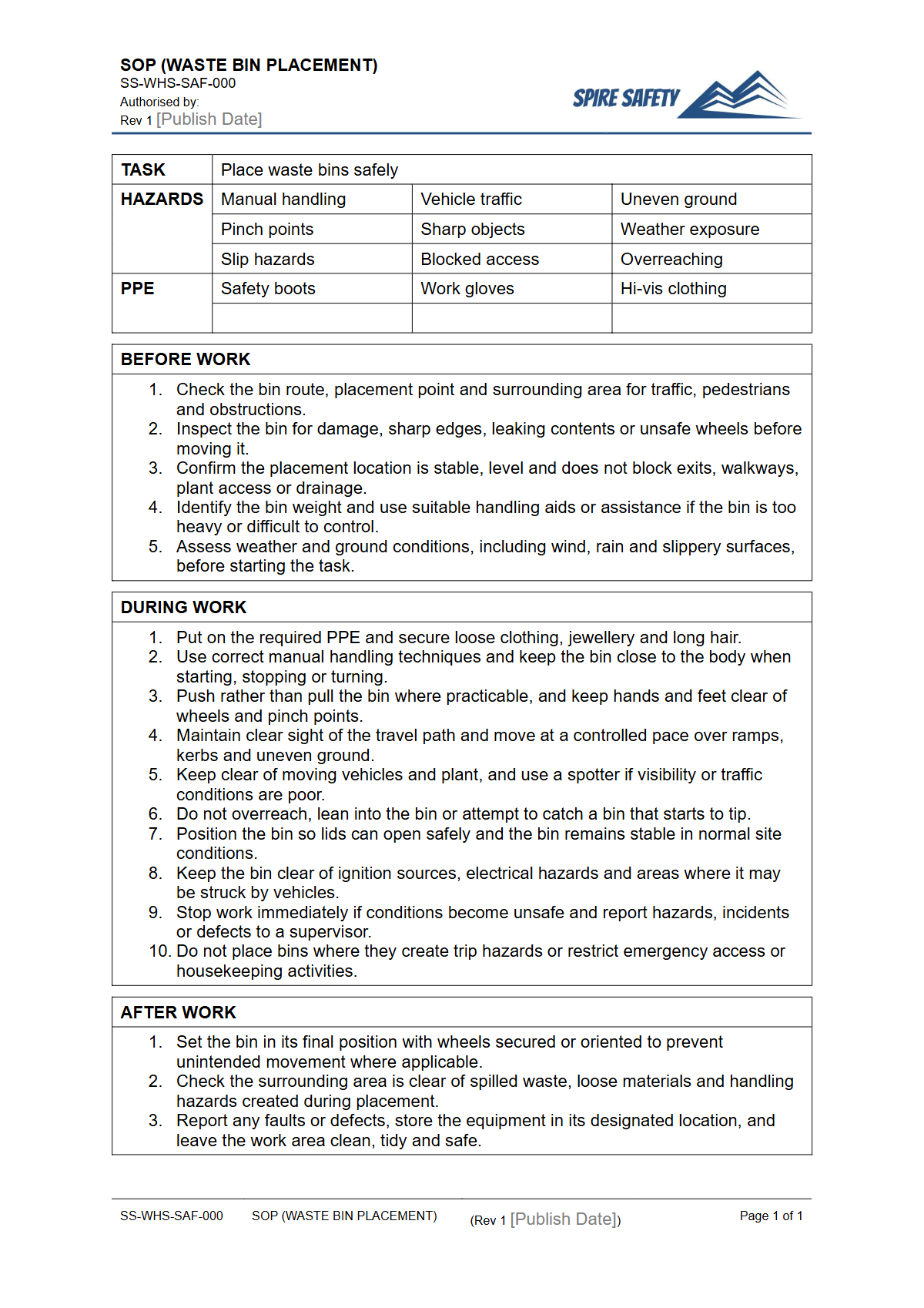
This Safe Operating Procedure template is provided in both DOCX and PDF formats for your convenience. The DOCX file is fully editable, allowing you to tailor the content to the specific layout, waste streams, and hazards present in your workplace.
The PDF version can be used as a reference or for immediate printing and use if the standard content is suitable.
Important: This document is a template and not a complete, ready-to-use procedure. To be effective, you must customise it.
We recommend a competent person reviews your site's specific conditions and amends the document accordingly. This includes adding site-specific details, identifying the types of waste generated (e.g., general, recyclable, clinical, hazardous), and detailing the requirements for bin size, labelling, and emptying frequency.
This SOP is one of many useful documents in our free WHS resources library, all designed to support your safety efforts.
The Safe Operating Procedure template includes sections to document:
- Potential hazards and risks (e.g., manual handling, trip hazards, fire)
- Required Personal Protective Equipment (PPE)
- Step-by-step procedures for safe placement
- Guidelines for bin selection and labelling
- Instructions for managing overfilled bins
- Emergency procedures
When to use a Safe Operating Procedure for Waste Bin Placement
A Safe Operating Procedure for waste bin placement should be developed, implemented, and reviewed in several key situations. It is essential when setting up a new facility or reconfiguring an existing workspace to ensure safety is considered from the outset.
It should form a core part of your employee induction and ongoing training programs, ensuring consistent practice across the organisation. Furthermore, this SOP should be referenced during routine workplace inspections and reviewed after any incident or near miss involving waste bins, such as a trip or a manual handling injury. In environments with specific waste demands, such as commercial kitchens, it complements other task-specific documents like the Free Safe Operating Procedure for a Deep Fryer.
In industrial environments, where different machinery and processes coexist, a planned approach to ancillary tasks like waste management is critical. The placement of bins must not interfere with the operation of equipment or movement of materials. For example, a workshop's bin placement strategy would need to account for workflows around fixed plant, which may be covered by documents like a Free Air Compressor SOP.
Who should use this template?
This template is designed for use by a range of personnel responsible for workplace health and safety. This includes:
- WHS Managers and Safety Officers: To establish a baseline procedure aligned with Australian WHS principles and integrate it into the broader safety management system.
- Facility and Operations Managers: To plan and manage workplace layouts, ensuring operational efficiency does not compromise safety.
- Supervisors and Team Leaders: To train their teams, enforce the procedure, and monitor compliance during day-to-day activities.
- Workers: As a clear guide on how to safely interact with and manage waste bins in their work area.
Ultimately, the documented procedure serves as evidence of your risk management process. It is a valuable document during safety consultations with workers and can be a key point of reference during a WHS compliance auditing process, showing how your organisation systematically addresses common workplace hazards.
In larger facilities with integrated material handling systems, this SOP can help define boundaries between pedestrian zones and automated areas. It ensures that manual tasks like waste disposal do not conflict with automated processes governed by procedures like a FREE Conveyer System SOP.
Common mistakes
Common mistakes to avoid
- Placing bins directly in walkways, corridors, or designated emergency egress paths.
- Obstructing access to critical safety equipment like fire extinguishers, first aid kits, or electrical panels.
- Using bins that are too large or heavy for their location, increasing manual handling risks during emptying.
- Failing to place bins in logical, convenient locations, which can lead to waste being left on floors or surfaces.
Legal references
Legal considerations
The following legal requirements may be relevant to this type of work.
- Work Health and Safety Act (Harmonised) — Provides the primary duties for protecting workers and other people from work health and safety risks.
- Work Health and Safety Regulations (Harmonised) — Sets out requirements supporting the management of workplace hazards and risks.
The following codes may be relevant to this type of work.
- Managing WHS Risks Code of Practice — Provides practical guidance on identifying hazards, assessing risks and applying effective controls.
- Work Health and Safety Consultation, Cooperation and Coordination Code of Practice — Provides practical guidance on consulting workers and coordinating with other duty holders.
- Managing the Work Environment and Facilities Code of Practice — Provides practical guidance on safe work environments, workplace facilities and related controls.
Did you know
A Leading Cause of Injury
According to Safe Work Australia, slips, trips and falls are a leading cause of serious workplace injuries. Poorly placed objects like waste bins are a common and easily preventable contributing factor to these incidents.
Manual Handling Risks
Incorrectly placed bins can lead to awkward manual handling when being emptied. Bins placed in tight corners or far from collection points increase the risk of musculoskeletal injuries for cleaning and maintenance staff.
FAQ
Frequently asked questions
01Why do we need an SOP for placing waste bins?
02What are the most common hazards related to waste bin placement?
03Where should waste bins never be placed?
04How often should our Safe Operating Procedure for waste bins be reviewed?
Share this resource
Free Safe Operating Procedure (Waste Bin Placement) Template
Browse Categories
How To Use It
- 1Download and open in Word or PDF.
- 2Replace the placeholders with your business details.
- 3Get it reviewed by a WHS specialist before rollout.
Need it customised?
Our WHS consultants can adapt this template to your site, run a gap analysis, or audit what you already have in place.
Book a Free Consultation WHS consulting servicesor call 1300 156 382
Related templates
- Free Safe Operating Procedure (Waste Bin Tagging) Template
- Free Safe Operating Procedure (Waste Compactor) Template
- Free Safe Operating Procedure (Waste Dropoff Check) Template
- Free Safe Operating Procedure (Waste Drum Handling) Template
- Free Safe Operating Procedure (Waste Load Inspection) Template
- Free Safe Operating Procedure (Waste Load Rejection) Template