
Free Safe Operating Procedure (Waste Compactor) Template
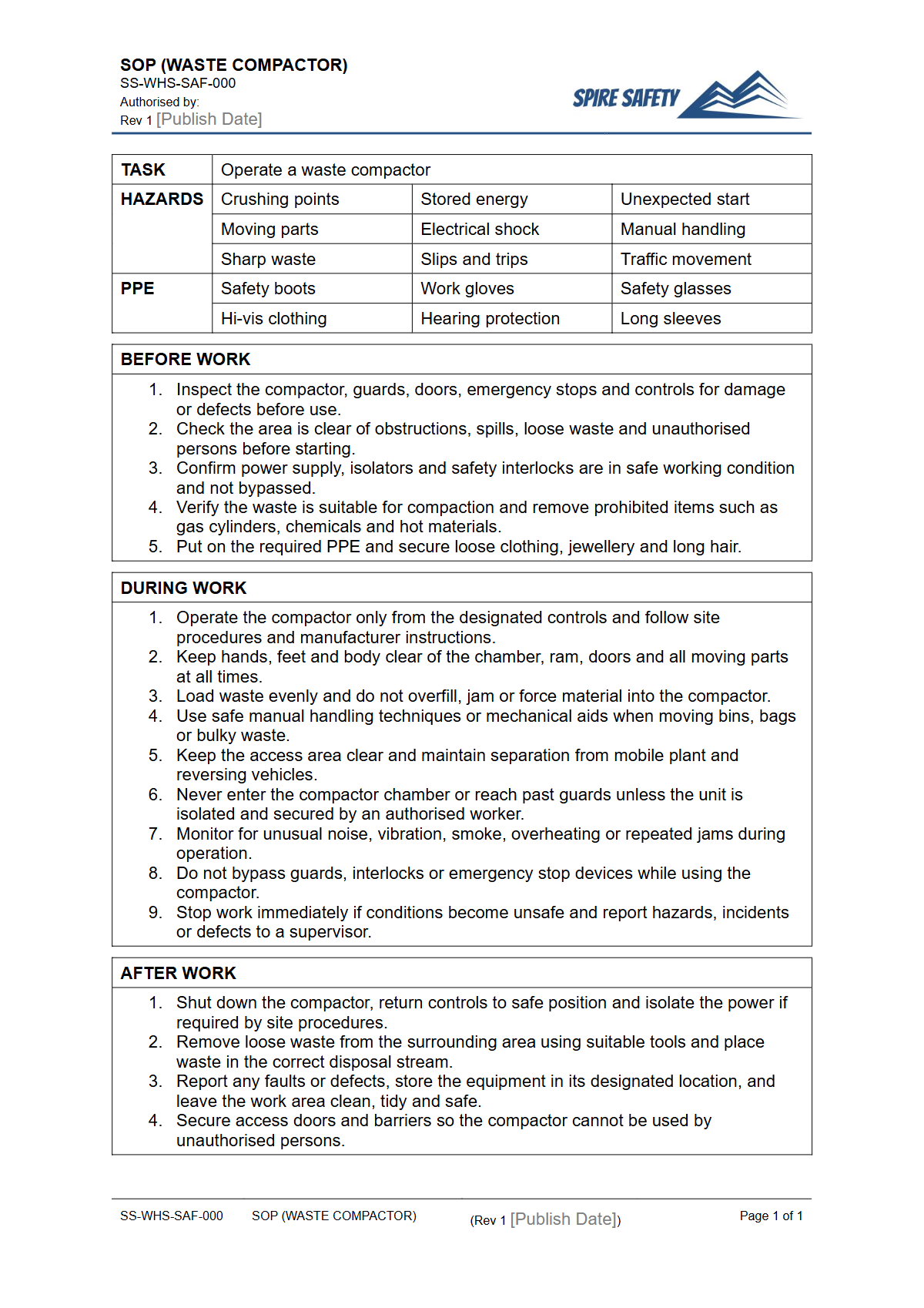
Standardise your workplace safety with our free Safe Operating Procedure (Waste Compactor) template. This document helps outline hazards and controls.
Free Safe Operating Procedure (Waste Compactor) Template
DOCX • 126 KB + PDF
Updated Oct 2026
No signup required
Purpose of the Free Safe Operating Procedure (Waste Compactor) Template
Operating a waste compactor involves significant risks, including crushing, shearing, and entanglement. A formalised safety process is essential to protect workers from harm.
This Free Safe Operating Procedure (Waste Compactor) Template provides a structured framework for documenting the key steps and precautions required for the safe use of this powerful machinery. It helps your organisation meet its duty of care obligations under WHS legislation by outlining controls, operator responsibilities, and emergency responses in a clear, accessible format.
A well-developed SOP is a cornerstone of a proactive safety culture. It standardises operating methods, reduces the chance of human error, and serves as a vital training tool for new and existing employees.
By systematically addressing hazards before they cause an incident, you create a safer and more predictable work environment. This document is aligned with Australian WHS principles and is designed to be integrated into your broader WHS management systems.
Video walkthrough
How to use the Free Safe Operating Procedure (Waste Compactor) Template
This template is available for download in both DOCX and PDF formats. The DOCX version is fully editable, allowing you to tailor it precisely to your workplace's needs.
- Download: Choose your preferred format and save the file.
- Customise: Open the DOCX file and replace the placeholder text with your site-specific information. This includes the exact make and model of the compactor, workplace location, names of responsible persons, and specific PPE requirements.
- Consult: Involve workers who operate the compactor in the drafting process. Their firsthand experience is invaluable for identifying practical hazards and effective controls.
- Approve: Have the final document reviewed and approved by a supervisor or manager before it is implemented.
Important Note: This is a template, not a finished document. To be effective, you must customise it with details relevant to your specific machinery and operational context.
We've designed it to be a starting point, but the responsibility for creating a comprehensive and suitable SOP lies with the Person Conducting a Business or Undertaking (PCBU).
When to use it
A Safe Operating Procedure for a waste compactor should be a readily accessible document used in several key situations. It forms the basis of operator training and competency assessment, ensuring every user understands the machine's functions and associated risks.
It should also be consulted for regular refresher training to prevent complacency. Workers should refer to the SOP before starting the machine, particularly when carrying out pre-operational checks.
Many industrial sites manage multiple pieces of equipment in the same area; for example, processes may involve a free Conveyer System SOP for moving waste to the compactor.
Furthermore, the SOP is a critical reference during maintenance, cleaning, or when clearing blockages, as these non-routine tasks often carry a higher risk. This may include isolating energy sources from ancillary equipment, for which documents like our Free Air Compressor SOP Template can provide a useful reference structure.
In the event of an incident or near-miss, the SOP should be reviewed as part of the investigation to identify any gaps or areas for improvement. A robust WHS compliance audit will verify that SOPs are not only documented but are also being followed correctly by all relevant personnel.
Who should use it
The primary users of this Safe Operating Procedure are the workers tasked with operating the waste compactor. It provides them with clear, step-by-step instructions to perform their duties safely. However, its use extends throughout the organisation:
- Supervisors and Managers: Use the SOP to train staff, conduct competency assessments, and supervise work to ensure procedures are being followed. They are also responsible for authorising the SOP and ensuring it is reviewed and updated.
- WHS Personnel: Integrate the SOP into the overall safety management system, use it as a basis for risk assessments, and refer to it during incident investigations and workplace inspections.
- Maintenance Staff: Refer to the SOP for critical safety information, especially lockout/tagout procedures, before performing any servicing or repairs.
- Business Owners / PCBUs: Use the development and implementation of SOPs as a key method for demonstrating compliance with their primary duty of care under WHS law.
This structured approach ensures that everyone, from the operator to senior management, has a clear understanding of the safety requirements for the task. This same principle applies to other high-risk plant, where documents like a Telehandler SOP template are essential for safe operation. For more guidance and other useful documents, browse our complete free WHS resources library.
Common mistakes
Common mistakes to avoid
- Using a generic SOP without customising it for the specific machine model and workplace.
- Failing to train workers on the SOP and verify their understanding and competency.
- Neglecting to include specific lockout/tagout procedures for cleaning, maintenance, and clearing jams.
- Not reviewing and updating the SOP after an incident, near miss, or change in equipment.
Legal references
Legal considerations
The following legal requirements may be relevant to this type of work.
- Work Health and Safety Act (Harmonised) — Provides the primary duties for protecting workers and other people from work health and safety risks.
- Work Health and Safety Regulations (Harmonised) — Sets out requirements supporting the management of workplace hazards and risks.
The following codes may be relevant to this type of work.
- Managing WHS Risks Code of Practice — Provides practical guidance on identifying hazards, assessing risks and applying effective controls.
- Work Health and Safety Consultation, Cooperation and Coordination Code of Practice — Provides practical guidance on consulting workers and coordinating with other duty holders.
- Managing the Work Environment and Facilities Code of Practice — Provides practical guidance on safe work environments, workplace facilities and related controls.
Did you know
Stored Energy Hazard
Even when powered off, hydraulic compactors can retain immense pressure. A formal lockout/tagout procedure within the SOP is critical to prevent accidental activation during maintenance or cleaning.
The Danger of Jams
A significant number of injuries involving compactors happen when workers reach into the chamber to clear a jam or retrieve an object. The SOP must include strict prohibitions against this and detail a safe procedure for clearing blockages.
FAQ
Frequently asked questions
01Is a Safe Operating Procedure a legal requirement for waste compactors in Australia?
02What is the difference between an SOP and a SWMS?
03How often should our waste compactor SOP be reviewed?
04Can I use this template for any type of waste compactor?
Share this resource
Free Safe Operating Procedure (Waste Compactor) Template
Browse Categories
How To Use It
- 1Download and open in Word or PDF.
- 2Replace the placeholders with your business details.
- 3Get it reviewed by a WHS specialist before rollout.
Need it customised?
Our WHS consultants can adapt this template to your site, run a gap analysis, or audit what you already have in place.
Book a Free Consultation WHS consulting servicesor call 1300 156 382
Related templates
- Free Safe Operating Procedure (Waste Dropoff Check) Template
- Free Safe Operating Procedure (Waste Drum Handling) Template
- Free Safe Operating Procedure (Waste Load Inspection) Template
- Free Safe Operating Procedure (Waste Load Rejection) Template
- Free Safe Operating Procedure (Waste Load Segregation) Template
- Free Safe Operating Procedure (Waste Oil Collection) Template