
Free Safe Operating Procedure (Waste Oil Collection) Template
Manage the hazards of handling waste oil with our customisable SOP template. Download your free Safe Operating Procedure for waste oil collection today.
Free Safe Operating Procedure (Waste Oil Collection) Template
DOCX • 126 KB + PDF
Updated Oct 2026
No signup required
Purpose of the Free Safe Operating Procedure (Waste Oil Collection) Template
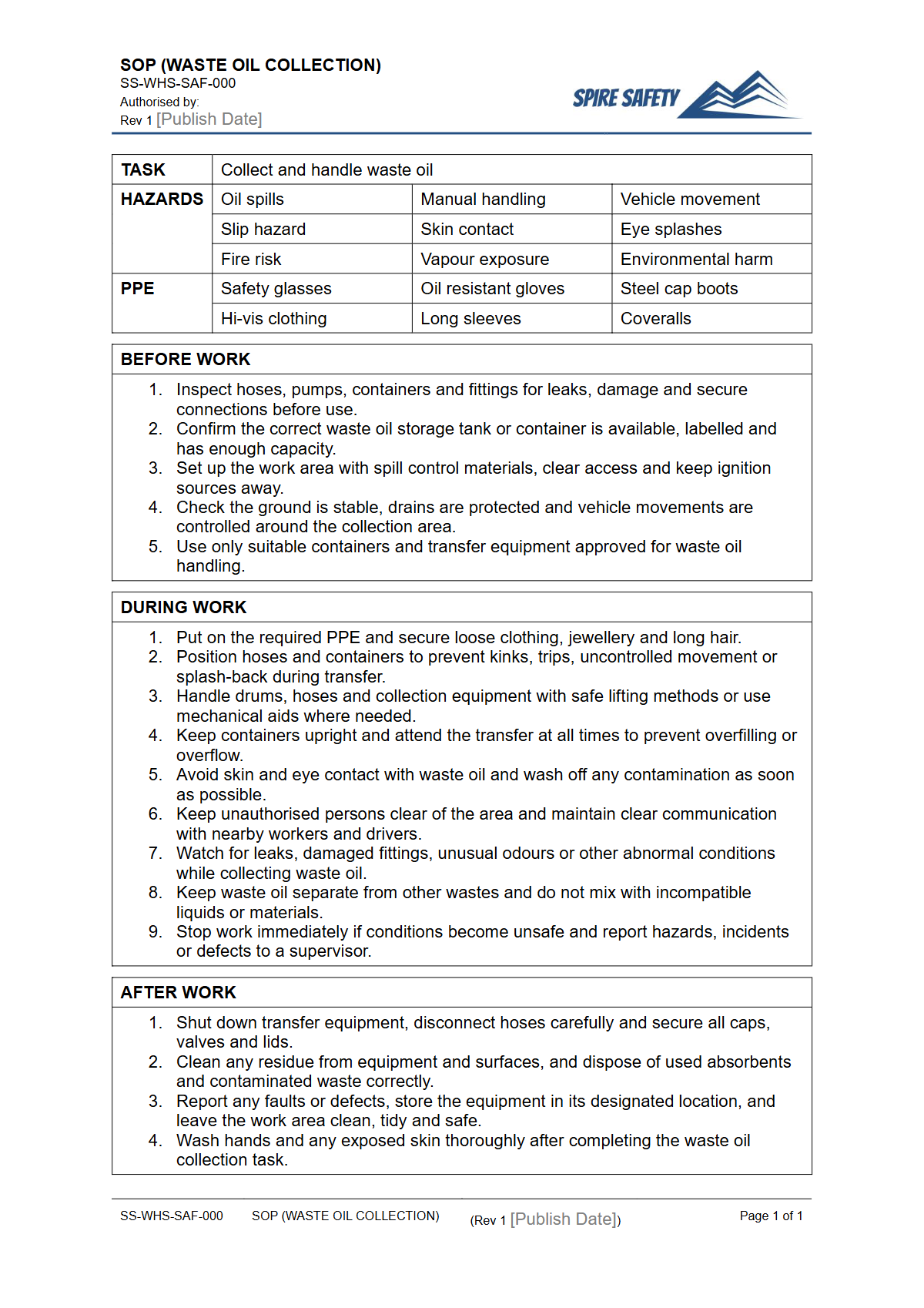
Handling waste oil presents numerous risks, including skin contact, burns, slips from spills, and significant environmental contamination. This Free Safe Operating Procedure (Waste Oil Collection) Template provides a structured framework for documenting the required steps to perform this task safely.
Using a documented procedure helps your organisation meet its primary duty of care under WHS law by managing identified hazards and controlling risks. It serves as a vital tool for worker training, competency assessment, and operational consistency, forming a key part of a robust WHS management system.
Video walkthrough
How to use the Free Safe Operating Procedure (Waste Oil Collection) Template
This document is a template and must be adapted to your specific workplace. After downloading the DOCX or PDF file, consult with your workers and supervisors to ensure the procedure reflects your unique equipment, types of oil handled (e.g., engine, hydraulic, cooking), storage facilities, and local environmental regulations.
Review and add site-specific details, such as emergency contact numbers, the location of spill kits, and the specific personal protective equipment (PPE) required. We recommend a manager or supervisor signs off on the finalised document before it is communicated to all relevant personnel.
The Safe Operating Procedure (SOP) should be used to:
- Train new and existing workers on the safe methods for draining, transferring, and storing waste oil.
- Induct contractors or visitors who may be involved in or exposed to the task.
- Provide a clear, step-by-step guide for infrequent tasks to ensure they are still performed safely.
- Act as a reference during incident investigations or workplace safety audits.
When to use it
A Safe Operating Procedure for waste oil collection should be developed, implemented, and reviewed before any worker is required to undertake the task. It is a critical control measure that should be referenced during routine vehicle and machinery servicing, oil changes, equipment cleaning, and any process that generates waste oil.
It is also essential for guiding the correct procedure for decanting oil from smaller containers into larger bulk storage units awaiting professional collection. Implementing this SOP proactively is far more effective than reacting after a spill or injury has occurred.
For complex operations, consider seeking assistance from a WHS consulting professional to ensure all risks are addressed.
Who should use it
This SOP is intended for all personnel involved in the generation and handling of waste oil. This includes, but is not limited to, mechanics, maintenance fitters, apprentices, service technicians, and any other workers who perform oil changes or manage waste storage areas.
Supervisors and managers also have a responsibility to use the SOP to ensure workers are adequately trained, are following the procedure correctly, and have access to the necessary PPE and spill control equipment. A well-written SOP ensures everyone, regardless of experience level, understands the expected safety standards and behaviour. You can find more templates for common workplace tasks in our free WHS resources library.
Key Elements of the Procedure
Our template prompts you to detail the critical safety components for managing waste oil. A comprehensive SOP should cover pre-operational checks, such as inspecting collection containers for leaks or damage and ensuring the work area is clear of ignition sources.
It outlines the specific PPE, typically including nitrile or neoprene gloves, safety glasses or goggles, and enclosed footwear. The core of the document is the step-by-step process, covering how to safely drain hot or cold oil, use funnels or pumps to prevent splashes, and securely seal and label containers. This process is just as important as for other hazardous workshop tasks covered in documents like an Oxy Acetylene SOP.
Finally, the procedure must include emergency protocols. This section details the immediate actions to take in the event of a spill, including the use of absorbent materials from a spill kit, how to manage contaminated materials, and who to notify.
It also specifies first aid measures for skin contact or eye splashes. Regularly verifying these procedures are understood and followed can be incorporated into your WHS compliance auditing schedule to ensure ongoing effectiveness.
Common mistakes
Common mistakes to avoid
- Using incorrect or damaged containers (e.g., milk cartons, open buckets) for waste oil storage.
- Pouring waste oil down stormwater drains or onto the ground, leading to environmental fines.
- Failing to clearly label containers as 'Waste Oil', creating a risk of it being used incorrectly.
- Not having an adequately stocked spill kit readily accessible in areas where oil is handled.
Legal references
Legal considerations
The following legal requirements may be relevant to this type of work.
- Work Health and Safety Act (Harmonised) — Provides the primary duties for protecting workers and other people from work health and safety risks.
- Work Health and Safety Regulations (Harmonised) — Sets out requirements supporting the management of workplace hazards and risks.
The following codes may be relevant to this type of work.
- Managing WHS Risks Code of Practice — Provides practical guidance on identifying hazards, assessing risks and applying effective controls.
- Work Health and Safety Consultation, Cooperation and Coordination Code of Practice — Provides practical guidance on consulting workers and coordinating with other duty holders.
- Managing the Work Environment and Facilities Code of Practice — Provides practical guidance on safe work environments, workplace facilities and related controls.
Did you know
Environmental Impact
A single litre of used motor oil can contaminate up to one million litres of fresh water, making proper collection and disposal procedures critical for environmental protection.
A Recyclable Resource
Used oil doesn't wear out, it just gets dirty. It can be re-refined into new lubricants or processed into fuel oil, turning a hazardous waste product into a valuable resource.
FAQ
Frequently asked questions
01Is a Safe Operating Procedure a legal requirement for collecting waste oil in Australia?
02What PPE is generally required for handling waste oil?
03How should I store waste oil before collection?
04Can I customise this waste oil collection SOP for different types of oil?
Share this resource
Free Safe Operating Procedure (Waste Oil Collection) Template
Browse Categories
How To Use It
- 1Download and open in Word or PDF.
- 2Replace the placeholders with your business details.
- 3Get it reviewed by a WHS specialist before rollout.
Need it customised?
Our WHS consultants can adapt this template to your site, run a gap analysis, or audit what you already have in place.
Book a Free Consultation WHS consulting servicesor call 1300 156 382
Related templates
- Free Safe Operating Procedure (Waste Stream Sorting) Template
- Free Safe Operating Procedure (Waste Transfer Handover) Template
- Free Safe Operating Procedure (Wastewater Sampling) Template
- Free Safe Operating Procedure (Water Bath) Template
- Free Safe Operating Procedure (Water Leak Response) Template
- Free Safe Operating Procedure (Water Level Meter) Template