
Free Safe Operating Procedure (Water Bath) Template
Outline the safe use of a water bath in your workplace with our customisable template. Download your free Safe Operating Procedure (Water Bath) today.
Free Safe Operating Procedure (Water Bath) Template
DOCX • 126 KB + PDF
Updated Oct 2026
No signup required
Purpose of the Free Safe Operating Procedure (Water Bath) Template
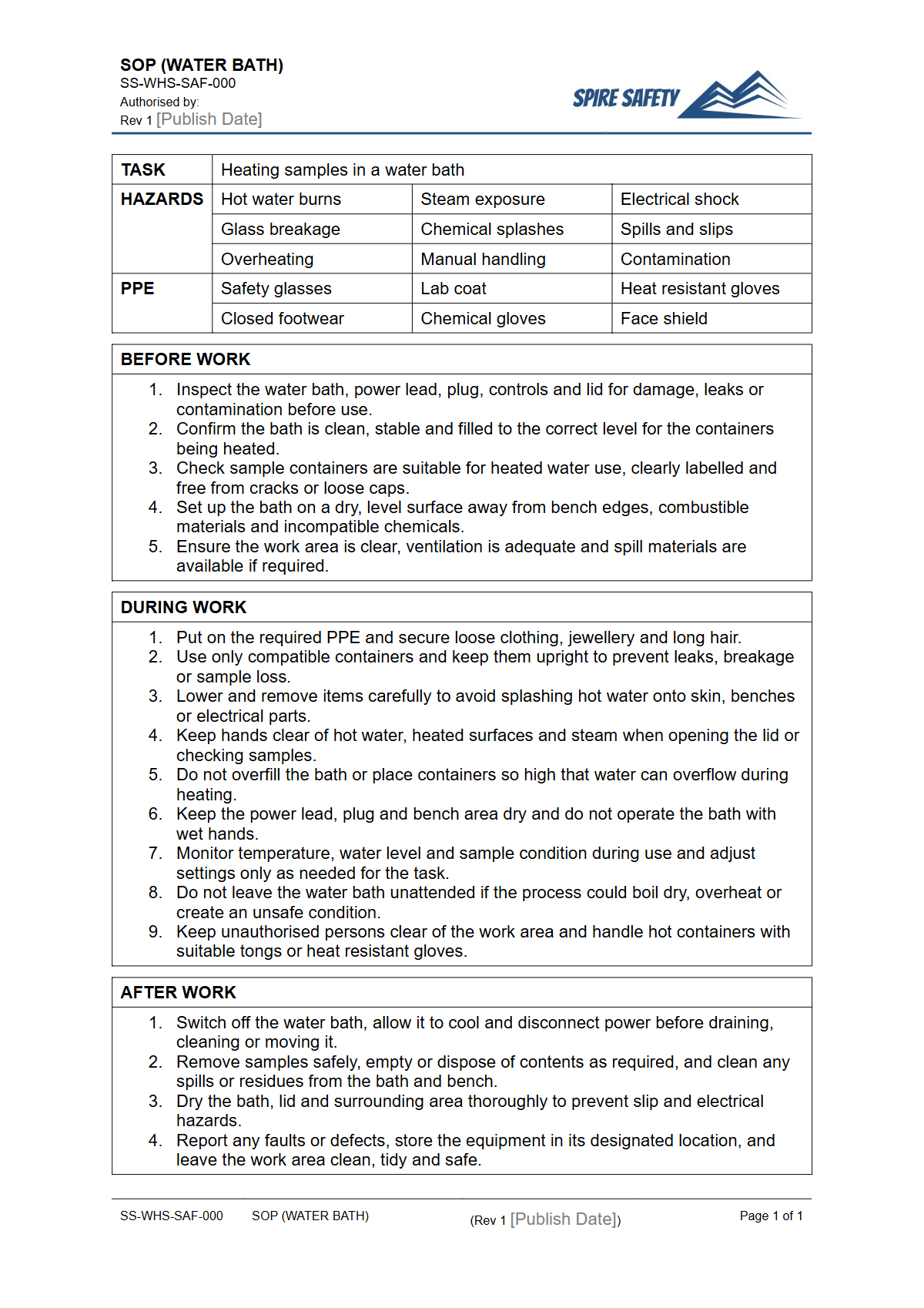
Effectively manage the risks associated with laboratory or kitchen water baths with our free Safe Operating Procedure (Water Bath) Template. This downloadable document provides a structured framework for outlining the step-by-step process for the safe operation, cleaning, and maintenance of a water bath.
Using a clear and comprehensive Safe Operating Procedure (SOP) is fundamental to ensuring workers are protected from hazards such as burns, scalds, and electrical shocks. This template is designed to be customised to the specific models and working conditions found in your organisation, forming a key part of your safety documentation.
A well-drafted SOP is more than just a procedural document; it is a critical training tool and a cornerstone of a proactive safety culture. It helps standardise tasks to minimise human error and ensures that all personnel, regardless of experience level, follow a consistent, safe method of work.
Implementing robust SOPs demonstrates a commitment to health and safety, forming an essential component of comprehensive WHS management systems that protect both your people and your organisation.
Video walkthrough
How to use the Free Safe Operating Procedure (Water Bath) Template
This Safe Operating Procedure template is provided as a starting point. It must be customised to reflect the specific equipment, chemicals, tasks, and environment at your workplace.
To use the template effectively, download the DOCX file and work through each section, adding details relevant to your specific water bath model and operational context. Consult with workers who regularly use the equipment to ensure the procedure is practical, accurate, and easy to understand.
Pay close attention to sections covering personal protective equipment (PPE), pre-operational checks, step-by-step operating instructions, and emergency procedures. Detail the exact type of gloves, eye protection, or aprons required.
List the specific steps for filling the unit, setting the temperature, and safely placing or removing items. While this SOP is for a water bath, the principles of risk control are similar for other heated appliances; our Safe Operating Procedure for a deep fryer offers another example for a different context.
If you are unsure how to conduct the necessary risk assessments or tailor the procedure to your specific legal obligations, seeking professional guidance is recommended. Spire Safety provides expert WHS consulting to help businesses develop and implement effective safety documentation that is suited to their unique operational risks.
When to use a Water Bath Safe Operating Procedure
A Safe Operating Procedure for a water bath should be developed and implemented before the equipment is first used in the workplace. It is an essential document for inducting and training new staff, as well as for refresher training for existing workers.
The SOP should be readily accessible to all operators at or near the location of the water bath. Regularly reviewing and updating your SOPs is crucial, particularly after an incident, when new models are introduced, or as part of periodic WHS compliance audits.
It is also beneficial to review the procedure when work environments change or if a risk assessment identifies new hazards. For example, if the bath is moved to a new location or used for a different type of application, the SOP must be updated to reflect any new risks.
This continuous improvement cycle ensures your safety documentation remains relevant and effective. You can apply this same logic to other common workplace equipment, such as that covered by our Air Compressor SOP template.
Who should use this Safe Operating Procedure
This Safe Operating Procedure should be used by several groups within an organisation. Primarily, workers and operators who are required to use the water bath must be trained on and follow the procedure.
It provides them with the clear, step-by-step instructions needed to perform their tasks safely. Supervisors and managers are responsible for ensuring that workers are trained and that the procedures are being followed correctly.
They also use the SOP as a tool for workplace inspections and for investigating any incidents or near misses involving the equipment.
Persons Conducting a Business or Undertaking (PCBUs) have the primary duty of care to ensure safe systems of work. Developing, implementing, and reviewing SOPs is a key way they fulfil this duty.
Health and Safety Representatives (HSRs) should also be familiar with the SOP as part of their role in representing workers on safety matters and monitoring the effectiveness of safety measures. This structured approach to safety is transferable across various high-risk tasks, such as those detailed in our free Oxy Acetylene SOP.
Ultimately, this document is for any organisation aiming to formalise its safety processes and meet its work health and safety obligations. For more tools to support your safety management framework, explore our complete free WHS resources library.
Common mistakes
Common mistakes to avoid
- Using tap water in baths where deionised or distilled water is required, leading to mineral buildup and equipment damage.
- Overfilling the bath, which increases the risk of spills, creating slip and electrical hazards when water contacts electronics.
- Failing to regularly clean and descale the unit, which can lead to poor temperature control, bacterial growth, and corrosion.
- Operating the unit without sufficient water, which can expose the heating element and create a serious fire hazard.
Legal references
Legal considerations
The following legal requirements may be relevant to this type of work.
- Work Health and Safety Act (Harmonised) — Provides the primary duties for protecting workers and other people from work health and safety risks.
- Work Health and Safety Regulations (Harmonised) — Sets out requirements supporting the management of workplace hazards and risks.
The following codes may be relevant to this type of work.
- Managing WHS Risks Code of Practice — Provides practical guidance on identifying hazards, assessing risks and applying effective controls.
- Work Health and Safety Consultation, Cooperation and Coordination Code of Practice — Provides practical guidance on consulting workers and coordinating with other duty holders.
- Managing the Work Environment and Facilities Code of Practice — Provides practical guidance on safe work environments, workplace facilities and related controls.
Did you know
Precision and Safety
Digital water baths offer greater temperature accuracy and control compared to analog models, which helps prevent overheating and reduces the risk of boil-overs or damage to sensitive samples.
Fire Prevention
In laboratories, water baths are a key safety device used to indirectly heat flammable chemicals, avoiding the significant fire risk posed by using an open flame from a Bunsen burner.
FAQ
Frequently asked questions
01What are the main hazards of using a laboratory water bath?
02How often should a Safe Operating Procedure for a water bath be reviewed?
03Who is responsible for writing a water bath SOP?
04Can this SOP template be used for other types of heated equipment?
Share this resource
Free Safe Operating Procedure (Water Bath) Template
Browse Categories
How To Use It
- 1Download and open in Word or PDF.
- 2Replace the placeholders with your business details.
- 3Get it reviewed by a WHS specialist before rollout.
Need it customised?
Our WHS consultants can adapt this template to your site, run a gap analysis, or audit what you already have in place.
Book a Free Consultation WHS consulting servicesor call 1300 156 382
Related templates
- Free Safe Operating Procedure (Water Leak Response) Template
- Free Safe Operating Procedure (Water Level Meter) Template
- Free Safe Operating Procedure (Water Main Burst Response) Template
- Free Safe Operating Procedure (Water Main Isolation) Template
- Free Safe Operating Procedure (Water Meter Pit Access) Template
- Free Safe Operating Procedure (Water Meter Pit Clean) Template