
Free Safe Operating Procedure (Water Main Burst Response) Template
Effectively manage the risks of a water main burst with a clear, structured procedure. Download our free Safe Operating Procedure template to get started.
Free Safe Operating Procedure (Water Main Burst Response) Template
DOCX • 126 KB + PDF
Updated Oct 2026
No signup required
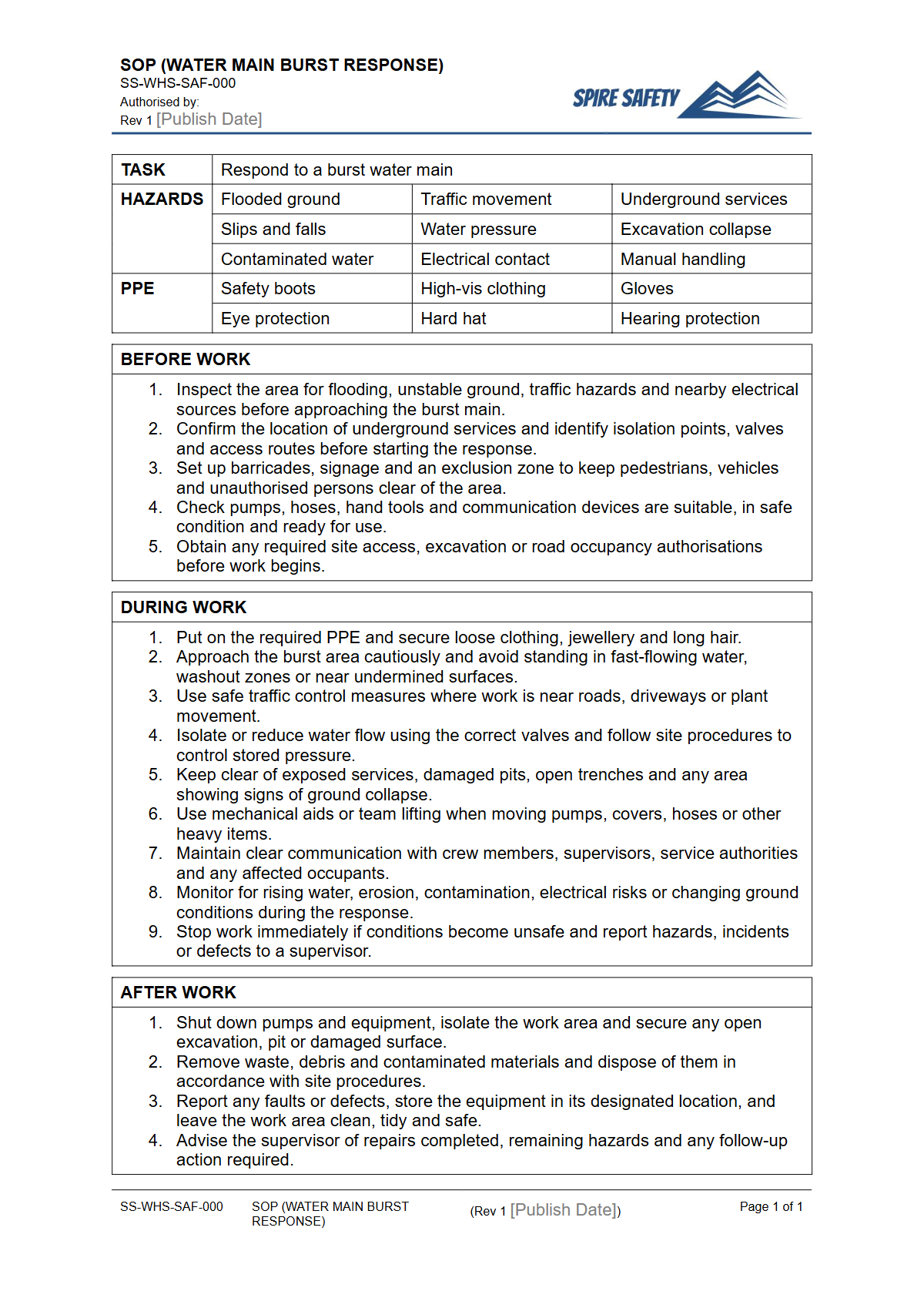
Purpose of the Free Safe Operating Procedure (Water Main Burst Response) Template
A water main burst is a high-risk event that can cause significant disruption, property damage, and serious harm to workers and the public. Responding without a clear plan introduces uncontrolled hazards like trench collapse, electrocution from damaged underground services, traffic incidents, and biological contamination.
This Free Safe Operating Procedure (Water Main Burst Response) Template provides a structured framework for managing these emergencies safely and effectively.
Using a documented SOP ensures that every team member understands their role, the required safety controls, and the sequence of actions to take. It formalises the process for isolating the area, identifying hazards, controlling energy sources, and undertaking repairs.
Integrating this procedure is a key part of developing robust WHS management systems, demonstrating a commitment to proactive risk management and operational readiness.
Video walkthrough
How to use the Free Safe Operating Procedure (Water Main Burst Response) Template
This document is available as a fully editable DOCX file and a print-ready PDF. It is designed to be a starting point, pre-filled with common steps and safety considerations aligned with Australian WHS principles.
To use it effectively, you must adapt it to your specific operational context. This includes adding site-specific details, listing the exact plant and equipment used, and detailing your emergency contact list.
Important: This is a template, not a finished document. We cannot know the unique hazards of your worksite, the equipment you use, or your specific state or territory regulations.
You must undertake a risk assessment in consultation with your workers and other relevant parties to ensure the final SOP is comprehensive and effective for your business. For example, if excavation is required, you must incorporate specific controls detailed in documents like our free Trencher SOP Template to manage ground collapse and service strike risks.
Key Elements of an Effective Response Procedure
A comprehensive water main burst SOP should cover several critical phases of the response. The initial response focuses on immediate safety, such as establishing exclusion zones and initiating traffic control.
The next phase involves hazard identification and risk assessment, including locating other underground services before any excavation begins. The procedure should then detail the safe work methods for de-watering, excavation, and repair, including the specific equipment to be used.
If earthmoving is involved, referencing procedures from a resource like our Scraper SOP template can ensure consistency in machinery operation. Finally, the SOP should cover post-repair procedures, including backfilling, site reinstatement, and incident reporting.
When to use this Safe Operating Procedure
A Safe Operating Procedure for a water main burst is not just for use during an emergency. It is a critical tool for multiple stages of your safety management lifecycle.
Its primary use is to guide the immediate, on-site response to an incident, ensuring a controlled and safe reaction. Beyond emergencies, the SOP should be the foundation for worker training and emergency drills, allowing teams to practice the response in a safe environment.
It should also be a key document referenced during incident investigations and reviewed as part of your scheduled WHS compliance auditing to identify areas for improvement.
Who should use it
This template is designed for use by any person or organisation responsible for managing infrastructure or responding to utility emergencies. This includes WHS Managers, Site Supervisors, and Project Managers in civil construction, plumbing, and utilities maintenance sectors.
Team Leaders and field crews who perform the hands-on work will use the finalised SOP as their primary guide for safe work practices during a response. Business owners and Persons Conducting a Business or Undertaking (PCBUs) can use this template to fulfil their duty of care to provide safe systems of work.
For guidance on customising this SOP to meet your specific legal obligations, consider engaging WHS consulting services.
This document is one of many industry-specific templates available. We encourage you to explore our complete free WHS resources library for other procedures, checklists, and forms to support your safety management system.
Common mistakes
Common mistakes to avoid
- Failing to identify and control all energy sources (e.g., electrical, gas, telecommunications) before excavating.
- Underestimating the area of ground instability and setting up work zones too close to the burst.
- Implementing inadequate traffic and pedestrian controls, leading to secondary incidents with the public.
- Not having up-to-date emergency contact details for all relevant utility providers and authorities readily available.
Legal references
Legal considerations
The following legal requirements may be relevant to this type of work.
- Work Health and Safety Act (Harmonised) — Provides the primary duties for protecting workers and other people from work health and safety risks.
- Work Health and Safety Regulations (Harmonised) — Sets out requirements supporting the management of workplace hazards and risks.
The following codes may be relevant to this type of work.
- Managing WHS Risks Code of Practice — Provides practical guidance on identifying hazards, assessing risks and applying effective controls.
- Work Health and Safety Consultation, Cooperation and Coordination Code of Practice — Provides practical guidance on consulting workers and coordinating with other duty holders.
- Managing the Work Environment and Facilities Code of Practice — Provides practical guidance on safe work environments, workplace facilities and related controls.
Did you know
Hidden Dangers
A water main burst can rapidly erode the soil supporting a road, creating large, concealed voids or sinkholes. The surface may appear intact until the weight of a vehicle or person causes it to collapse suddenly.
Immense Force
Pressure in large trunk water mains can exceed 1,000 kPa. A failure at this pressure can release millions of litres of water per hour with enough force to move cars, tear apart road surfaces, and throw heavy debris significant distances.
FAQ
Frequently asked questions
01What are the primary hazards associated with a water main burst?
02Who is legally responsible for creating a Water Main Burst Response SOP?
03How often should our water main burst procedure be reviewed?
04Does this template include a traffic management plan?
Share this resource
Free Safe Operating Procedure (Water Main Burst Response) Template
Browse Categories
How To Use It
- 1Download and open in Word or PDF.
- 2Replace the placeholders with your business details.
- 3Get it reviewed by a WHS specialist before rollout.
Need it customised?
Our WHS consultants can adapt this template to your site, run a gap analysis, or audit what you already have in place.
Book a Free Consultation WHS consulting servicesor call 1300 156 382
Related templates
- Free Safe Operating Procedure (Water Main Isolation) Template
- Free Safe Operating Procedure (Water Meter Pit Access) Template
- Free Safe Operating Procedure (Water Meter Pit Clean) Template
- Free Safe Operating Procedure (Water Ram) Template
- Free Safe Operating Procedure (Water Rescue Equipment) Template
- Free Safe Operating Procedure (Water Sample Handover) Template