
Free Safe Operating Procedure (Water Main Isolation) Template
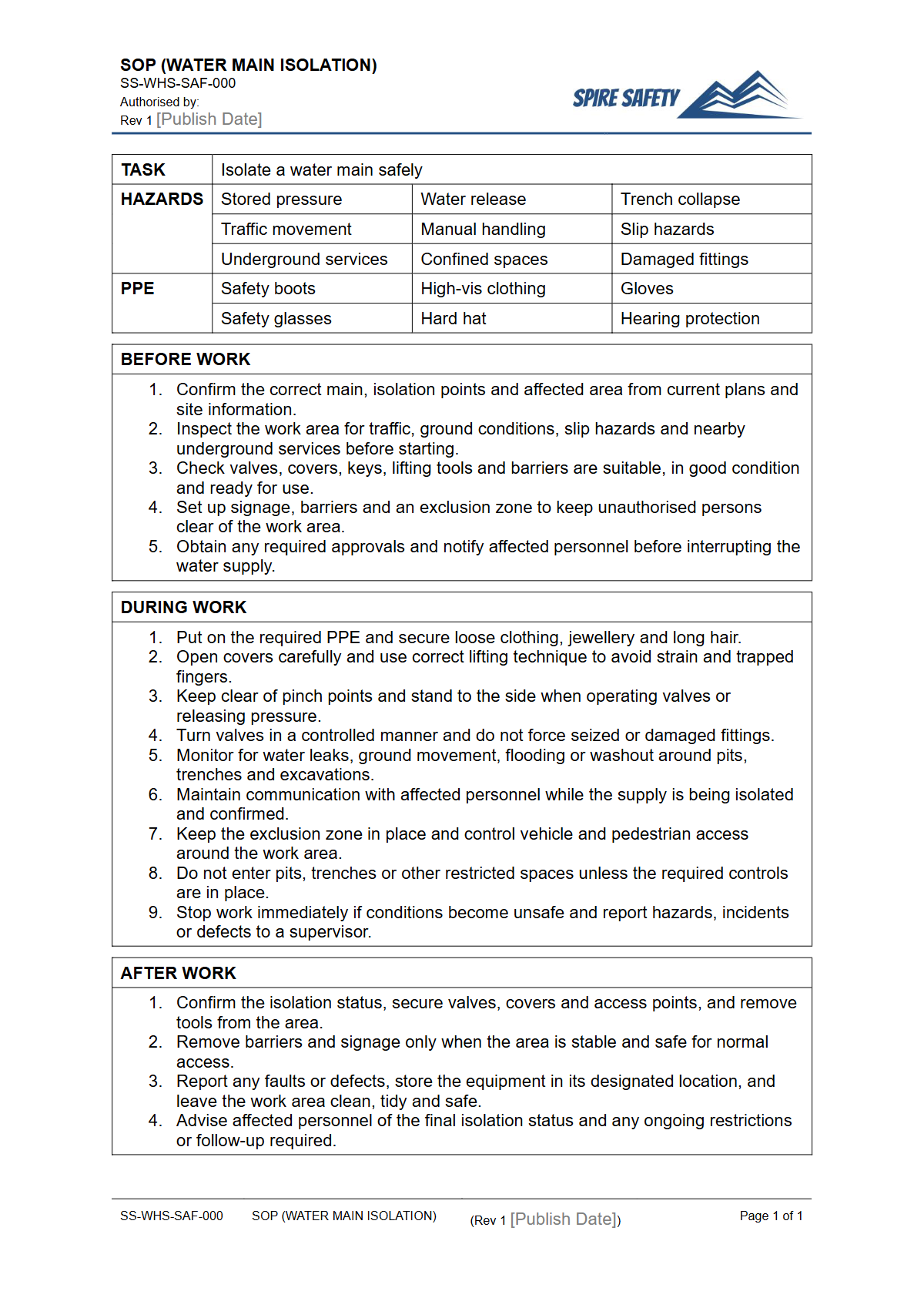
Effectively manage risks associated with water main isolation with our structured template. Download this free Safe Operating Procedure to get started.
Free Safe Operating Procedure (Water Main Isolation) Template
DOCX • 126 KB + PDF
Updated Oct 2026
No signup required
Purpose of the Free Safe Operating Procedure (Water Main Isolation) Template
Working with pressurised water mains presents significant safety risks, including uncontrolled water release, trench collapse, exposure to hazardous substances, and damage to adjacent services. This free Safe Operating Procedure (Water Main Isolation) template provides a structured framework for documenting a safe system of work.
It helps your organisation formalise the step-by-step process required to safely isolate, de-pressurise, and reinstate a water main. Using a documented SOP ensures tasks are performed consistently and safely by all personnel, reducing the chance of incidents and promoting a proactive safety culture.
A well-defined SOP is a cornerstone of operational risk management. It serves as a vital training tool for new workers and a reference for experienced operators, ensuring that critical safety checks are never overlooked.
The procedure outlines required personal protective equipment (PPE), pre-start checks, and emergency response actions, forming a complete guide for the task. It demonstrates a commitment to meeting Work Health and Safety (WHS) obligations by providing clear, accessible instructions for managing known hazards.
Video walkthrough
How to use the Free Safe Operating Procedure (Water Main Isolation) Template
This Safe Operating Procedure template is provided in both DOCX and PDF formats for your convenience. The DOCX file is fully editable, allowing you to tailor the content to the specific equipment, environment, and regulations relevant to your worksite.
It is essential that you customise this document to reflect your unique operational context, including specific valve types, site conditions, and local water authority requirements. A generic procedure is not sufficient; it must be made site-specific to be effective.
Important: This is a template, not a finished document. We have provided a comprehensive starting point, but you must consult with operators, supervisors, and other relevant stakeholders to review and adapt the content.
Your final SOP should accurately describe the way work is actually carried out at your site. For tasks involving trenching or excavation, you may also need to supplement this SOP with resources like our free Trencher SOP Template to cover associated ground-disturbance risks.
When to use a Water Main Isolation SOP
A Safe Operating Procedure for water main isolation should be used whenever a section of a water distribution network needs to be taken out of service. This includes a range of scenarios:
- Planned Maintenance: For routine tasks such as valve replacement, pipe repairs, or hydrant servicing.
- Emergency Repairs: Following a sudden pipe burst or leak, an SOP provides a controlled methodology amidst a high-pressure situation, preventing further damage or injury.
- New Installations: When connecting new pipelines, branches, or developments to an existing live main.
- System Decommissioning: For permanently taking a section of pipeline out of service.
Using an SOP in these situations ensures that the isolation is performed correctly, the work area is proven to be safe, and the system is reinstated with minimal disruption and maximum safety. This process forms a critical part of broader comprehensive WHS management systems that govern all high-risk activities on site.
Who should use this Safe Operating Procedure
This SOP is designed for use by competent and authorised personnel involved in civil construction, plumbing, and utilities maintenance. This includes:
- Licensed Plumbers and Pipe Layers: The primary operators responsible for carrying out the physical isolation tasks.
- Site Supervisors and Foremen: Individuals responsible for overseeing the work, ensuring the SOP is followed, and managing overall site safety.
- Utility Workers: Employees of water authorities or councils who perform maintenance and repair on public water infrastructure.
- Safety Officers: WHS personnel who use the SOP as a tool for risk assessments, incident investigations, and workplace inspections.
All individuals using this SOP must be trained and assessed as competent in the procedure itself, as well as in the use of all associated tools and equipment. Regular reviews and WHS compliance auditing can verify that the documented procedures are being implemented effectively in the field.
For complex projects or to develop a suite of integrated safety documents, you may benefit from expert WHS consulting services. If you need other templates, you can browse our complete free WHS resources library for more downloads.
Common mistakes
Common mistakes to avoid
- Failing to physically verify de-pressurisation before cutting or dismantling a pipe.
- Neglecting to check for other underground services before starting any excavation.
- Using incorrect or poorly maintained isolation valves, fittings, or equipment.
- Inadequate shoring or benching of trenches, creating a high risk of ground collapse.
Legal references
Legal considerations
The following legal requirements may be relevant to this type of work.
- Work Health and Safety Act (Harmonised) — Provides the primary duties for protecting workers and other people from work health and safety risks.
- Work Health and Safety Regulations (Harmonised) — Sets out requirements supporting the management of workplace hazards and risks.
The following codes may be relevant to this type of work.
- Managing WHS Risks Code of Practice — Provides practical guidance on identifying hazards, assessing risks and applying effective controls.
- Work Health and Safety Consultation, Cooperation and Coordination Code of Practice — Provides practical guidance on consulting workers and coordinating with other duty holders.
- Managing the Work Environment and Facilities Code of Practice — Provides practical guidance on safe work environments, workplace facilities and related controls.
Did you know
Stored Energy Hazard
Even after a valve is closed, significant pressure can remain trapped in a section of water main. This stored energy poses a serious hazard if the line is not properly bled or vented before work commences.
Dial Before You Dig
Before any excavation, Australian safety practices and regulations require contacting Dial Before You Dig. This service provides plans for underground utilities, helping to prevent costly and potentially fatal service strikes on gas lines, electrical cables, or communication conduits.
FAQ
Frequently asked questions
01What are the main hazards involved in water main isolation?
02Is a Safe Operating Procedure a legal requirement for water main isolation in Australia?
03How often should a water main isolation SOP be reviewed?
04What is the difference between an SOP and a SWMS for this task?
Share this resource
Free Safe Operating Procedure (Water Main Isolation) Template
Browse Categories
How To Use It
- 1Download and open in Word or PDF.
- 2Replace the placeholders with your business details.
- 3Get it reviewed by a WHS specialist before rollout.
Need it customised?
Our WHS consultants can adapt this template to your site, run a gap analysis, or audit what you already have in place.
Book a Free Consultation WHS consulting servicesor call 1300 156 382
Related templates
- Free Safe Operating Procedure (Water Meter Pit Access) Template
- Free Safe Operating Procedure (Water Meter Pit Clean) Template
- Free Safe Operating Procedure (Water Ram) Template
- Free Safe Operating Procedure (Water Rescue Equipment) Template
- Free Safe Operating Procedure (Water Sample Handover) Template
- Free Safe Operating Procedure (Water Sampling) Template