
Free Safe Operating Procedure (Water Sample Handover) Template
Handle water sample handovers safely and consistently with our structured template. Download your free Safe Operating Procedure to standardise your process.
Free Safe Operating Procedure (Water Sample Handover) Template
DOCX • 126 KB + PDF
Updated Oct 2026
No signup required
Purpose of the Free Safe Operating Procedure (Water Sample Handover) Template
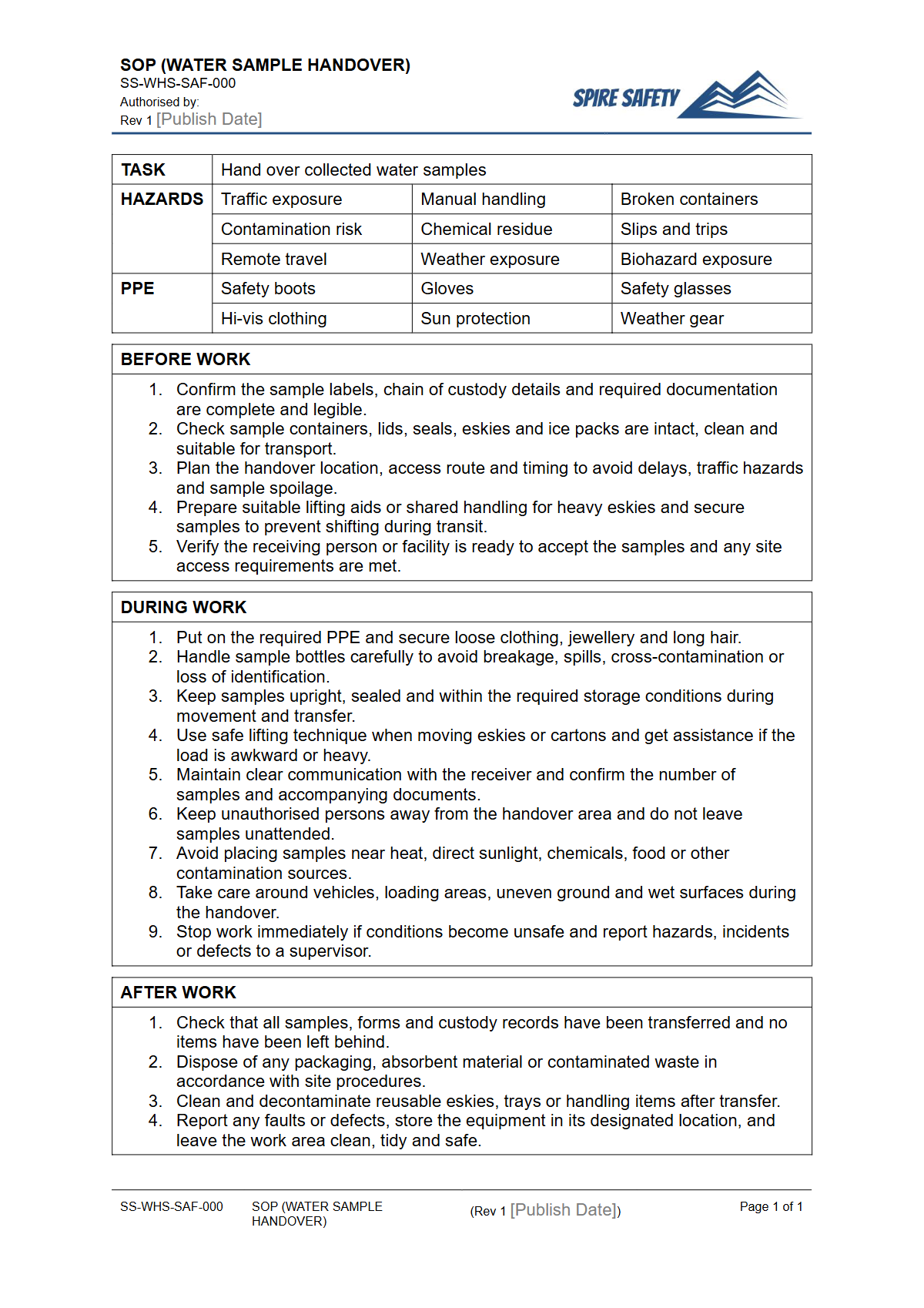
This Free Safe Operating Procedure (Water Sample Handover) Template provides a clear, step-by-step framework for transferring water samples from the point of collection to a laboratory or another person. Its purpose is to ensure the task is performed safely and consistently, minimising risks to personnel and maintaining the integrity of the sample.
Proper handover is critical for accurate analytical results, particularly in environmental monitoring, public health testing, and regulatory compliance scenarios.
The SOP addresses key hazards associated with water sampling, such as exposure to biological or chemical contaminants, manual handling risks, and potential for spills. By documenting a standardised process, organisations can ensure the chain of custody is maintained, which is a vital legal and scientific requirement.
This template serves as a structured starting point for creating a site-specific procedure that aligns with Australian WHS principles and industry best practices for sample management. Integrating this document into your operational framework helps demonstrate due diligence in managing workplace health and safety risks.
Video walkthrough
How to use the Free Safe Operating Procedure (Water Sample Handover) Template
This Safe Operating Procedure template is provided in both DOCX and PDF formats for your convenience. To use it, simply download the file and open the DOCX version to begin customisation.
The document is structured with clear headings covering aspects like required personal protective equipment (PPE), pre-handover checks, step-by-step handover instructions, and emergency procedures for spills.
IMPORTANT: This document is a template only. We cannot provide legal advice, and this document must be customised to meet the specific needs of your workplace.
You must consult with your workers, site managers, and WHS representatives to identify all relevant hazards and control measures unique to your equipment, materials, and operating environment. This includes specifying the exact types of samples handled, laboratory-specific requirements for transport and storage, and emergency contact details.
A robust safety procedure is a key component of an effective safety framework. We recommend integrating this customised SOP into your broader WHS management systems to ensure it is communicated, implemented, and reviewed regularly.
When to use this Safe Operating Procedure
This SOP should be used whenever there is a transfer of custody for a water sample. This includes handing a sample from a field technician to a courier, from one staff member to another, or from site personnel to a laboratory representative. It is particularly important in situations involving:
- Environmental Monitoring: Sampling groundwater, surface water, or wastewater for contamination analysis on sites that may also require a trencher SOP for earthworks.
- Regulatory Compliance: Collecting samples to meet licensing conditions or government regulations, where chain of custody is legally mandated.
- Public Health: Testing drinking water supplies, swimming pools, or cooling towers for pathogens like Legionella.
- Agricultural Operations: Assessing water quality for irrigation or monitoring runoff for contaminants, often on properties where other procedures like a spreader SOP are also in effect.
- Scientific Research: Ensuring sample integrity for projects where data accuracy is paramount.
Who should use this Safe Operating Procedure
This procedure is designed for any person involved in the water sampling chain of custody. It provides clear instructions for workers who may not have a scientific background but are tasked with handling samples. Key users include:
- Environmental Scientists and Technicians: The primary individuals collecting and handling samples in the field.
- Field Workers and Site Operators: Personnel who may assist in sample collection or transport as part of their duties.
- Laboratory Staff: Those receiving samples, who need to verify that handover procedures were correctly followed.
- WHS Managers and Supervisors: Individuals responsible for implementing and enforcing safe work practices and ensuring staff are adequately trained. If you need help with training or customisation, our WHS consulting team can provide tailored support.
- Couriers and Logistics Personnel: Anyone tasked with transporting samples from the field to the lab.
Regular reviews and updates are crucial to ensure the SOP remains relevant. We suggest incorporating this procedure into your periodic WHS compliance auditing schedule to verify its effectiveness and ensure it is being followed correctly by all relevant personnel.
You can also explore our free WHS resources library for other templates that can support your safety management system.
Common mistakes
Common mistakes to avoid
- Using incorrect or non-sterile sample containers for the intended analysis.
- Failing to complete handover forms (Chain of Custody) with all required information.
- Breaking the cold chain by not maintaining the required temperature during storage and transport.
- Forgetting to document a transfer between personnel, creating a gap in the chain of custody.
Legal references
Legal considerations
The following legal requirements may be relevant to this type of work.
- Work Health and Safety Act (Harmonised) — Provides the primary duties for protecting workers and other people from work health and safety risks.
- Work Health and Safety Regulations (Harmonised) — Sets out requirements supporting the management of workplace hazards and risks.
The following codes may be relevant to this type of work.
- Managing WHS Risks Code of Practice — Provides practical guidance on identifying hazards, assessing risks and applying effective controls.
- Work Health and Safety Consultation, Cooperation and Coordination Code of Practice — Provides practical guidance on consulting workers and coordinating with other duty holders.
- Managing the Work Environment and Facilities Code of Practice — Provides practical guidance on safe work environments, workplace facilities and related controls.
Did you know
Sample Integrity
The temperature of a water sample can significantly affect its chemical and biological composition. Many Australian standards require samples to be chilled immediately to below 10°C, and often to around 4°C, to halt microbial activity and preserve the sample.
Chain of Custody
A 'Chain of Custody' (CoC) form is a legal document that tracks a sample's journey. Any break in the documented chain can render the sample's analytical results inadmissible in legal or regulatory proceedings.
FAQ
Frequently asked questions
01What should be included in a water sample handover SOP?
02Is this template suitable for all types of water sampling?
03How does a Safe Operating Procedure differ from a risk assessment?
04Why is documenting the chain of custody so important?
Share this resource
Free Safe Operating Procedure (Water Sample Handover) Template
Browse Categories
How To Use It
- 1Download and open in Word or PDF.
- 2Replace the placeholders with your business details.
- 3Get it reviewed by a WHS specialist before rollout.
Need it customised?
Our WHS consultants can adapt this template to your site, run a gap analysis, or audit what you already have in place.
Book a Free Consultation WHS consulting servicesor call 1300 156 382
Related templates
- Free Safe Operating Procedure (Water Sampling) Template
- Free Safe Operating Procedure (Water Stain Removal) Template
- Free Safe Operating Procedure (Water Tank Inspection) Template
- Free Safe Operating Procedure (Water Valve Inspection) Template
- Free Safe Operating Procedure (Waterway Debris Removal) Template
- Free Safe Operating Procedure (Waterway Litter Cleanup) Template