
Free Safe Operating Procedure (Waterway Litter Cleanup) Template
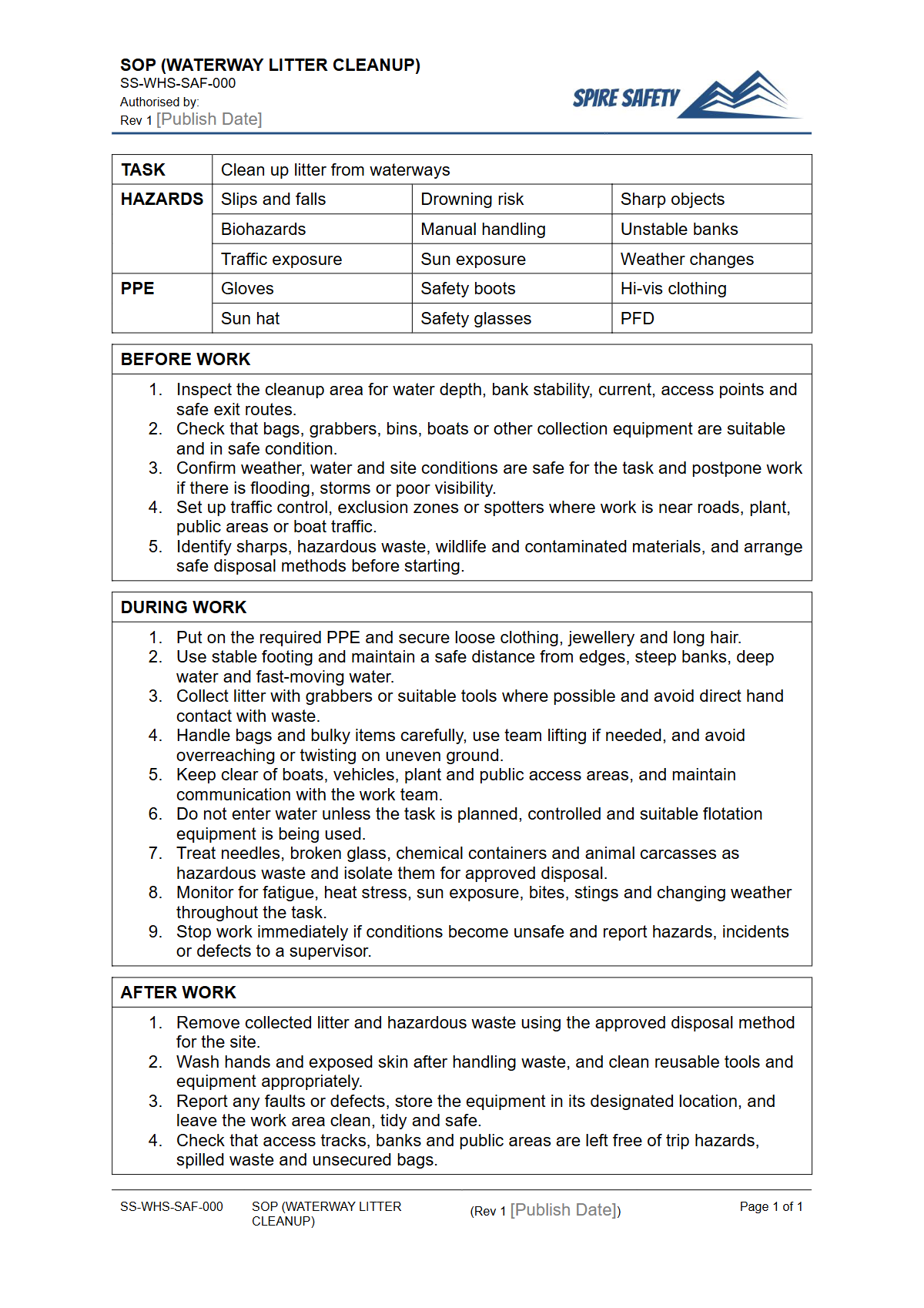
Download our free Safe Operating Procedure for waterway litter cleanup activities. This template provides a structured starting point for your safety protocols.
Free Safe Operating Procedure (Waterway Litter Cleanup) Template
DOCX • 126 KB + PDF
Updated Oct 2026
No signup required
Purpose of the Free Safe Operating Procedure (Waterway Litter Cleanup) Template
Managing the health and safety of workers and volunteers during environmental cleanup activities is critical. This Free Safe Operating Procedure (Waterway Litter Cleanup) Template provides a structured framework for identifying hazards and implementing control measures specific to cleaning litter from rivers, creeks, beaches, and other water bodies.
Using an SOP helps to formalise your process, ensuring that everyone involved understands the risks—such as slips near water, manual handling injuries, contact with hazardous materials, and biological threats—and the steps required to work safely. It is a fundamental component of any robust WHS management system, demonstrating a commitment to proactive risk management.
Video walkthrough
How to use the Free Safe Operating Procedure (Waterway Litter Cleanup) Template
This resource is available for immediate download as a DOCX file, allowing for easy customisation to suit your specific operational needs. A PDF version is also provided for straightforward printing and distribution.
It is essential to adapt this document to your unique work environment. Unlike procedures for specific heavy machinery such as those covered in a FREE Trencher SOP Template, this SOP must account for the highly variable conditions of an outdoor, uncontrolled environment like a riverbank or coastline.
You must conduct a site-specific risk assessment and incorporate your findings into the final document.
Important Note on Customisation
This template is a starting point and is not a substitute for a comprehensive risk assessment. We strongly recommend that you customise this document to reflect the specific hazards, equipment, and control measures relevant to your site and operations.
You should consult with your workers and any other relevant stakeholders during this process to ensure the SOP is practical and effective.
When to use this Safe Operating Procedure
A Safe Operating Procedure for waterway cleanup should be used before any work commences. It serves as a key document for worker and volunteer inductions, ensuring everyone is aware of the safety protocols from the outset.
It should also be a reference point for pre-start meetings and toolbox talks to reinforce safe work practices. The SOP is a living document that requires regular evaluation; consistent reviews are a common focus during a WHS compliance auditing process to verify procedural effectiveness and ongoing relevance.
Review and update the SOP after any incident, near miss, or when changes to the task or environment occur.
Who should use this Safe Operating Procedure
This template is designed for use by any person responsible for planning, managing, or supervising waterway litter cleanup activities. This includes WHS Managers, Environmental Officers, Site Supervisors, and Team Leaders in commercial and government organisations.
It is also highly relevant for coordinators and leaders within volunteer groups and not-for-profit organisations conducting community clean-up events. For those needing expert assistance in developing and implementing site-specific procedures, our WHS consulting team can provide tailored support. If your cleanup work involves heavy plant, ensure operators are trained and you have specific procedures for each machine, like our FREE Telehandler SOP Template.
Developing a Culture of Safety
Beyond documentation, the goal of an SOP is to embed a proactive safety culture within your organisation or group. It encourages a systematic approach to thinking about safety before, during, and after any task.
By clearly outlining responsibilities, procedures, and emergency responses, you empower individuals to take ownership of their safety and the safety of those around them. You can find more templates and guides to support your safety initiatives in our extensive free WHS resources library.
Common mistakes
Common mistakes to avoid
- Failing to conduct a site-specific risk assessment before starting work.
- Providing inadequate or incorrect Personal Protective Equipment (PPE).
- Not having a clear emergency plan, especially for working near water.
- Using the template without customising it for the specific location, tasks, and equipment.
Legal references
Legal considerations
The following legal requirements may be relevant to this type of work.
- Work Health and Safety Act (Harmonised) — Provides the primary duties for protecting workers and other people from work health and safety risks.
- Work Health and Safety Regulations (Harmonised) — Sets out requirements supporting the management of workplace hazards and risks.
The following codes may be relevant to this type of work.
- Managing WHS Risks Code of Practice — Provides practical guidance on identifying hazards, assessing risks and applying effective controls.
- Work Health and Safety Consultation, Cooperation and Coordination Code of Practice — Provides practical guidance on consulting workers and coordinating with other duty holders.
- Managing the Work Environment and Facilities Code of Practice — Provides practical guidance on safe work environments, workplace facilities and related controls.
Did you know
Plastic Pollution
Around 8 million tonnes of plastic enter the world's oceans every year. Much of this starts as litter in local waterways like rivers and creeks.
Legal Duty of Care
Under Australian WHS legislation, a Person Conducting a Business or Undertaking (PCBU) has a primary duty of care to ensure the health and safety of workers and 'others', which includes volunteers.
FAQ
Frequently asked questions
01What hazards should be included in a waterway litter cleanup SOP?
02Is this template suitable for volunteer organisations?
03How often should a Safe Operating Procedure be reviewed?
04What Personal Protective Equipment (PPE) is needed for waterway cleanup?
Share this resource
Free Safe Operating Procedure (Waterway Litter Cleanup) Template
Browse Categories
How To Use It
- 1Download and open in Word or PDF.
- 2Replace the placeholders with your business details.
- 3Get it reviewed by a WHS specialist before rollout.
Need it customised?
Our WHS consultants can adapt this template to your site, run a gap analysis, or audit what you already have in place.
Book a Free Consultation WHS consulting servicesor call 1300 156 382
Related templates
- Free Safe Operating Procedure (Wax Heater) Template
- Free Safe Operating Procedure (Wayfinding Sign Cleaning) Template
- Free Safe Operating Procedure (Weather Station) Template
- Free Safe Operating Procedure (Weaving Loom) Template
- Free Safe Operating Procedure (Weed Mat Installation) Template
- Free Safe Operating Procedure (Weed Spraying Setup) Template