
Free Safe Operating Procedure (Weaving Loom) Template
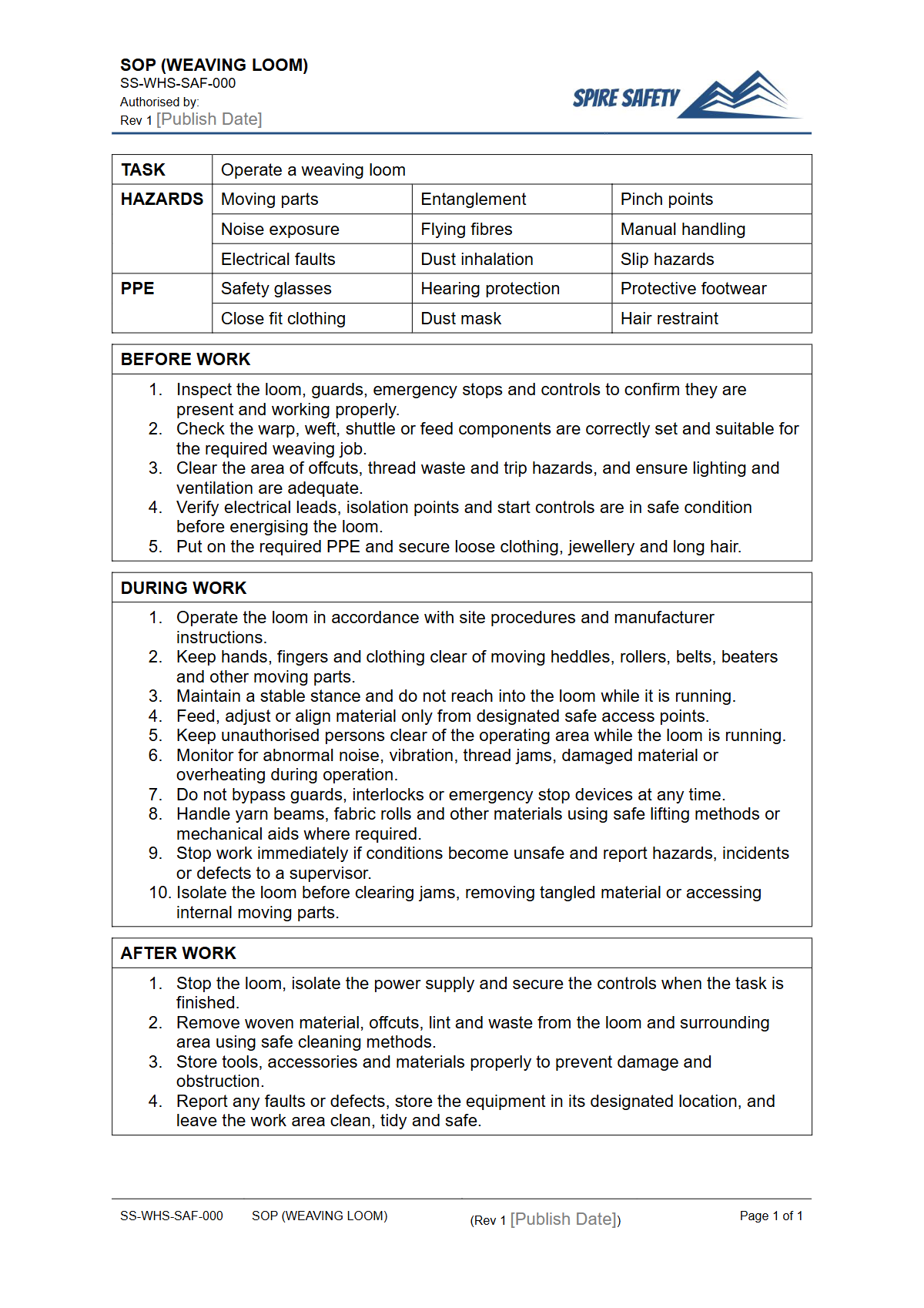
Download our free Safe Operating Procedure (Weaving Loom) Template. This structured document helps detail safety protocols for loom operation.
Free Safe Operating Procedure (Weaving Loom) Template
DOCX • 126 KB + PDF
Updated Oct 2026
No signup required
Purpose of the Free Safe Operating Procedure (Weaving Loom) Template
This Free Safe Operating Procedure (Weaving Loom) Template provides a structured framework for documenting the safety requirements for operating industrial or workshop weaving looms. Its purpose is to help Persons in Control of a Business or Undertaking (PCBUs) manage risks and provide clear, step-by-step instructions to workers.
Properly used, this SOP helps control specific hazards associated with looms, such as entanglement in moving parts, ergonomic strains from repetitive tasks, noise exposure, and respiratory hazards from textile dust. A documented procedure is a critical part of a safe system of work.
By formalising the process, you create a consistent training tool and a reference point for competent operators. It standardises the expected safety behaviour and operational steps, reducing the likelihood of incidents and injuries.
An effective SOP is a foundational element within broader WHS management systems, demonstrating a commitment to proactive risk management.
Video walkthrough
How to use the Free Safe Operating Procedure (Weaving Loom) Template
To effectively use this Safe Operating Procedure template, you should download the DOCX version and populate it with information specific to your workplace and the particular weaving loom in use. The document is structured with sections covering pre-operational checks, operational steps, shutdown procedures, and potential hazards.
Follow these steps:
- Identify the Machine: Clearly state the make, model, and asset number of the weaving loom.
- Consult Workers: Involve the operators who use the loom. Their practical experience is invaluable for identifying the real-world risks and effective control measures.
- Customise Hazards and Controls: Review the pre-filled examples and adapt them. Add or remove hazards and control measures to accurately reflect your specific equipment and work environment. For example, the risks of a large industrial power loom are different from a smaller, manual floor loom.
- Detail Procedures: Write clear, concise instructions for each stage of operation. Use simple language and avoid jargon where possible.
- Review and Approve: Once drafted, the SOP should be reviewed by a supervisor or WHS representative before being formally approved for use.
Note: This document is a template only. It must be customised to suit the specific conditions and equipment at your workplace.
We are not responsible for the outcomes if you use this template without tailoring it to your unique operational context.
When to use a Weaving Loom SOP
A Safe Operating Procedure for a weaving loom should be used consistently as part of your daily operations. It is not a document to be filed away and forgotten.
It should be readily accessible to operators at or near the equipment. Key times to use the SOP include during the induction and training of new staff, as a refresher for existing workers, and as a guide for maintenance personnel.
It also serves as a critical piece of evidence during safety reviews or a WHS compliance auditing process, showing how risks are being managed.
Who should use this template
This template is designed for use by WHS managers, supervisors, and business owners responsible for workplace safety in industries such as textiles, manufacturing, art and design studios, or educational institutions. Supervisors should use the completed SOP to train and assess the competency of their team members.
Operators are the primary end-users, referring to the SOP to ensure they are following the established safe work method for every task. Just as you would have a specific procedure for a different piece of machinery, like what's outlined in our conveyer system SOP, each type of high-risk plant requires its own tailored SOP.
Developing a library of SOPs for all relevant plant and equipment is a key part of WHS due diligence. Whether it's a loom, a forklift, or a simple hand tool like a saw, documented procedures are essential.
You can find more examples for different equipment, like our free Circular Saw SOP, in our resources library. You can find many more helpful documents in our free WHS resources library to build out your safety management system.
Common mistakes
Common mistakes to avoid
- Using a generic template without customising it for the specific loom model and workplace environment.
- Failing to consult with the actual loom operators when drafting the procedure, missing crucial practical insights.
- Not including specific requirements for training, competency assessment, and ongoing supervision.
- Storing the SOP in an office, making it inaccessible to operators at the point of use where it is most needed.
Legal references
Legal considerations
The following legal requirements may be relevant to this type of work.
- Work Health and Safety Act (Harmonised) — Provides the primary duties for protecting workers and other people from work health and safety risks.
- Work Health and Safety Regulations (Harmonised) — Sets out requirements supporting the management of workplace hazards and risks.
The following codes may be relevant to this type of work.
- Managing WHS Risks Code of Practice — Provides practical guidance on identifying hazards, assessing risks and applying effective controls.
- Work Health and Safety Consultation, Cooperation and Coordination Code of Practice — Provides practical guidance on consulting workers and coordinating with other duty holders.
- Managing the Work Environment and Facilities Code of Practice — Provides practical guidance on safe work environments, workplace facilities and related controls.
Did you know
Ancient Technology
Weaving is one of humanity's oldest crafts, with archaeological evidence of looms and woven textiles dating back to the Neolithic period, over 8,000 years ago.
Industrial Game-Changer
Edmund Cartwright's invention of the power loom in 1785 was a pivotal moment in the Industrial Revolution, mechanising textile production and dramatically changing manufacturing and society.
FAQ
Frequently asked questions
01What are the main hazards of operating a weaving loom?
02Is a Safe Operating Procedure a legal requirement in Australia for a weaving loom?
03How often should a weaving loom SOP be reviewed?
04Can I use this template for different types of looms?
Share this resource
Free Safe Operating Procedure (Weaving Loom) Template
Browse Categories
How To Use It
- 1Download and open in Word or PDF.
- 2Replace the placeholders with your business details.
- 3Get it reviewed by a WHS specialist before rollout.
Need it customised?
Our WHS consultants can adapt this template to your site, run a gap analysis, or audit what you already have in place.
Book a Free Consultation WHS consulting servicesor call 1300 156 382
Related templates
- Free Safe Operating Procedure (Weed Mat Installation) Template
- Free Safe Operating Procedure (Weed Spraying Setup) Template
- Free Safe Operating Procedure (Weighbridge Load Check) Template
- Free Safe Operating Procedure (Weighbridge Operation) Template
- Free Safe Operating Procedure (Weighbridge Ticketing) Template
- Free Safe Operating Procedure (Weld Post Heating) Template